
- Released
- 2004
- Formats
- Digital Media
- Format
- Digital only
- Producers
- Kevin Moore
- Art direction
- Theron Patterson
Solo albums · Kevin Moore · 2004
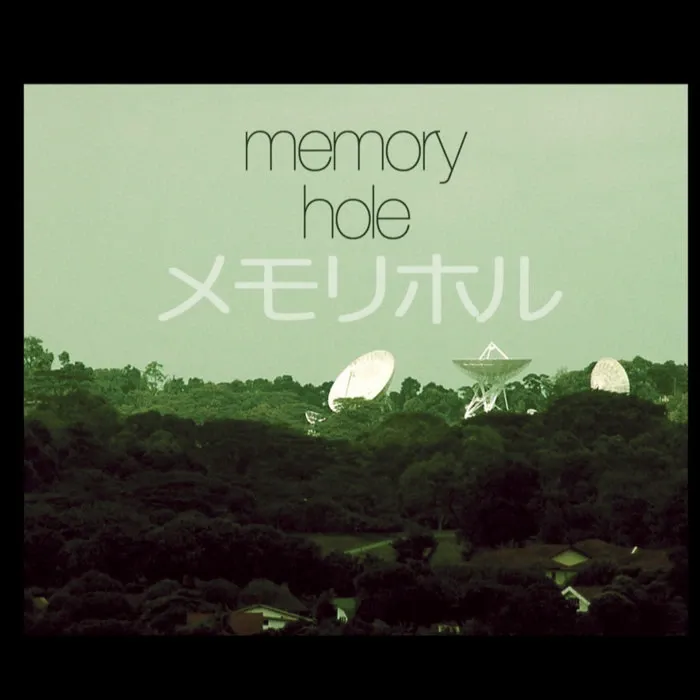
Memory Hole
✎ Edit this releaseTracklist
- Intro00:08
- It Goes Something Like This · Enduring Freedom, Part 1 begins.07:55
- homily03:13
- the little parts we like04:23
- when fear ends03:04
- i'd like to beat you up02:47
- verily02:39
- saying this in a time of war04:07
- christmas message01:19
- So You Become · Enduring Freedom, Part 2 begins.01:07
- mother of exiles06:40
- black horse carousel01:27
- preacher man show04:56
- why is it06:56
- Our Folks · Meet the New Boss begins.02:53
- state of the union06:58
- what the bastards say06:07
- the mark of the wizard03:36
- the christ android03:12
- think back06:11
Personnel
Personnel
- Kevin Moore – Production; original music
- Theron Patterson – Original music; artwork
- Daniel Beierstettel – Original music
- Bob Nekrasov – Spoken-word contribution
- Saya – Spoken-word contribution
- James Latham – Radio material
Memory Hole belongs to the part of Kevin Moore’s work where the distinction between a composition and a radio construction becomes difficult to maintain. Spoken material is the foundation, with original music and existing recordings arranged around it. The voice in the foreground is often somebody else’s.1
Moore describes the album as a document of a three-part program made at Radio for Peace International, a shortwave station in Ciudad Colón, Costa Rica, in 2004. His current edition calls it Memory Hole; the release is also commonly catalogued as Memory Hole 1. The Bandcamp program contains twenty indexed tracks.12
A radio record
The sections are “Enduring Freedom”, in two parts, and “Meet the New Boss”. The source speech comes from programs broadcast by the station. Moore contributed original music alongside Theron Patterson and Daniel Beierstettel, with collaborators working locally and remotely. Bob Nekrasov and Saya recorded monologues, while James Latham supplied excerpts from his investigation of far-right radio.1
The backing material also uses recordings by Múm, Fela Kuti and the Who. It would therefore be misleading to describe the album as twenty entirely new pieces written and performed only by Moore. The construction is the work, and the difference between an original musical passage and an existing recording is part of its method.1
The track divisions are useful for navigation, but the three-program origin is the larger structure. Titles such as “Mother of Exiles”, “State of the Union” and “What the Bastards Say” place the spoken material in a recognisably political setting. The album is not trying to make those voices disappear into a neutral ambient background.1
The voice as the organising instrument
Chroma Key had already made recorded speech central to a song’s atmosphere. Here that relationship is reversed. The music has to respond to the speaker’s timing, tone and argument, rather than treating speech as a brief interruption between sung verses.
That also changes the kind of listening the record invites. A phrase can become disturbing through repetition or through the sound placed underneath it. A change of speaker can have the structural effect that a new melody would have elsewhere. The construction asks the listener to notice what a voice is doing as well as what it says.
Memory Hole sits alongside Moore’s 2004 soundtrack and Chroma Key work without being interchangeable with either. Its radio provenance explains its shape, and the collective source material explains why a conventional solo-instrument performance credit would tell very little of the story.