


Transcription
Dream Theater: Images & Words
No. 1 · Vol. 1, No. 1
A text transcription of the first issue of the fanzine. Original page scans appear in the reader above.
FOR THE FIRST TIME IN A LONG TIME…
…IT’S ABOUT MUSIC
Source: scanned 24-page PDF. Original spellings and diction are retained where legible; only obvious recognition errors and broken line wraps have been repaired. Original page boundaries are marked in source comments.
Editorial
Original page 2 · Vol. 1 No. 1
Welcome to the first issue of Dream Theater - “Images And Words.” After featuring the band in several issues of ‘Spirit Of Rush,’ it was time to dedicate a magazine to the band themselves. So here it is. The front cover statement and opposite, was how the initial 4-page black & white press release for their debut album, “When Dream And Day Unite” read. The rest of that release is featured overleaf; they detail a brief history, along with pictures of the band. Soon after followed another 4-page release, this time colour, containing basically the same information; and an endorsement by Steve Sinclair the President of Mechanic Records Inc. (who were the record company at the time), on how the band’s signing came about. Also reproduced.
The majority of this first issue is taken up with the first part of an exclusive interview, warts an’ all, with James, John P, and Mike, when they were in London last October to promote the start of their second European stint of the year, on the Images And Words: Music In Progress Tour ‘93.
In future issues I hope to feature contributions from the band themselves, dips into the large and extensive Portnoy archives, and news on what the band are currently up to. Plus anything of a positive interest on the band. So, if you have anything to submit, be it pictures, artwork, reviews, articles, letters etc., please send it along as all contributions will be welcomed and needed!
In the back you will find details of costs for issues and for subscriptions. Subscribe and save money, you’ll also receive your copy before people who don’t! So, do the wise thing, it makes sense.
I hope you enjoy the first issue and I look forward to hearing your views for inclusion in issue 2, due hopefully to arrive early May.
Many thanks go to band and management, Mick, Janet, Chris, Mark B, Geoff and Dante at East/West, anyone who I may have forgotten, and, the smile of Dawn which arrived early July - thanks for everything, don’t break the spell!
Published by: Neil Elliott
8 Ryelands Close, Caterham, Surrey, CR3 5HY, England
Printers: C.J.L.
For the First Time in a Long Time… It’s About Music
Original page 3. The full-page title reproduces the slogan from the first-album promotional material.
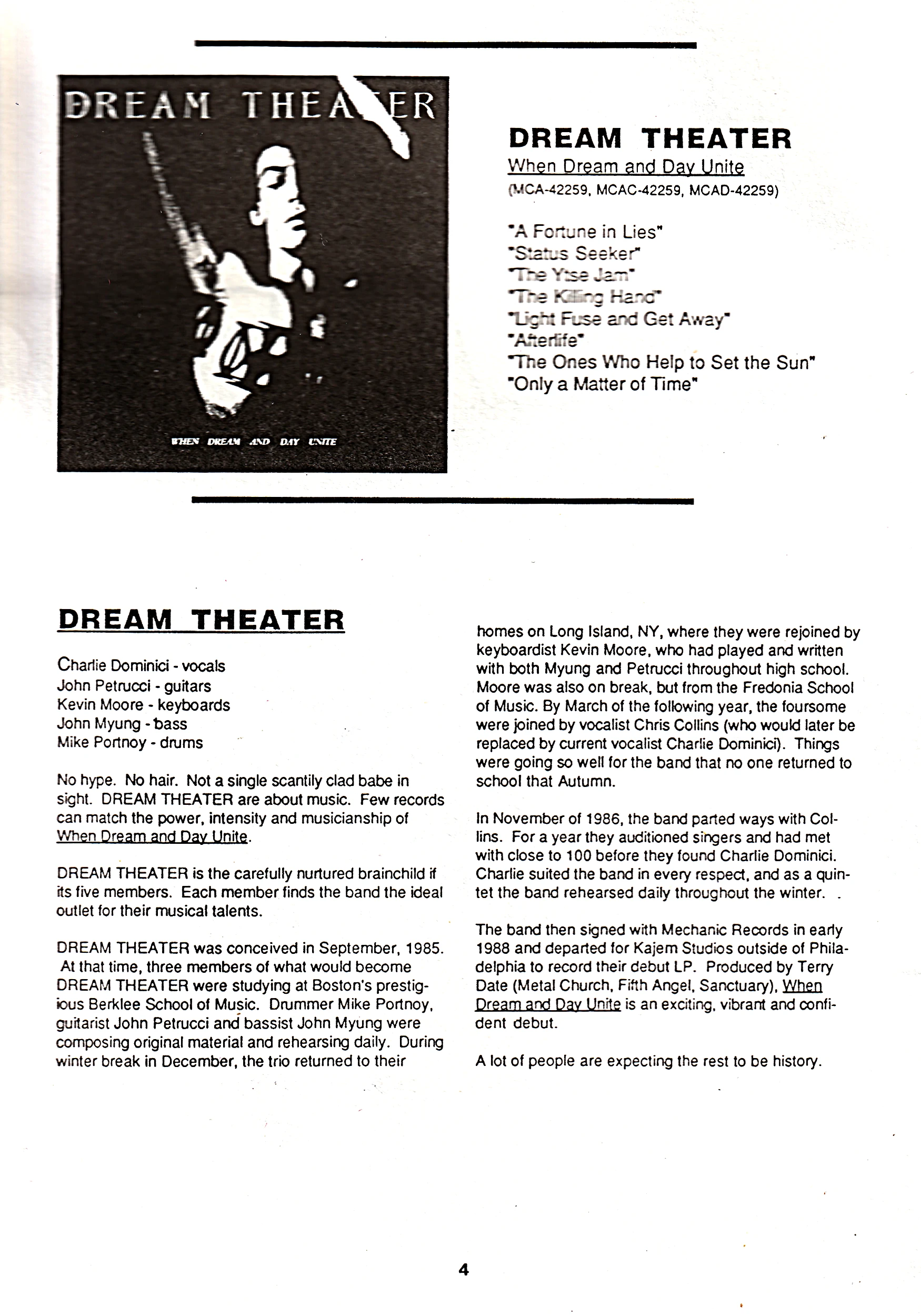
Dream Theater: When Dream and Day Unite
Original promotional biography and launch materials, pages 4–5.
Album: When Dream and Day Unite
Catalogue: MCA-42259, MCA4-42259, MCAD-42259
Tracks
- A Fortune in Lies
- Status Seeker
- The Ytse Jam
- The Killing Hand
- Light Fuse and Get Away
- Afterlife
- The Ones Who Help to Set the Sun
- Only a Matter of Time
Dream Theater (first album lineup)
| Member | Instrument |
|---|---|
| Charlie Dominici | Vocals |
| John Petrucci | Guitars |
| Kevin Moore | Keyboards |
| John Myung | Bass |
| Mike Portnoy | Drums |
No hype. No hair. Not a single scantily clad babe in sight. DREAM THEATER are about music. Few records can match the power, intensity and musicianship of When Dream and Day Unite.
DREAM THEATER is the carefully nurtured brainchild of its five members. Each member finds the band the ideal outlet for their musical talents.
DREAM THEATER was conceived in September, 1985. At that time, three members of what would become DREAM THEATER were studying at Boston’s prestigious Berklee School of Music. Drummer Mike Portnoy, guitarist John Petrucci and bassist John Myung were composing original material and rehearsing daily. During winter break in December, the trio returned to their homes on Long Island, NY, where they were rejoined by keyboardist Kevin Moore, who had played and written with both Myung and Petrucci throughout high school. Moore was also on break, but from the Fredonia School of Music. By March of the following year, the foursome were joined by vocalist Chris Collins (who would later be replaced by current vocalist Charlie Dominici). Things were going so well for the band that no one returned to school that Autumn.
In November of 1986, the band parted ways with Collins. For a year they auditioned singers and had met with close to 100 before they found Charlie Dominici. Charlie suited the band in every respect, and as a quintet the band rehearsed daily throughout the winter.
The band then signed with Mechanic Records in early 1988 and departed for Kajem Studios outside of Philadelphia to record their debut LP. Produced by Terry Date (Metal Church, Fifth Angel, Sanctuary), When Dream and Day Unite is an exciting, vibrant and confident debut.
A lot of people are expecting the rest to be history.
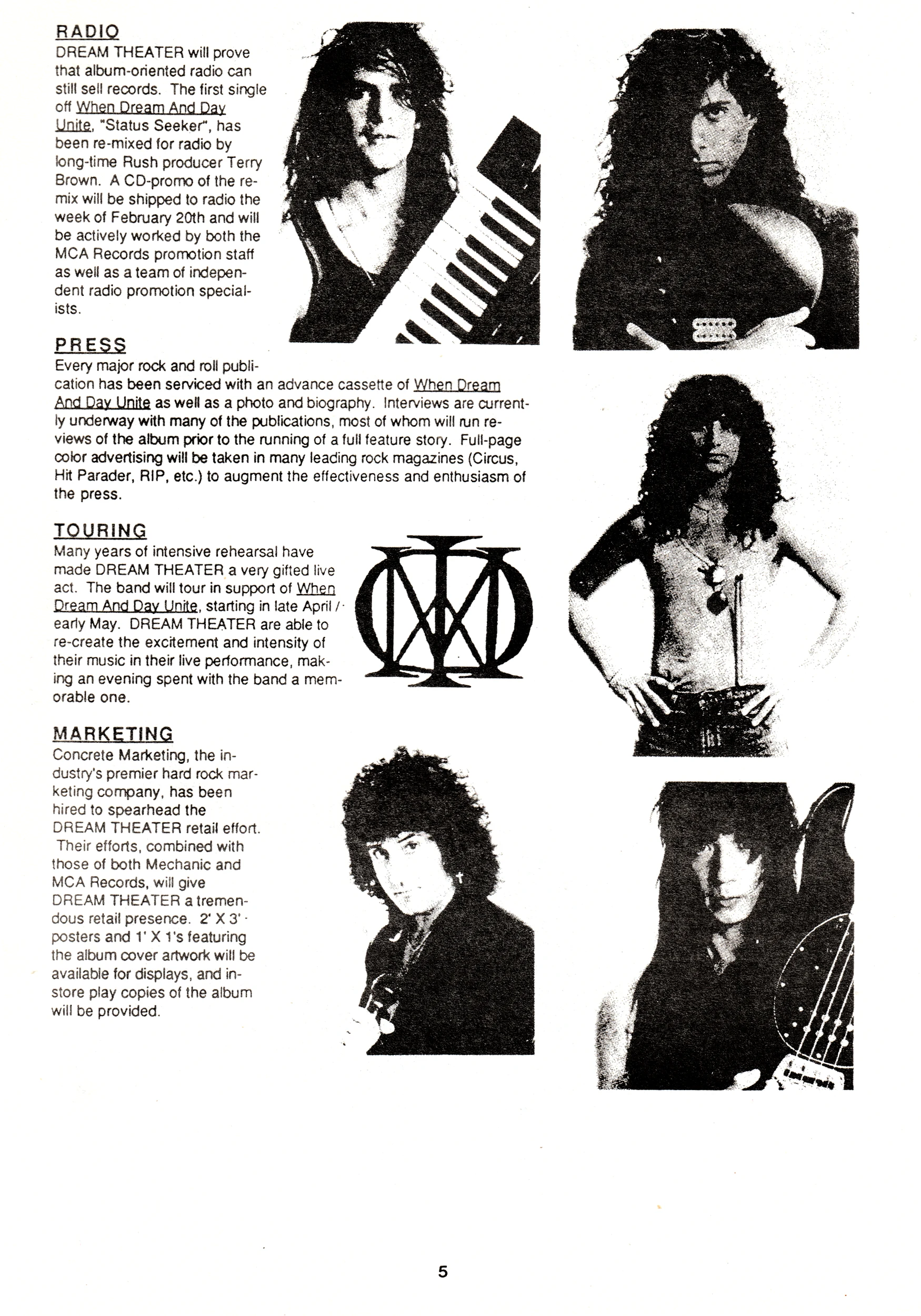
Radio
DREAM THEATER will prove that album-oriented radio can still sell records. The first single off When Dream and Day Unite, “Status Seeker”, has been re-mixed for radio by long-time Rush producer Terry Brown. A CD-promo of the re-mix will be shipped to radio the week of February 20th and will be actively worked by both the MCA Records promotion staff as well as a team of independent radio promotion specialists.
Press
Every major rock and roll publication has been serviced with an advance cassette of When Dream And Day Unite as well as a photo and biography. Interviews are currently underway with many of the publications, most of whom will run reviews of the album prior to the running of a full feature story. Full-page color advertising will be taken in many leading rock magazines (Circus, Hit Parader, RIP, etc.) to augment the effectiveness and enthusiasm of the press.
Touring
Many years of intensive rehearsal have made DREAM THEATER a very gifted live act. The band will tour in support of When Dream And Day Unite, starting in late April/early May. DREAM THEATER are able to re-create the excitement and intensity of their music in their live performance, making an evening spent with the band a memorable one.
Marketing
Concrete Marketing, the industry’s premier hard rock marketing company, has been hired to spearhead the DREAM THEATER retail effort. Their efforts, combined with those of both Mechanic and MCA Records, will give DREAM THEATER a tremendous retail presence. 2’ × 3’ posters and 1’ × 1’s featuring the album cover artwork will be available for displays, and in-store play copies of the album will be provided.
Mechanic Press Release
Original pages 6–7. Written in the voice of Steve Sinclair, President, Mechanic Records Inc.
Some bands have a superstar member, that one unbelievable performer that guarantees success. Some groups have an amazing frontman, or a virtuoso guitarist, or a super songwriter, and some bands simply make girls crazy with their good looks. Surprisingly, in Dream Theater are found all the attributes that could be described as “star material.”
Talking about Dream Theater is like describing a new, sophisticated piece of equipment. Dream Theater are precision, innovative, high tech and meticulous. As drummer/percussionist Mike Portnoy explains, “In Dream Theater, there is a very high standard set. Nothing is done in this band without reaching that standard, both individually and collectively. “Dream Theater are simply “state-of-the-art.”
Someone is going to use the label “progressive,” and Dream Theater really doesn’t mind, because this is definitely progress. What separates this group from a slew of other bands that have been called progressive is their utter lack of self indulgence, unheard-of teamwork, true melodiousness, and unbelievable hooks. These songs refuse to leave your mind.
Dream Theater is the carefully nurtured brainchild of its five members, who share a common vision of how they choose to direct their musical efforts. “We realise,” says Portnoy, “that if you are going to spend the rest of your life making music, then you should be in a band with the best possible musicians you can find,that you should play your instrument to your fullest capabilities, and that you should write music that is taken to it’s furthest potential.”
Dream Theater are tremendously dedicated to their work. Each member finds the band the ideal outlet for their musical talents. As Petrucci explains, “The respect we have for each other as friends and musicians is tremendous in this band. There is a healthy challenge that exists every night at rehearsal. Everyone has the freedom to thrive as a songwriter, improviser, expressionist and visionary. There is no other situation I’d rather be in.”
Dream Theater was conceived in September, 1985. At that time, three members of what would become Dream Theater were studying in Boston at The Berklee School of Music. Portnoy, Petrucci, and bassist John Myung were composing original material, and rehearsing daily. During winter break in December, the trio returned to their home on Long Island, where they were rejoined by keyboardist Kevin Moore, who had played and written with both Petrucci and Myung throughout high school. Moore was also on break, but from the Fredonia School of Music. By March of the following year the foursome were joined by vocalist Chris Collins (who would later be replaced by current vocalist Charlie Dominici). Things were going so well for the band that no one returned to school that Autumn.
Around this time, the group were calling themselves Majesty. Majestic, yes, but the band began gigging locally, and winning the admiration of their musician peers. In 1986 the band recorded a four track demo, that received rave reviews internationally. The first 1,000 copies of the demo sold out and fan mail started coming in from all over the world.
In November of 1986, the band parted ways with Collins. For a year they auditioned singers, and had met with close to 100 before they found Charlie Dominici in the Autumn of 1987. Charlie suited the band in every respect, and as a quintet the band rehearsed daily throughout the Winter.
In early 1988, the band’s demo crossed my desk. Before anyone knew what was happening, the entire staff of the record company were at their rehearsal in Long Island. I can honestly say this is the way it was; about 35 seconds into the first song a few glances were exchanged, a couple of jaws dropped, a contract was being written.
Immediately after the ink dried the band departed for Kajem Studios in Pennsylvania to record with producer Terry Date, (Metal Church, Fifth Angel, Sanctuary). The group named their album “When Dream And Day Unite” and christened themselves DREAM THEATER. Recently, Producer Terry Brown, (Rush, Cutting Crew), remixed two tracks from the album, “Status Seeker” and “Afterlife.”
It is my personal belief that this is an important opus from an exceptionally creative and ground-breaking new talent. I hope you feel the same.
Sincerely,
Steve Sinclair
President, Mechanic Records Inc.
The Second Coming!
Exclusive Interview!
Original pages 8–16 · First of a two-part interview with Mike Portnoy, James LaBrie and John Petrucci in London, October 1993.
This is the first of a two part interview with band members Mike, James and John (Petrucci), in London in October, literally a few hours after they had arrived in the country. They were here to promote their second tour of Europe, and with bleary eyes …
We’ll start off with the early days, tell me about the history of the band, the early years, the formation, when you were Majesty etc. How did it all come about? The story.
Mike: The story! Take it John.
John: Alright. Well, John (Myung), Kev and myself grew up together in Long Island, New York and we played in various bands together. And graduated from the same High school and basically when it came to go to college, John and I went to Berklee in Boston and we met Mike there. It kind of clicked. We formed, we rehearsed all the time and we decided not to go to school after a year and dropped out. We hooked up with Kev, he went to Fredonia in up-state New York and we kept in touch and there was four of us. We recorded demos - we were called Majesty at that point- in fact weren’t we waiting in line for Rush tickets when we thought of the name of our band?
Mike: Yeah. Actually the name Majesty came, was inspired by a Rush song. We were waiting on line for Rush tickets, right outside Berklee, I guess it was on the Power Windows tour in ‘85, and everyone was waiting for tickets and playing Rush tapes, and we were listening to Bastille Day, and it got to the very end section, the guitar melody, and we said this part is so majestic - we were then trying to think of a name for the band - wait that would be a great name for the band.
Then you found out that someone else had that name?
Mike: Yeah. Years later. Then we were just looking for a singer. We had this guy that we grew up with, that we thought was pretty good, so he joined the band at that point, we recorded this demo and then we got rid of him. We played a lot of gigs and he really wasn’t that good.
So Majesty did play live then?
John: Yeah, we played some local shows.
Mike: The summer of ‘86 we were playing, we were playing all the time actually. That was pretty much the only period that Chris Collins was in the band, ‘cos we came home from college in May, he joined the band singing and we did shows in June/July and then by August it was over for him, and we knew that he wouldn’t work out.
John: Then we did auditions and put ad’s out looking for a singer -so we got Charlie Dominici (vocals on the first album), and we recorded another demo.
Was Charlie considerably older than the rest of you?
Mike: Yeah. He still is!
What’s he doing nowadays, do you see him, speak to him?
Mike: We’ve seen him like once since we parted ways, he came out to see one of the shows in New York on this album, but basically we don’t keep in contact.
So Majesty didn’t actually record anything other than demo’s?
Mike: Well, actually the first album was recorded as Majesty. When we signed to Mechanic we were called Majesty and we were booked in the studio, there was press releases, you could see magazine articles talking about Majesty working on the album “When Dream And Day Unite.”
John: The artwork on the album was all done with Majesty on it, we had to change it. You know the brand, our symbol, it’s like an M, for Majesty, we had to change the name, but the artwork was already done. So we figured we’d keep the symbol, and we’ll change the name, so we did. Doesn’t Derek Simon have the original artwork somewhere? Our old manager has in his apartment, the original first cover of the first album with the Majesty instead of Dream Theater on it. It’s kinda neat. Anyway, then what happened? We got signed to the…
Mike: This is the long and winding road of Dream Theater!
John: I’m doing an edited version also. Then we got signed, we did the album, we did a couple of shows with Charlie and it just didn’t work out, for various reasons, and we went on a year and a half long search, through every possible means we could think of and that’s when we finally got James. All the time we were writing, we had enough material for Images And Words.
Where did the name Dream Theater come from?
Mike: It came from a movie theater in. Monterey, California where my dad lives and basically we were just trying to think of names for months on end, it was like one of our million dilemma’s we went through at the time, and we were just getting so desperate, we wanted to name the band anything. Like: “Coca Cola, yeah that’d be good.” I flipped through our legal files, we did trade mark searches on all these different names, and they were horrible. I can’t believe we spent so much to get these names searched.
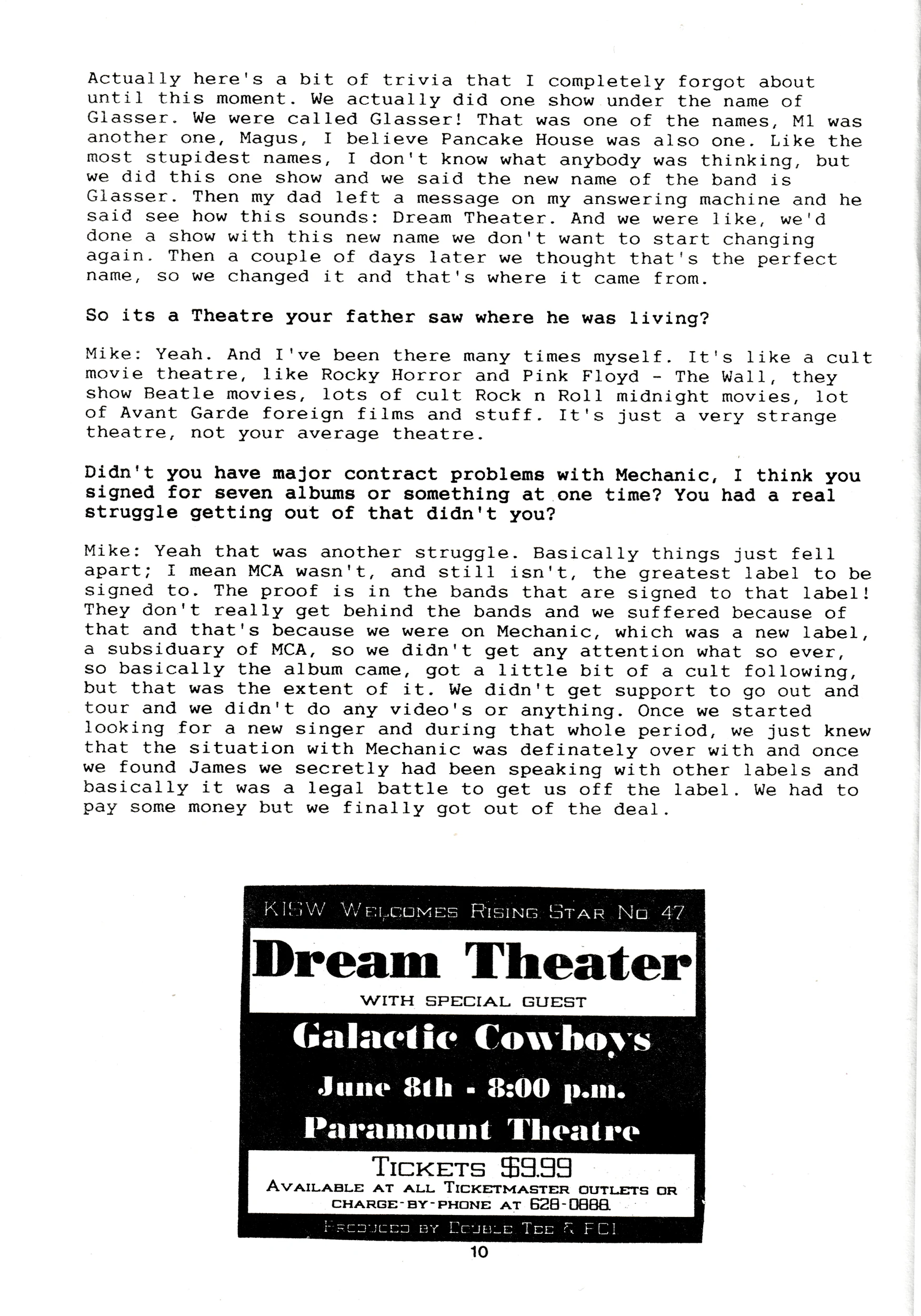
Actually here’s a bit of trivia that I completely forgot about until this moment. We actually did one show under the name of Glasser. We were called Glasser! That was one of the names, M1 was another one, Magus, I believe Pancake House was also one. Like the most stupidest names, I don’t know what anybody was thinking, but we did this one show and we said the new name of the band is Glasser. Then my dad left a message on my answering machine and he said see how this sounds: Dream Theater. And we were like, we’d done a show with this new name we don’t want to start changing again. Then a couple of days later we thought that’s the perfect name, so we changed it and that’s where it came from.
So its a Theatre your father saw where he was living?
Mike: Yeah. And I’ve been there many times myself. It’s like a cult movie theatre, like Rocky Horror and Pink Floyd - The Wall, they show Beatle movies, lots of cult Rock n Roll midnight movies, lot of Avant Garde foreign films and stuff. It’s just a very strange theatre, not your average theatre.
Didn’t you have major contract problems with Mechanic, I think you signed for seven albums or something at one time? You had a real struggle getting out of that didn’t you?
Mike: Yeah that was another struggle. Basically things just fell apart; I mean MCA wasn’t, and still isn’t, the greatest label to be signed to. The proof is in the bands that are signed to that label! They don’t really get behind the bands and we suffered because of that and that’s because we were on Mechanic, which was a new label, a subsidiary of MCA, so we didn’t get any attention whatsoever, so basically the album came, got a little bit of a cult following, but that was the extent of it. We didn’t get support to go out and tour and we didn’t do any video’s or anything. Once we started looking for a new singer and during that whole period, we just knew that the situation with Mechanic was definitely over with and once we found James we secretly had been speaking with other labels and basically it was a legal battle to get us off the label. We had to pay some money but we finally got out of the deal.
Contemporary concert advertisement (reproduced on page 10)
Dream Theater with special guest Galactic Cowboys
June 8th, 8:00 p.m. · Paramount Theatre
Tickets: $9.99 (printed advertisement; additional small print omitted).
As we know Rush were an influence on your early career, what other bands do you consider to have influenced you as regards to writing, thoughts, recording and ideas. What inspired you?
Mike: The Dregs, Iron Maiden.
John: Yes. For me as a guitar player, there’s a different range of guitarist’s, that weren’t necessarily in Progressive bands. Al Di Meola, I got turned on to that Latin influence, Chick Corea, Stevie Ray Vaughan, Vai and all that stuff. That’s just from a guitarist’s stand point.
What about you James, what bands and/or vocalist’s influenced you?
James: Band’s first would definitely be Rush, Aerosmith, Van Halen, Judas Priest, Iron Maiden, Yes. Vocalist’s, I would listen to Journey, Foreigner, Starship and actually Deep Purple.
Basic main stream Rock bands with vocalists that were more on the melodic side?
James: Yeah exactly. Powerful voice with a good range.
Onto the live album. Are you pleased with it, the sound of it?
James: No! I’m not speaking for the band, only my point of view. That came together so quick when we did that, it was just rushed into us, like we are going to do this, it was a week before we actually got to London to do the Marquee show that it was said we were going to do this. You could tell that day that everything was being rushed and trying to be put together smoothly. But I think we captured something that night definitely, some raw energy, but I don’t know the sound didn’t freak me out, I didn’t think each guy was represented sound-wise as well as they actually did sound that night. The final mix didn’t come out.
John: The venue, it was like when I heard that we were gonna record there, I was like NO, because we had played there the first night of the tour and we were ending up there. I remember it was a nightmare just because the noises on stage and the atmosphere and that there were so many other venues throughout Europe that we Played that were so nice and comfortable, and it would have been such a better atmosphere to record. So that was a kind of a bummer, but I think there’s something about it that’s actually cool, there’s some magic things that happened and because we just recorded it on one night, if you messed up something in a song, it wasn’t like you could go to another night and take it from there. So, obviously we couldn’t use all the material, we never intended to anyway, we just wanted to make a short sampling of that tour I guess.
A good idea between albums to get some product on the street.
John: Especially here. We only released it Europe and Japan. We thought it was too early to have a full fledged live thing. When we do do that I think we’ll take more care in our choices.
James: We’ll also record more than one night.
So it’s unlikely the remainder of the material from the Marquee will get released in the future?
Mike: I don’t know why we picked certain songs, but I have a feeling that the reason was that some were just bogus, someone might have just messed up so bad… these things happen, untold things that happen live that you can’t control. And if you don’t do any overdubs…!
There’s a difference between the Japanese version and the European version, one song! Was that your choice or the record companies?
Mike: No, that was the record companies. They were like we want this one we want that one. It should be stressed that our involvement with this record was very minimal. We don’t look at this album like a real Dream Theater album by any means; it’s just something that came up, we did it and put it out for any fans that would be interested in having it or hearing it, we didn’t really spend any time on it; I’m not saying that we’re not proud of it, you know, I like it, I think its a good souvenir or whatever but, we weren’t really that hands-on with it at all.
John: Its like a really good recorded bootleg, that’s what it is. It’s just like one night and we didn’t do anything to it, and it was just recorded better than the average thing. I’d rather have that than some cheesey bootleg.
There’s some good bootleg’s out there already. Quite a few!
John: Yeah I know there are, believe me. There’s a lot of them.
What’s your feelings on bootlegs?
Mike: Here we go. Get out the boxing gloves.
John: It’s mixed throughout the band. I don’t endorse bootlegs, I don’t think it’s right.
James: Yeah, very mixed. I think there are two sides there. It’s cool for the fans, they can go out and get something that is exactly the way it was that night, you know I was there. But I don’t think it is fair for the musicians because maybe they’re not being recorded off of the right type of equipment, it may not truly represent the way that it actually did sound there. Somebody’s recording off of a little microphone, it’s not a true sound of what was really happening that night. It’s not fair to the musician’s - what if one of them is really sick that night, not feeling well, it’s, I don’t know it’s very mixed.
It’s something you’re going to accept now, because throughout the rest of your career now, it’s gonna happen night after night. More so as you get more successful. Video’s as well.
John: It’s bizarre because you have no clue how these people got these things. To give an example, we played this one show in Copenhagen, this place was as big as this room (very small), and you can see everybody that was in the room, we were this close to the people.
I’ve seen the video and you’re looking right at the camera, I can’t believe you can’t see the guy recording it.
John: Right, this is what I’m saying. If somebody got a video camera in a situation like that, when we were literally this close to people, how did that happen?
James: We’ve seen it before, I’ve looked over the side of the stage and gone there’s a guy out there with a camera! Remember the guy in Ludwigsburg, the set-up he had you should have seen it, behind the stage above us.
Mark (Road Manager): He was gonna shoot a shot from behind the back-drop going past the drums and out looking into the crowd. He was the house DJ of the club and he was taking a feed off our board into the DJ system, and he unplugged the turntables and plugged in a video camera. So the audio was coming off through his camera from the house and he had the camera going out through it.
James: But I know what you mean, I can’t believe that I didn’t see that, literally this is how big the room was I think that we played, and there’s a guy out there with his camera recording it!
There’s a show you did in Holland where the guy has shot it from high on the left side of the stage looking down. There’s also Warfield, San Francisco which is very good quality.
Mike: Yeah Warfield is very good quality, I collect them. I feel differently about bootlegs than these guys. I’m supportive of it because I feel that the only people interested in bootlegs are fans, I don’t take the stance that the band is losing money. Obviously you’re not getting the money, but you’re not losing money because these fans just want whatever they can get.
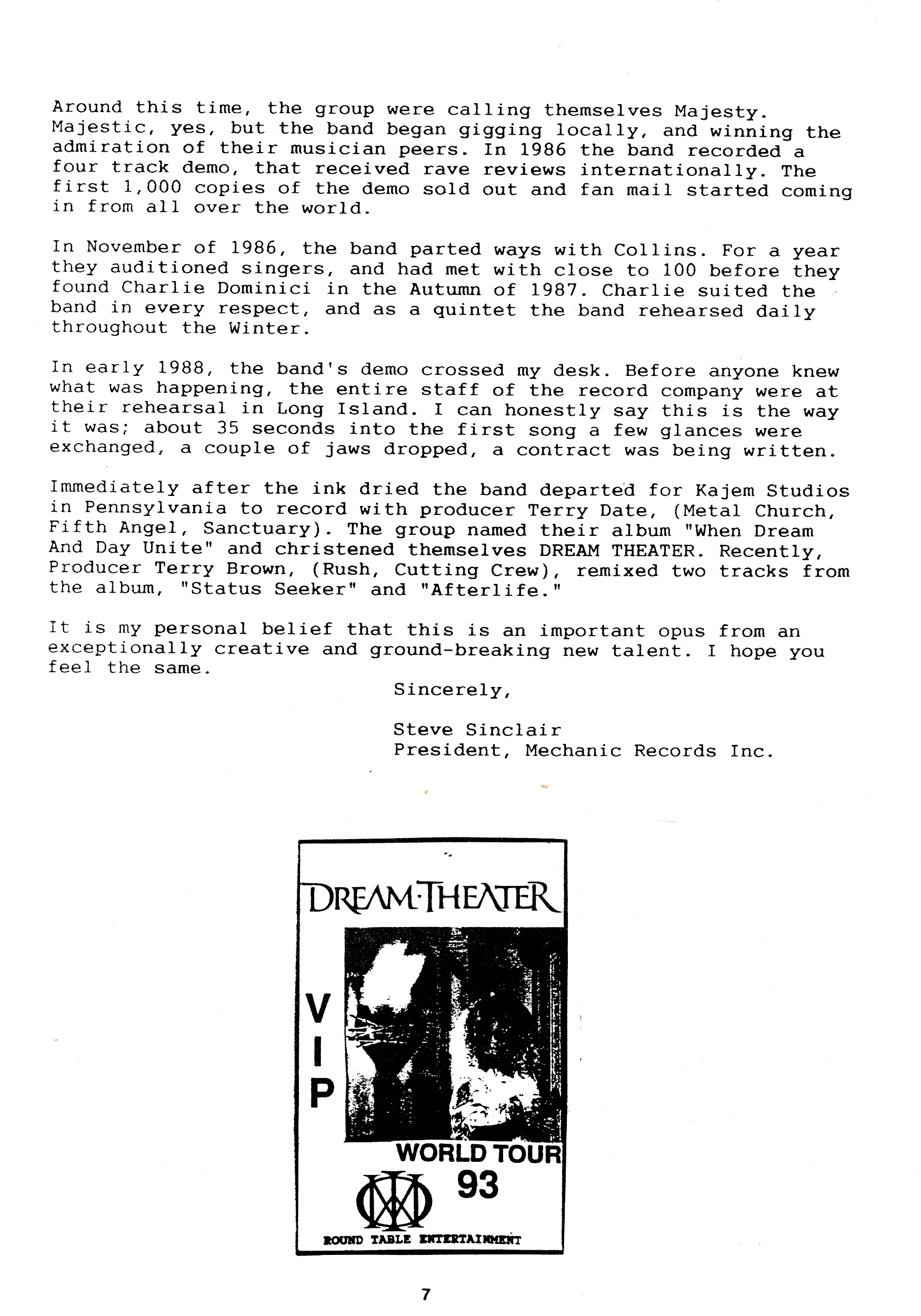
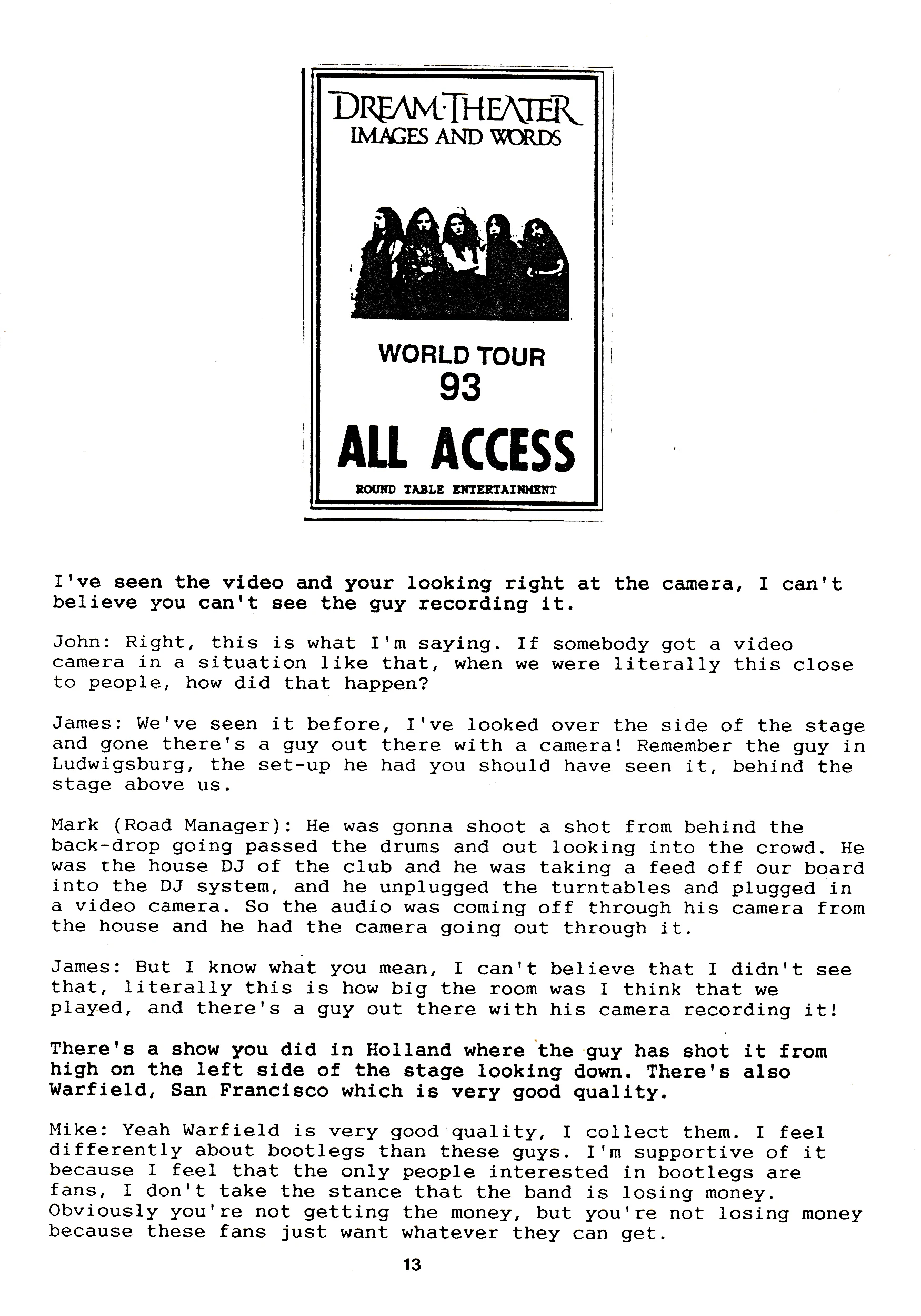
Reproduced tour credential (page 13)
DREAM THEATER · WORLD TOUR ‘93 · ALL ACCESS
Round Table Entertainment.
The fans actively seek them out, go out of their way to find them.
Mike: Yeah, I do it myself. I’m a big bootleg collector myself, I have a huge collection and I collect our bootlegs and stuff. When I was in Japan they were just everywhere and I collected them all.
You can do what Frank Zappa did, in twenty years time put them all out, beat the boots. Enough about bootlegs. Was there an official video shot in Japan, is it readily available, or will it be?
Mike: Yeah, it will be available. We shot the third night in Tokyo, which was August 26th, and that was real good. The performance that night was really on, we had a good night. The home video is primarily live footage, its over an hour’s worth of live footage from that show and its got the three promo clips we did for the three songs and its got all’sorts of home video stuff like recording the album, stuff on tour and everything.
John: Its also a different perspective so far as the way it sounds as it was mixed by our live engineer, which is something we never did before, the stuff was always mixed by a studio engineer. So its a little different. It’s from somebody else’s perspective, from somebody who mixes us every night, so it’s kind of interesting. Its drier, it doesn’t sound as though its processed.
As Live At The Marquee was only released in Japan and Europe, has there been anything that has only been released in North America at all?
Mike: No, you guys are the lucky ones. Everybody out there is shelling out $30-40 to get the imports. The first album, I don’t know about you here in the U.K. but Europe and Japan still has the first album, it’s not available in America. So in America all they have is Images And Words, whereas out here you have three albums at this point.
Bombay Vindaloo, where did the title come from? Who had the curry the night before?
John: Derek Oliver. It was just a jam and you know Derek Oliver right? I asked him “what’s a good Indian dish?” Cos it sounds kinda Indian or Egyptian or whatever. He came up with some curry ideas, and said Bombay Vindaloo. That sounds cool!
Was it the same sort of thing with Another Hand, was that another improv or was that specially written?
John: No we wrote that as a segway to connect two songs - and as it was Another Day into The Killing Hand - it was called Another Hand.
Mike: It doesn’t make sense on the European version of The Marquee CD; the European one has Surrounded and not Another Day so Surrounded is followed by Another Hand then The Killing Hand, whereas the Japanese version follows on correctly as it hasn’t got Surrounded on it!
John: I think stuff like that is cool live. That is stuff I’d rather hear, cos we’re not gonna record Bombay Vindaloo - it wasn’t a song - we’re not gonna record Another Hand. If someone buys it and they’re a fan and they know all our material and they see Another Hand - it’s like what’s that.
Mike: For me, for a fan of another band, that’s why I would buy something. Also James’ singing material; doing The Killing Hand, doing A Fortune In Lies, I think they also make the Marquee CD interesting, cos obviously its much different.
It gives another perspective of those songs that James didn’t record.
Mike: Yeah that’s right.**
Can any other members of the band sing at all? Any thought about backing vocals? Listening to a tape of the live album, knowing the songs from the album, backing vocals may have enhanced the overall live sound if one of the other band members could sing!
John: I just listened to something today that Kev was singing, I’ve been doing demo’s at home and I’ve been singing on them. I think it’s something that we’ll develop, the only problem is when it comes to the range. If you notice a lot of the background vocals on the CD are high, and if you sing it in like a cheesey falsetto, wimpy voice it just sounds really bad. Maybe it’s something on the next album we can work on our ranges.
James: We really haven’t had time to sit down with each other, a cappella sing with each other. I’d like to work on that for the next tour, I think Mike, John and Kevin can definitely sing. It’s just a question of getting together and working things out; and them feeling comfortable because they’re doing so much damn stuff instrumentally. I don’t want that to ever take away from the instrumental.
John: We toured with the Galactic Cowboys in the States, and all those guys sing. And it was inspiration because, it’s not like they have these amazing voices or anything, but when they put it together it sounds so cool, and makes you feel ‘we can do that.’
Are you going to play The Ones Who Help To Set The Sun live?
Mike: That’s actually the only song on the first album that we’ve never played on this tour, we’ve played every other song!
James: We’re doing Afterlife, A Fortune In Lies and then Only A Matter Of Time.
Mike: Maybe one day. I’d like to do The Ones Who Helped To Set The Sun eventually. Just because we haven’t done it in such a long time, so maybe next time round but not this time.
The live set has changed quite a bit since you were last in Europe in April, hasn’t it?
Mike: Yeah. We’re always trying to change it as much as possible. Actually the set we’re doing on this tour, we haven’t sat down and figured it out yet. I think it’ll be similar to what we just did in Japan; which included To Live Forever, a piece called Eve which we are doing before Learning To Live, there’s also thing like Another Hand, a little piece that sets up Take The Time, a thing that we call Puppy’s On Acid - that’s just a working title. So there’s a bunch of new ideas and bits and pieces throughout the set.
John: Plus this thing I’ve been working on over the last couple of weeks, another guitar solo. I don’t know if you’ve noticed, but we’ve changed the guitar solo section every leg of the tour, and so we want to change it again.
The second and concluding part of this exclusive interview with the band next time. When we’ll hear about plans for the future; the writing and recording for the new album.
Thanks go to all at East/West Records for setting it all up, and a special thanks go to the guys for their time and words.
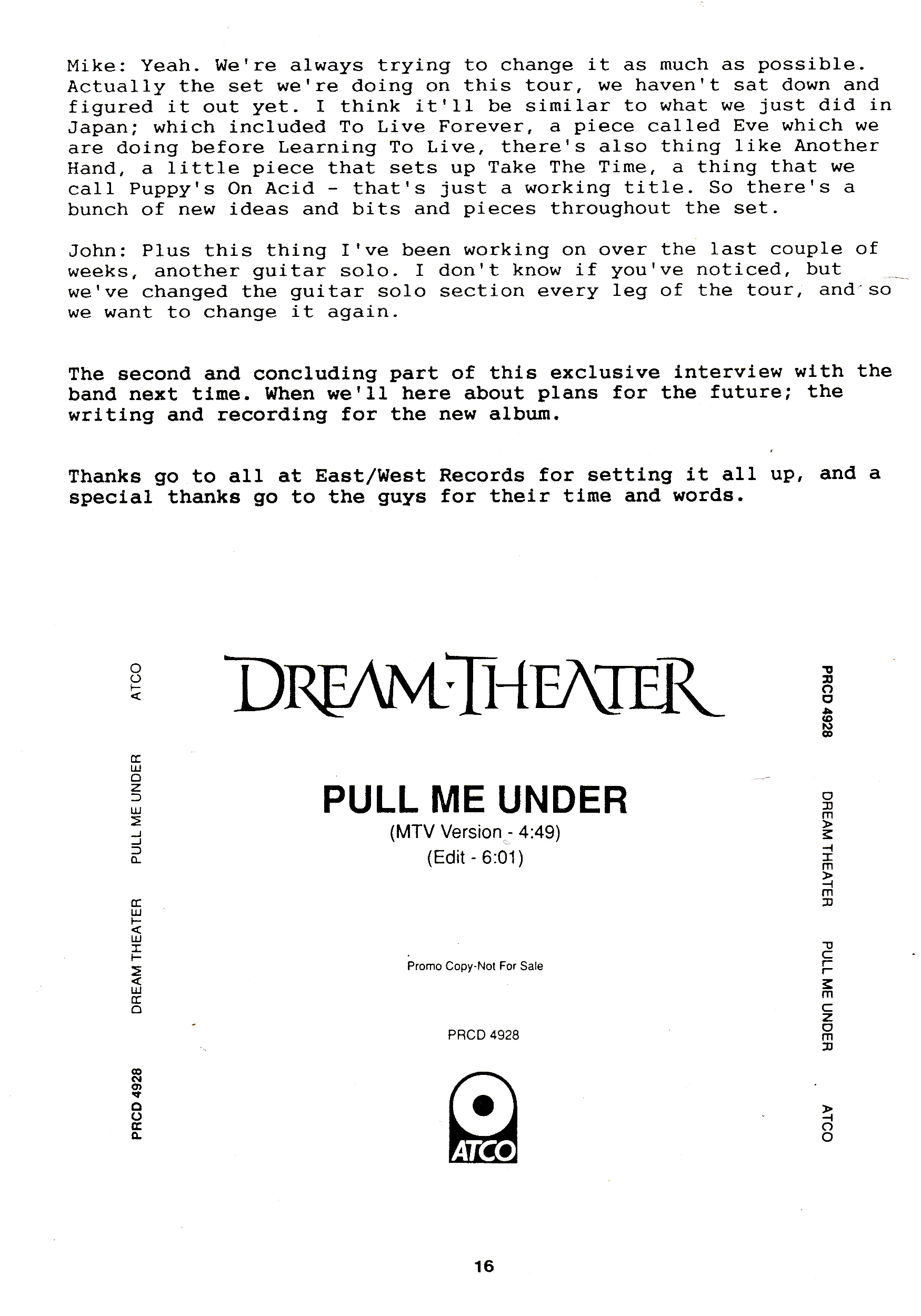
Reproduced promo CD sleeve (page 16)
DREAM THEATER · PULL ME UNDER
MTV Version — 4:49 / Edit — 6:01
Promo Copy — Not For Sale · PRCD 4928 · ATCO.
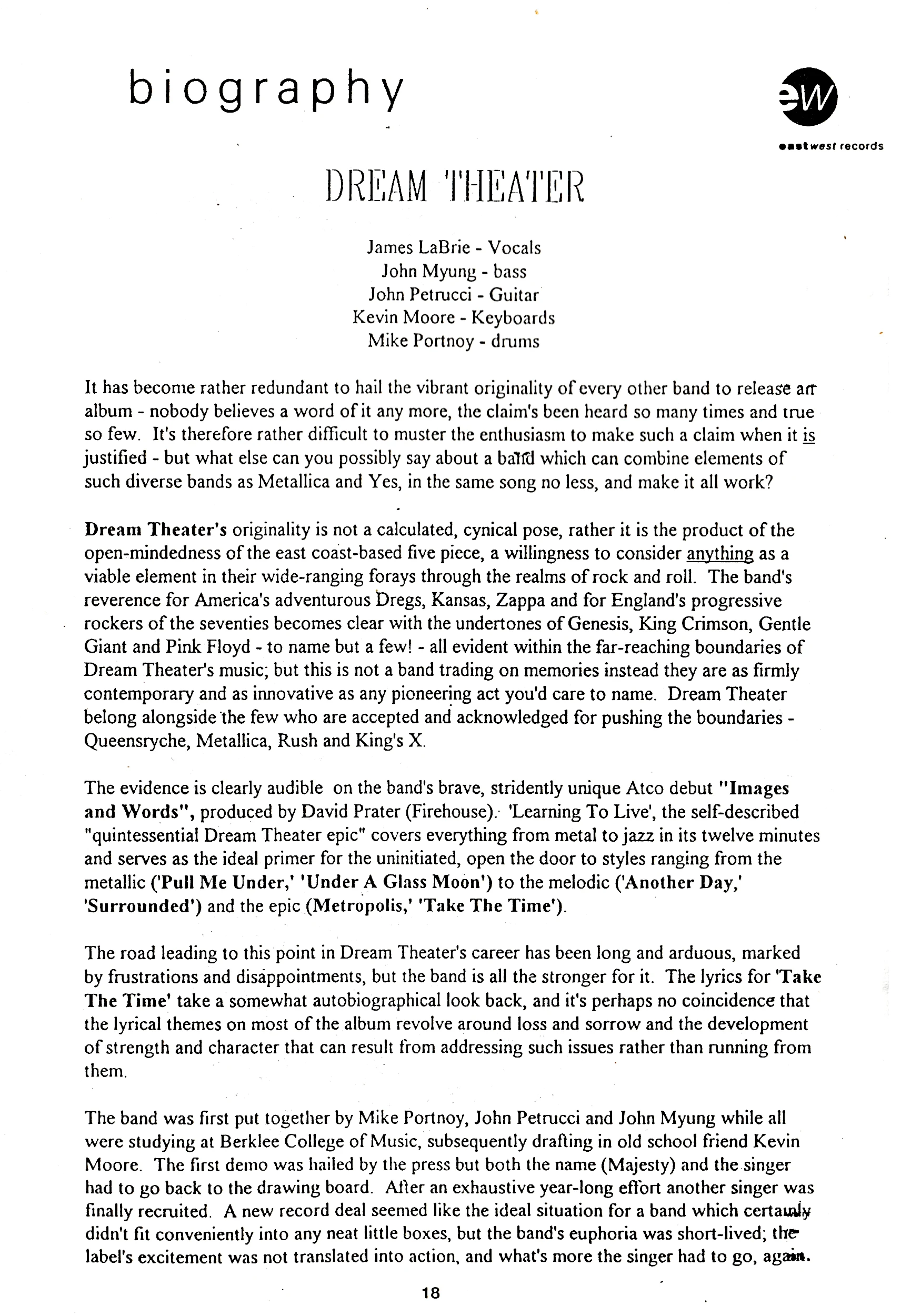
Biography: Dream Theater
Original band biography, pages 18–19 · EastWest / ATCO-era promotional copy.
| Member | Role |
|---|---|
| James LaBrie | Vocals |
| John Myung | Bass |
| John Petrucci | Guitar |
| Kevin Moore | Keyboards |
| Mike Portnoy | Drums |
It has become rather redundant to hail the vibrant originality of every other band to release an album - nobody believes a word of it any more, the claim’s been heard so many times and true so few. It’s therefore rather difficult to muster the enthusiasm to make such a claim when it is justified - but what else can you possibly say about a band which can combine elements of such diverse bands as Metallica and Yes, in the same song no less, and make it all work?
Dream Theater’s originality is not a calculated, cynical pose, rather it is the product of the open-mindedness of the east coast-based five piece, a willingness to consider anything as a viable element in their wide-ranging forays through the realms of rock and roll. The band’s reverence for America’s adventurous Dregs, Kansas, Zappa and for England’s progressive rockers of the seventies becomes clear with the undertones of Genesis, King Crimson, Gentle Giant and Pink Floyd - to name but a few! - all evident within the far-reaching boundaries of Dream Theater’s music; but this is not a band trading on memories instead they are as firmly contemporary and as innovative as any pioneering act you’d care to name. Dream Theater belong alongside the few who are accepted and acknowledged for pushing the boundaries - Queensryche, Metallica, Rush and King’s X.
The evidence is clearly audible on the band’s brave, stridently unique Atco debut “Images and Words”, produced by David Prater (Firehouse). ‘Learning To Live’, the self-described “quintessential Dream Theater epic” covers everything from metal to jazz in its twelve minutes and serves as the ideal primer for the uninitiated, opening the door to styles ranging from the metallic (‘Pull Me Under,’ ‘Under A Glass Moon’) to the melodic (‘Another Day,’ ‘Surrounded’) and the epic (‘Metropolis,’ ‘Take The Time’).
The road leading to this point in Dream Theater’s career has been long and arduous, marked by frustrations and disappointments, but the band is all the stronger for it. The lyrics for ‘Take The Time’ take a somewhat autobiographical look back, and it’s perhaps no coincidence that the lyrical themes on most of the album revolve around loss and sorrow and the development of strength and character that can result from addressing such issues rather than running from them.
The band was first put together by Mike Portnoy, John Petrucci and John Myung while all were studying at Berklee College of Music, subsequently drafting in old school friend Kevin Moore. The first demo was hailed by the press but both the name (Majesty) and the singer had to go back to the drawing board. After an exhaustive year-long effort another singer was finally recruited. A new record deal seemed like the ideal situation for a band which certainly didn’t fit conveniently into any neat little boxes, but the band’s euphoria was short-lived; the label’s excitement was not translated into action, and what’s more the singer had to go, again.
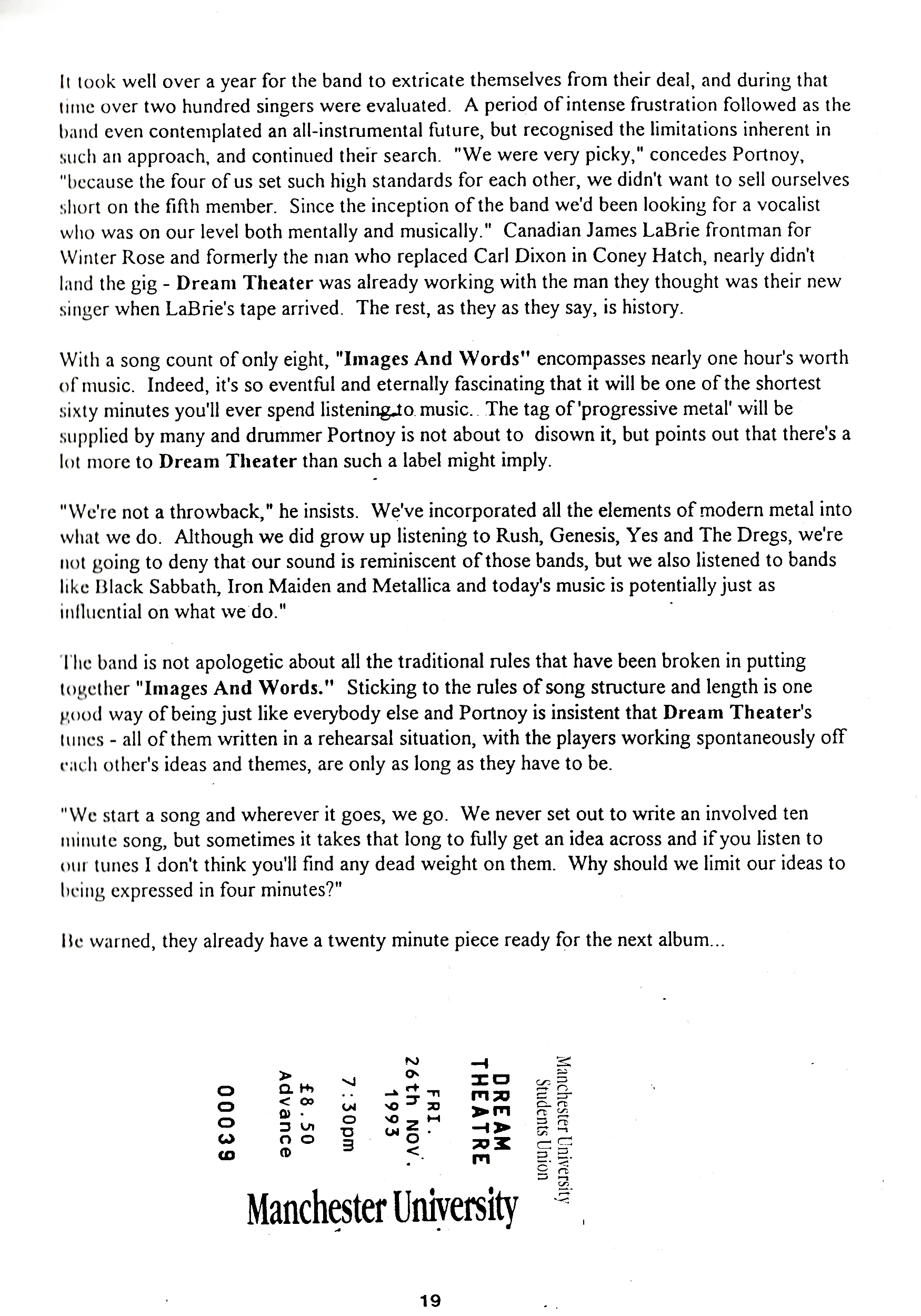
It took well over a year for the band to extricate themselves from their deal, and during that time over two hundred singers were evaluated. A period of intense frustration followed as the band even contemplated an all-instrumental future, but recognised the limitations inherent in such an approach, and continued their search. “We were very picky,” concedes Portnoy, “because the four of us set such high standards for each other, we didn’t want to sell ourselves short on the fifth member. Since the inception of the band we’d been looking for a vocalist who was on our level both mentally and musically.” Canadian James LaBrie frontman for Winter Rose and formerly the man who replaced Carl Dixon in Coney Hatch, nearly didn’t land the gig - Dream Theater was already working with the man they thought was their new singer when LaBrie’s tape arrived. The rest, as they say, is history.
With a song count of only eight, “Images And Words” encompasses nearly one hour’s worth of music. Indeed, it’s so eventful and eternally fascinating that it will be one of the shortest sixty minutes you’ll ever spend listening to music. The tag of ‘progressive metal’ will be supplied by many and drummer Portnoy is not about to disown it, but points out that there’s a lot more to Dream Theater than such a label might imply.
“We’re not a throwback,” he insists. “We’ve incorporated all the elements of modern metal into what we do. Although we did grow up listening to Rush, Genesis, Yes and The Dregs, we’re not going to deny that our sound is reminiscent of those bands, but we also listened to bands like Black Sabbath, Iron Maiden and Metallica and today’s music is potentially just as influential on what we do.”
The band is not apologetic about all the traditional rules that have been broken in putting together “Images And Words.” Sticking to the rules of song structure and length is one good way of being just like everybody else and Portnoy is insistent that Dream Theater’s tunes - all of them written in a rehearsal situation, with the players working spontaneously off each other’s ideas and themes, are only as long as they have to be.
“We start a song and wherever it goes, we go. We never set out to write an involved ten minute song, but sometimes it takes that long to fully get an idea across and if you listen to our tunes I don’t think you’ll find any dead weight on them. Why should we limit our ideas to being expressed in four minutes?”
Be warned, they already have a twenty minute piece ready for the next album…
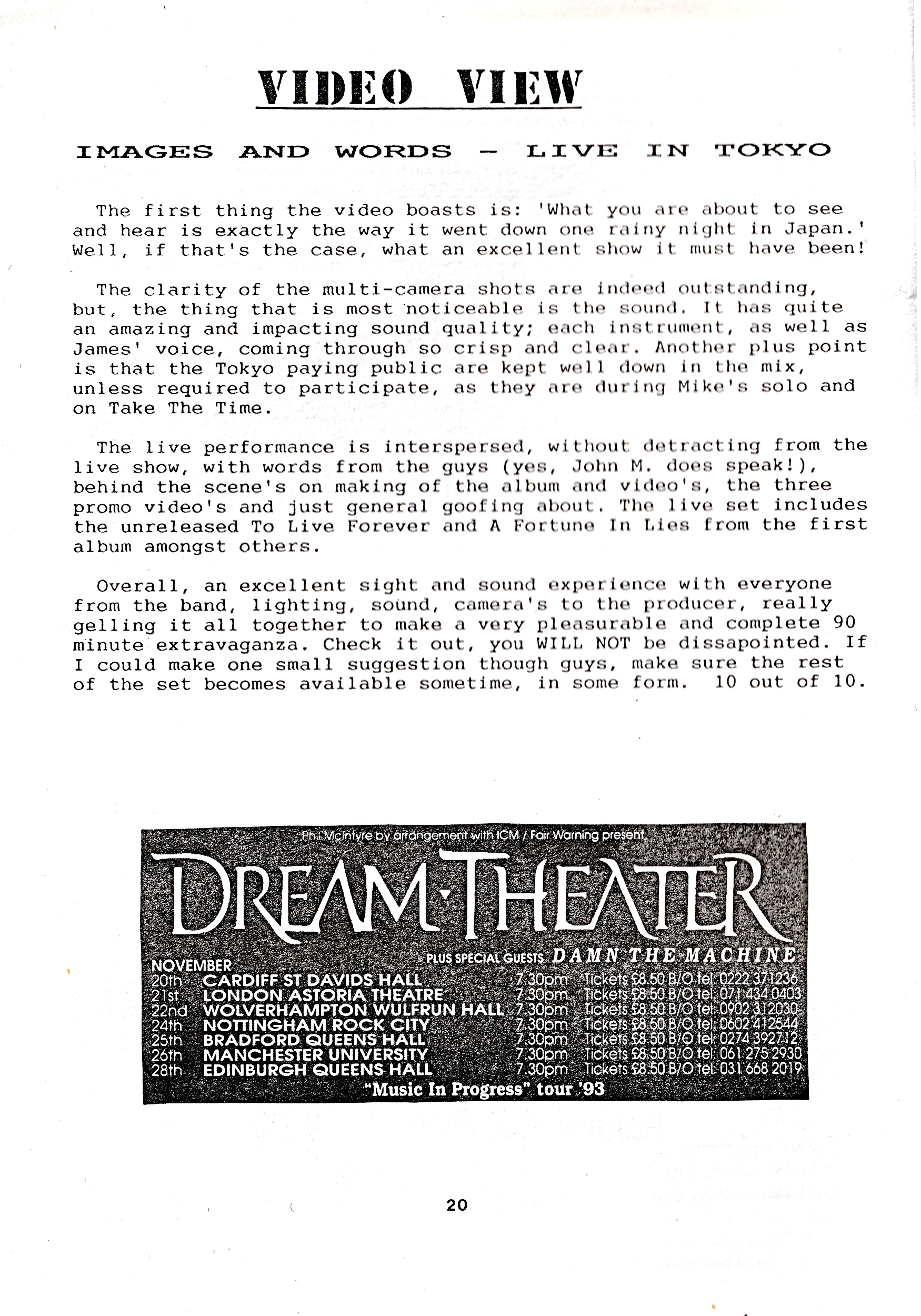
Video View
Images and Words — Live in Tokyo
Original page 20.
The first thing the video boasts is: ‘What you are about to see and hear is exactly the way it went down one rainy night in Japan.’ Well, if that’s the case, what an excellent show it must have been!
The clarity of the multi-camera shots are indeed outstanding, but, the thing that is most noticeable is the sound. It has quite an amazing and impacting sound quality; each instrument, as well as James’ voice, coming through so crisp and clear. Another plus point is that the Tokyo paying public are kept well down in the mix, unless required to participate, as they are during Mike’s solo and on Take The Time.
The live performance is interspersed, without detracting from the live show, with words from the guys (yes, John M. does speak!), behind the scene’s on making of the album and video’s, the three promo video’s and just general goofing about, The live set includes the unreleased To Live Forever and A Fortune In Lies from the first album amongst others.
Overall, an excellent sight and sound experience with everyone from the band, lighting, sound, camera’s to the producer, really gelling it all together to make a very pleasurable and complete 90 minute extravaganza. Check it out, you WILL NOT be disappointed. If I could make one small suggestion though guys, make sure the rest of the set becomes available sometime, in some form. 10 out of 10.
Contemporary tour advert on page 20: Dream Theater — Music in Progress Tour ‘93. The advertisement lists November UK dates; it is reproduced in miniature in the source.
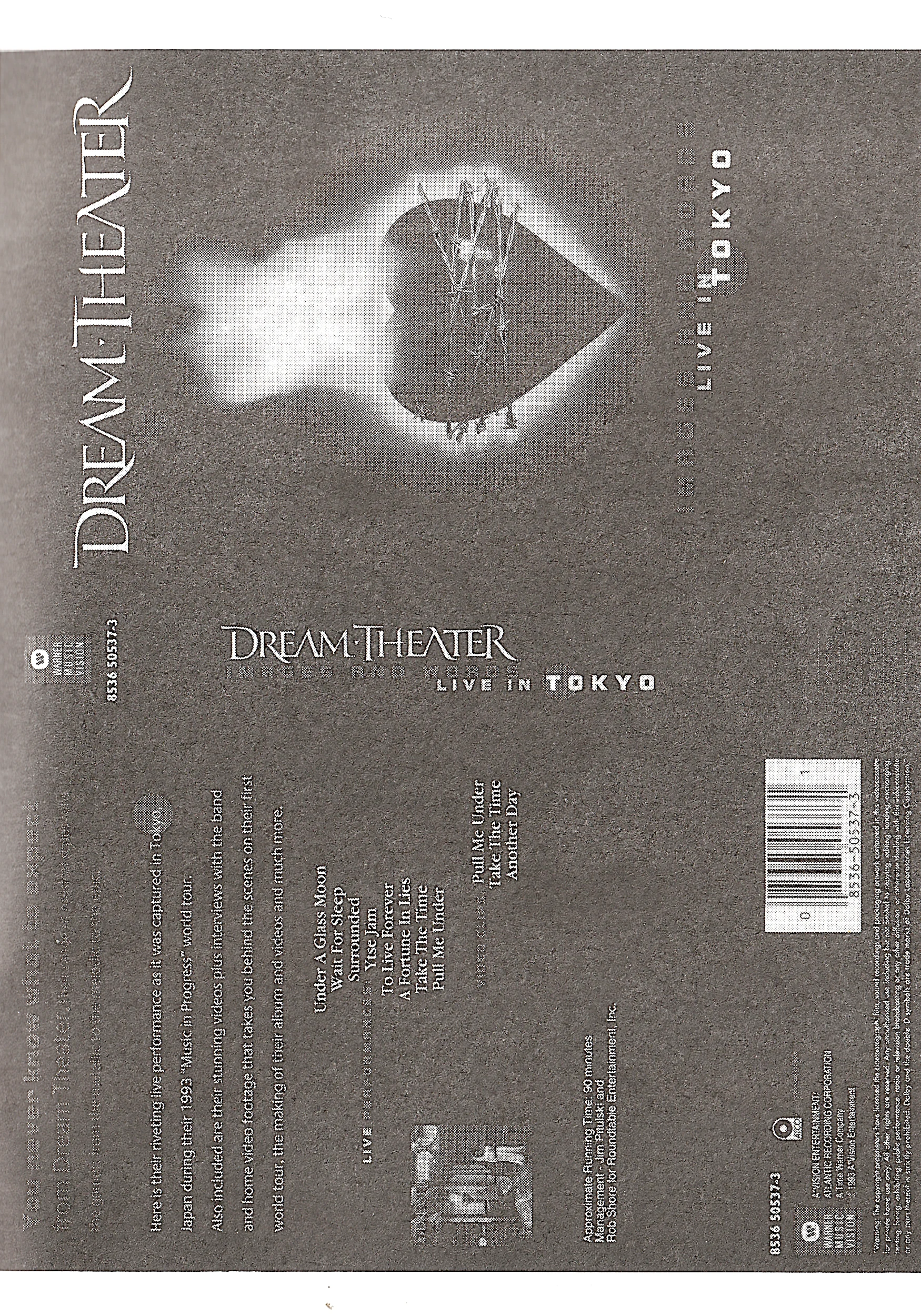
Images & Words: Live in Tokyo — Video Sleeve Copy
Original page 21. Text transcribed from a sideways, full-page video sleeve reproduction. Artwork omitted.
“You never know what to expect from Dream Theater, but always expect a surprise.”
Here is their riveting live performance as it was captured in Tokyo, Japan during their 1993 “Music in Progress” world tour. Also included are their stunning videos plus interviews with the band and home video footage that takes you behind the scenes on their first world tour, the making of their album and videos and much more.
Live performances
- Under a Glass Moon
- Wait for Sleep
- Surrounded
- Ytse Jam
- To Live Forever
- A Fortune in Lies
- Take the Time
- Pull Me Under
Video clips
- Pull Me Under
- Take the Time
- Another Day
Approximate running time: 90 minutes
Management: Jim Pitulski and Rob Shore for Roundtable Entertainment, Inc.
Video catalogue: 8536 50537-3
Words
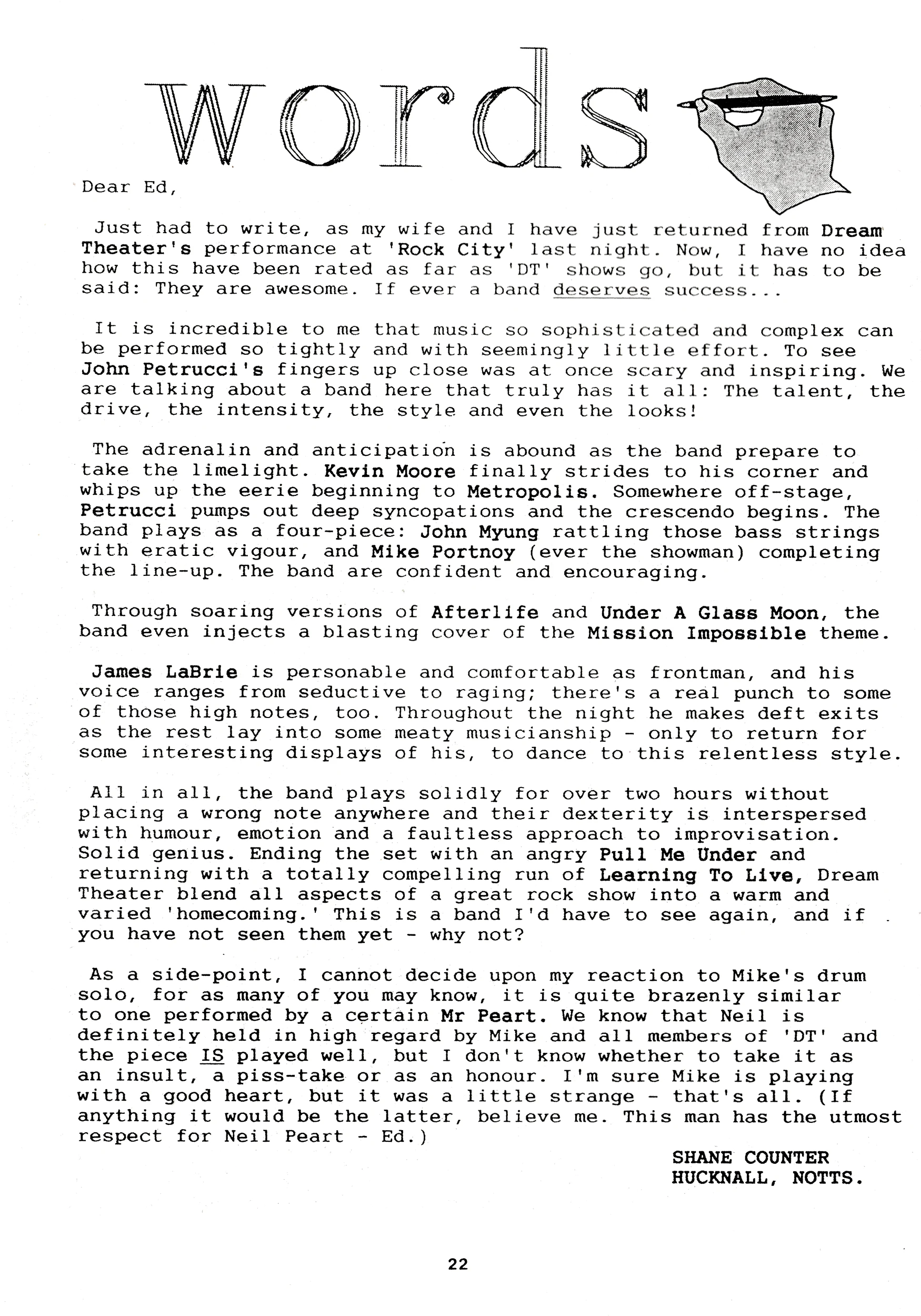
Letter to the Editor: Rock City, Nottingham
Original page 22. Reader letter by Shane Counter, Hucknall, Notts.
Dear Ed,
Just had to write, as my wife and I have just returned from Dream Theater’s performance at ‘Rock City’ last night. Now, I have no idea how this have been rated as far as ‘DT’ shows go, but it has to be said: They are awesome. If ever a band deserves success…
It is incredible to me that music so sophisticated and complex can be performed so tightly and with seemingly little effort. To see John Petrucci’s fingers up close was at once scary and inspiring. We are talking about a band here that truly has it all: The talent, the drive, the intensity, the style and even the looks!
The adrenalin and anticipation is abound as the band prepare to take the limelight. Kevin Moore finally strides to his corner and whips up the eerie beginning to Metropolis. Somewhere off-stage, Petrucci pumps out deep syncopations and the crescendo begins. The band plays as a four-piece: John Myung rattling those bass strings with eratic vigour, and Mike Portnoy (ever the showman) completing the line-up. The band are confident and encouraging.
Through soaring versions of Afterlife and Under A Glass Moon, the band even injects a blasting cover of the Mission Impossible theme.
James LaBrie is personable and comfortable as frontman, and his voice ranges from seductive to raging; there’s a real punch to some of those high notes, too. Throughout the night he makes deft exits as the rest lay into some meaty musicianship - only to return for some interesting displays of his, to dance to this relentless style.
All in all, the band plays solidly for over two hours without placing a wrong note anywhere and their dexterity is interspersed with humour, emotion and a faultless approach to improvisation. Solid genius. Ending the set with an angry Pull Me Under and returning with a totally compelling run of Learning To Live, Dream Theater blend all aspects of a great rock show into a warm and varied ‘homecoming.’ This is a band I’d have to see again, and if you have not seen them yet - why not?
As a side-point, I cannot decide upon my reaction to Mike’s drum solo, for as many of you may know, it is quite brazenly similar to one performed by a certain Mr Peart. We know that Neil is definitely held in high regard by Mike and all members of ‘DT’ and the piece IS played well, but I don’t know whether to take it as an insult, a piss-take or as an honour. I’m sure Mike is playing with a good heart, but it was a little strange - that’s all.
Editor’s note: If anything it would be the latter, believe me. This man has the utmost respect for Neil Peart.
Shane Counter
Hucknall, Notts.
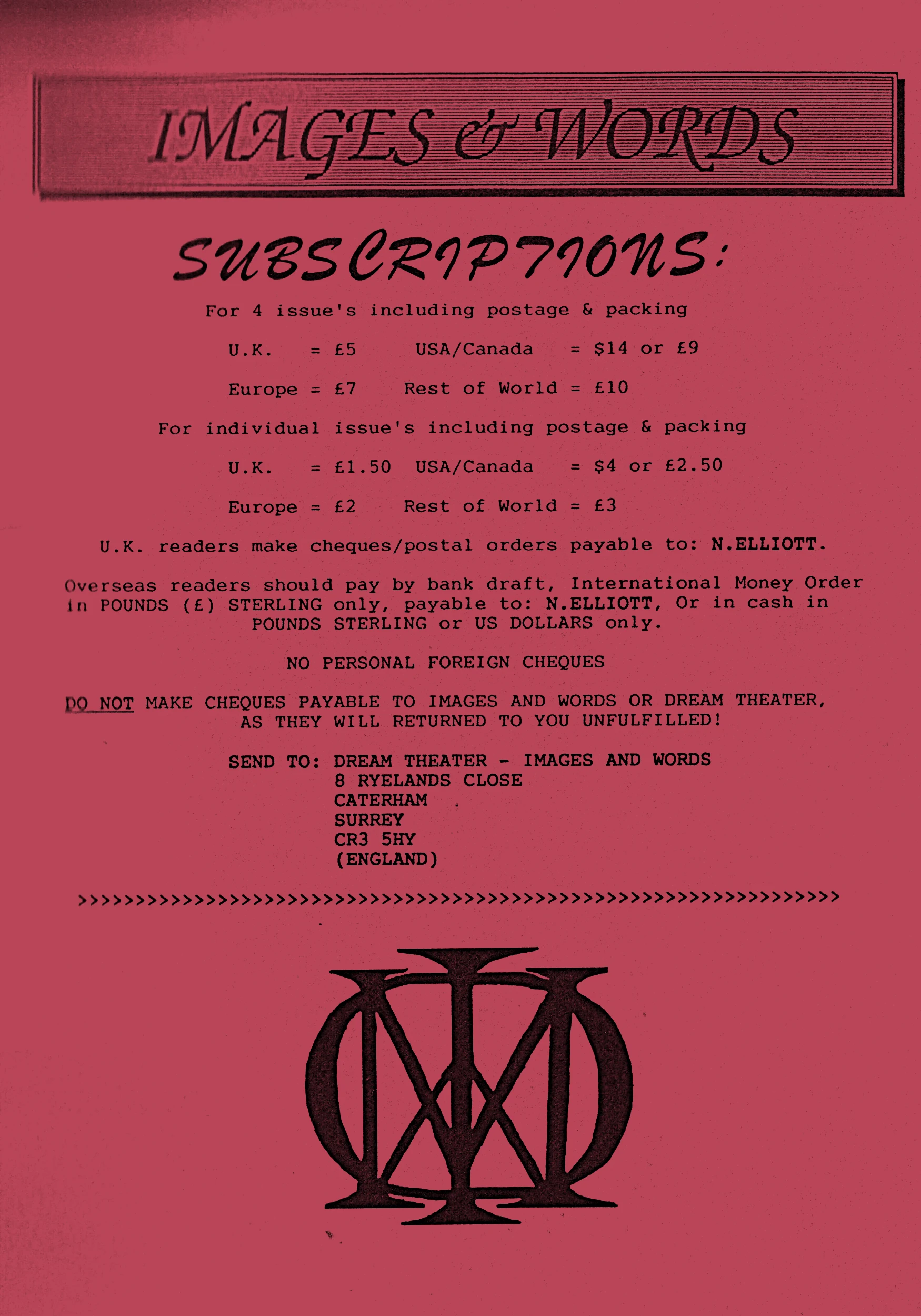
Subscriptions
Original page 23 · Prices as printed at the time of publication.
Four issues (including postage and packing)
| Region | Price |
|---|---|
| U.K. | £5 |
| USA / Canada | $14 or £9 |
| Europe | £7 |
| Rest of world | £10 |
Individual issues (including postage and packing)
| Region | Price |
|---|---|
| U.K. | £1.50 |
| USA / Canada | $4 or £2.50 |
| Europe | £2 |
| Rest of world | £3 |
U.K. readers make cheques/postal orders payable to N. ELLIOTT.
Overseas readers should pay by bank draft, International Money Order in POUNDS (£) STERLING only, payable to N. ELLIOTT, or in cash in POUNDS STERLING or US DOLLARS only.
NO PERSONAL FOREIGN CHEQUES.
DO NOT MAKE CHEQUES PAYABLE TO IMAGES AND WORDS OR DREAM THEATER, AS THEY WILL BE RETURNED TO YOU UNFULFILLED!
Send to:
DREAM THEATER — IMAGES AND WORDS
8 RYELANDS CLOSE
CATERHAM
SURREY
CR3 5HY
ENGLAND
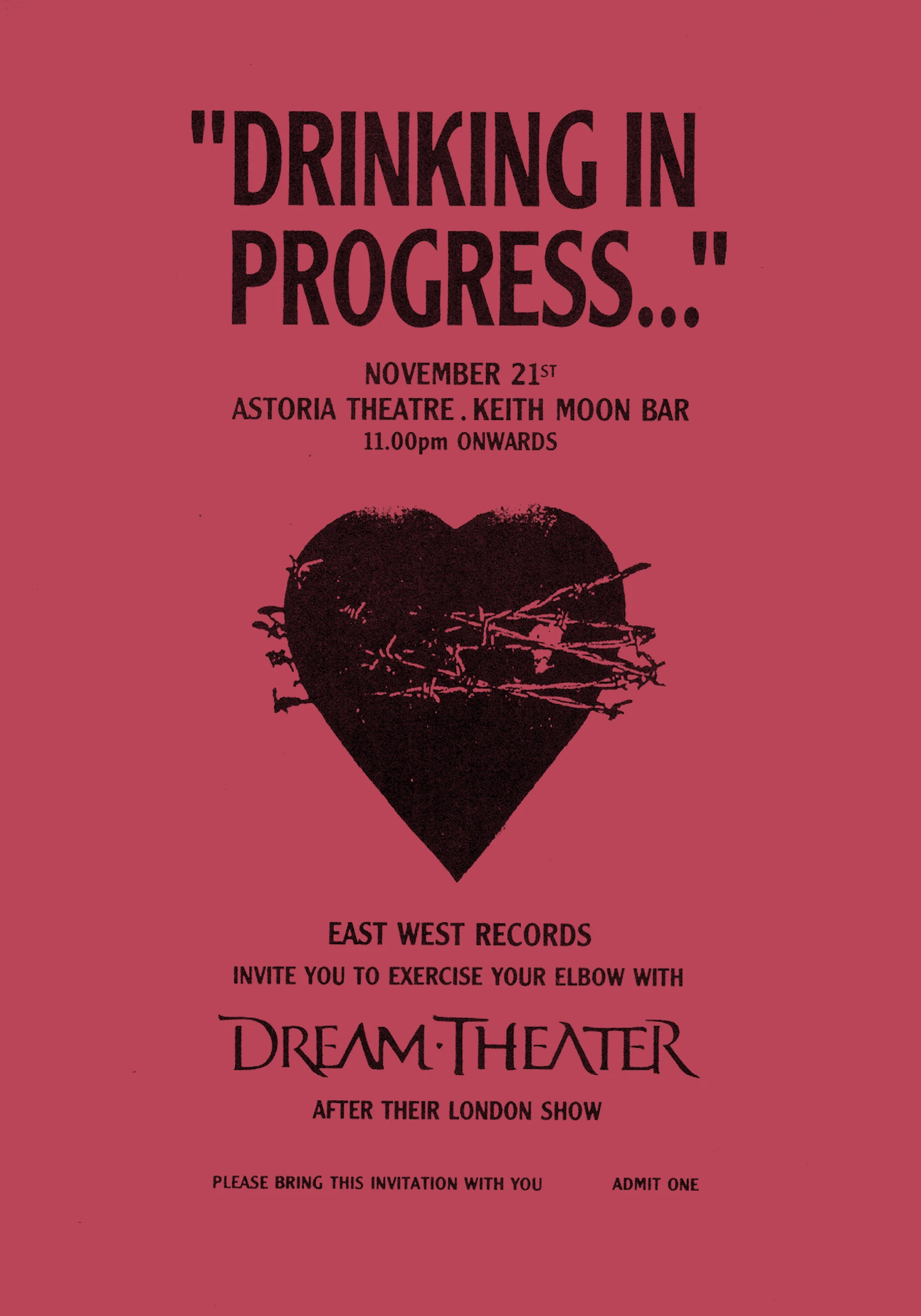
“Drinking in Progress…”
Original back-cover invitation, page 24.
“DRINKING IN PROGRESS…”
NOVEMBER 21st
ASTORIA THEATRE · KEITH MOON BAR
11.00 p.m. onwardsEAST WEST RECORDS
INVITE YOU TO EXERCISE YOUR ELBOW WITH
DREAM THEATER
AFTER THEIR LONDON SHOWPLEASE BRING THIS INVITATION WITH YOU · ADMIT ONE