
Your rating
Your collection and ratings are saved in this browser and shown in My Dream Theater.
- Released
- 29 Jun 2004
- Label
- Inside Out Music
- Formats
- CD, Digital Media
- Producers
- Kevin Moore
Solo albums · Kevin Moore · 2004
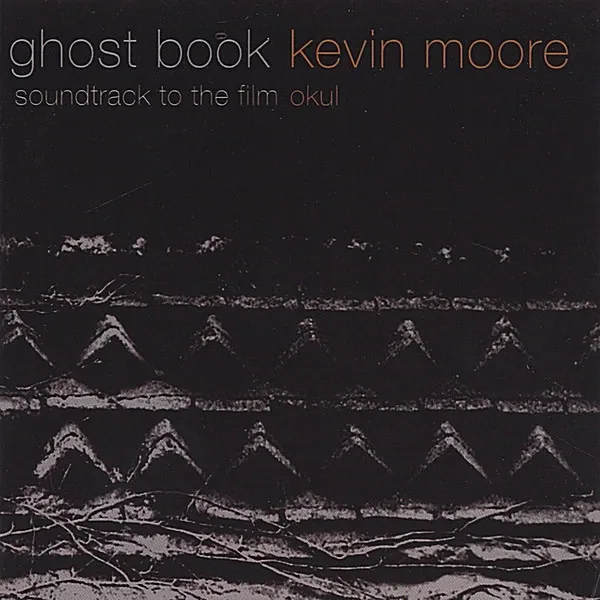
Ghost Book
✎ Edit this releaseTracklist
- Rhodes Song01:34
- Prayer Call00:48
- Piano Theme01:42
- Roof Access (Day)03:33
- Far Fara01:41
- P.S.01:30
- Library Noise02:19
- Overheard03:32
- Romantik (Foe Sho cover)01:31
- The Hecklers03:37
- Mirrors and Phones04:03
- Shall We Jump01:44
- Cowbloke02:26
- Erotik (Foe Sho cover)02:46
- Roof Access (Night)03:21
- Hallways and Light02:40
- Afterschool00:54
- Sad Sad Movie (Chroma Key cover)05:38
Personnel
Personnel
- Kevin Moore – All instruments; vocals (except Romantik, Erotik)
- Bige Akdeniz – Vocals (Far Fara)
- Muarem Akkus – Vocals (Prayer Call)
- Foe Sho – Composition and performance (Romantik, Erotik)
The route to Ghost Book was unusually circular. Doğu Yücel had listened to Kevin Moore’s music while writing the novel Hayalet Kitap. When that story became the Turkish film Okul, Moore ended up supplying its score. Music that had helped a writer imagine the story was now being written specifically for its screen version.1
Released in 2004, Ghost Book is Moore’s first film soundtrack album. It contains eighteen tracks, ranging from short scene-setting cues to the longer closing song “Sad Sad Movie”. It is a Kevin Moore release, rather than a fourth Chroma Key album.2
An unlikely practical coincidence
Yücel recalled discussing the score with directors Durul and Yağmur Taylan while they were exchanging records, including OSI’s debut. They wanted music in that territory, but initially treated asking Moore as an unlikely prospect. A friend in the Turkish Dream Theater fan club then told Yücel that Moore was in Turkey. Contact with his management led to a meeting and an agreement to work on the film.1
The film mixes a school setting, supernatural events and black comedy. That gives the soundtrack several jobs, and helps explain why it moves between restrained keyboard writing, electronics, voices and less expected changes of style. A single continuous layer of ominous strings would have been a much simpler assignment.
The score and the other performers
Moore performs the bulk of the music, with two pieces, “Romantik” and “Erotik”, composed and performed by Foe Sho. Bige Akdeniz sings on “Far Fara”, and Muarem Akkus contributes the vocal to “Prayer Call”. The soundtrack’s changes of style include work made by different performers, as well as Moore’s own experiments.34
“Rhodes Song” and “Piano Theme” make the keyboard foundation explicit. The paired “Roof Access (Day)” and “Roof Access (Night)” cues belong to different points in the film’s changing atmosphere, while pieces such as “P.S.” and “Afterschool” are brief enough to work as transitions. Their brevity makes more sense with the film’s needs in mind.2
“Sad Sad Movie” provides a more self-contained conclusion. It also appeared on Graveyard Mountain Home later that year, linking the soundtrack to the music Moore released under the Chroma Key name. The shared composition belongs in both release histories.2
Restraint, and the limits of a soundtrack album
Contemporary responses picked up on that restraint. Jedd Beaudoin praised the way Moore avoided routine horror-score gestures and overcrowded arrangements. Sea of Tranquility’s Steve Pettengill also found worthwhile atmosphere, but felt that some of the short extracts ended before they became satisfying pieces away from the film.45
Those observations describe the album’s attraction and its limitation quite neatly. A cue that leaves a scene room to breathe can feel unfinished when the scene is absent. Ghost Book is most useful heard with that purpose in mind, while still allowing the longer pieces and the stranger stylistic turns to stand on their own.
The original Turkish Okul soundtrack has a longer twenty-one-track programme. The international Ghost Book edition retains Moore’s score and the Foe-Sho contributions while omitting the three additional Teoman songs.