
Your rating
Your collection and ratings are saved in this browser and shown in My Dream Theater.
- Released (Europe)
- 8 Nov 2004
- Released (US)
- 9 Nov 2004
- Label
- Inside Out Music
- Formats
- CD, Digital Media
- Producers
- Kevin Moore
- Recorded
- September 2003-September 2004, Istanbul, Turkey
Solo albums · Chroma Key · 2004
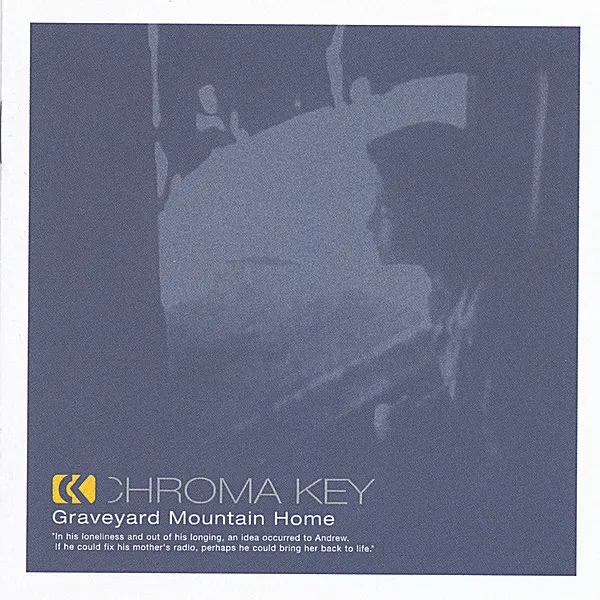
Graveyard Mountain Home
✎ Edit this releaseTracklist
- YYY02:11
- Give Up04:04
- White Robe04:55
- Mother's Radio04:15
- Graveyard Mountain Home02:32
- Salvation02:40
- Before You Started04:24
- Human Love06:01
- Come in, Over05:01
- Pure Laughter02:08
- Andrew Was Drowning His Stepfather02:12
- Sad Sad Movie05:38
- True and Lost02:30
- Again Today06:28
Personnel
Personnel
- Kevin Moore – Vocals; keyboards; guitar; production; mixing
- Utku Ünal – Drums
- Theron Patterson – Bass; programming (tracks 4, 8, 14)
- Bige Akdeniz – Additional vocals and lyrics (tracks 9, 13)
- Bob Nekrasov – Monologue (Human Love)
- Erdem Helvacıoğlu – Additional guitar (White Robe)
Graveyard Mountain Home takes the relationship between music and found material further than either of the first two Chroma Key records. Kevin Moore chose an old film, slowed it down, removed its soundtrack and let its images guide the writing. The result can be heard as an album, but it was also designed to accompany something visible.1
The film was Age 13, a 1955 educational drama about a boy dealing with his mother’s death. Moore’s half-speed treatment changes its pacing so thoroughly that the images become a source of mood and structure rather than a conventional story being illustrated at normal speed. The special edition included the film on DVD with the new music.1
Istanbul, 2003-2004
The recording was produced and mixed in Istanbul between September 2003 and September 2004. Moore worked with drummer Utku Ünal, bassist and programmer Theron Patterson, singer Bige Akdeniz, guitarist Erdem Helvacıoğlu and spoken-word contributor Bob Nekrasov. InsideOut announced the American release for November 9, 2004; European listings place it a day earlier.12
The contributions are specific. Akdeniz supplies additional vocals and lyrics on “Come In, Over” and “True and Lost”. Patterson adds programming on “Mother’s Radio”, “Human Love” and “Again Today”, while Nekrasov’s monologue belongs to “Human Love”. Helvacıoğlu contributes additional guitar to “White Robe”.2
This is still Moore’s project, but the voices and performances are not all his. Their presence helps prevent a deliberately restricted method from becoming a completely closed musical world.
A film imposing useful limits
Moore explained that choosing a film with an appropriate mood gave the songs a guide. He did not regard the unusual method as a reason to demand that listeners admire an experiment. He still wanted the music to communicate, including to people who had liked the first two Chroma Key albums.3
That intention is important. Slowing a film down is a method; it does not automatically make a compelling album. The useful question is what the restriction does to the pacing, the entrances of voices and the amount of space between events. Here, songs can emerge from an atmosphere instead of having to establish themselves immediately through a chorus.
The fourteen-track sequence includes brief pieces such as “YYY” and “Pure Laughter” alongside more developed material. “Sad Sad Movie” also appears on Moore’s Ghost Book soundtrack, released earlier in 2004. It is the same composition crossing between two closely related areas of his work, not a new song merely sharing a title.24
From screen to stage
At Moore’s first solo show in Istanbul on March 23, 2007, material from the album was accompanied by the corresponding Age 13 images. The visual relationship therefore survived beyond the DVD edition and entered the performance itself.5
The record asks for a different kind of attention from the early Dream Theater albums. Much of the tension is in the restraint and in the way speech, sound and image alter one another. Anyone waiting for a keyboard solo to explain the point may be waiting a while.
Footnotes
-
Graveyard Mountain Home, film method, original editions and release chronology. ↩ ↩2 ↩3
-
InsideOut announcement, recording period, track list and guest credits, September 24, 2004. ↩ ↩2 ↩3
-
Kevin Moore interview with Electric Basement, reported February 9, 2005. ↩
-
Report of Moore’s first solo performance, Istanbul, March 2007. ↩