
Your rating
Your collection and ratings are saved in this browser and shown in My Dream Theater.
- Released
- 1993
- Label
- Invincible Recordings
- Formats
- CD, Digital Media
- Producers
- Liv Singh Khalsa, Quantum Dream
- Art direction
- William Giese
Solo albums · Jordan Rudess · 1993
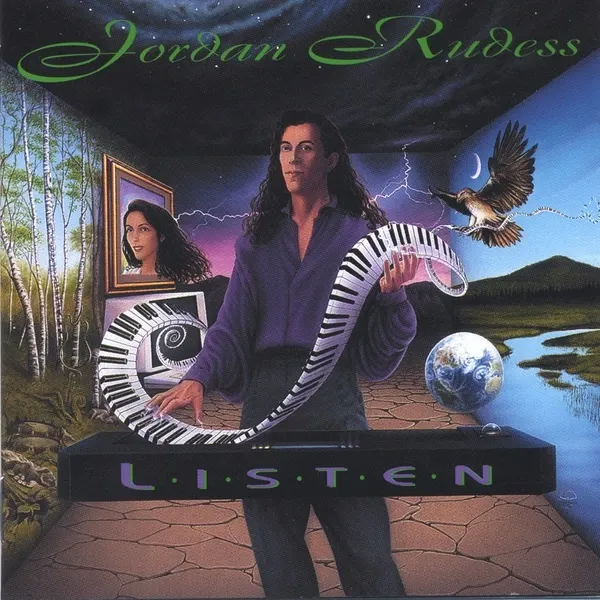
Listen
✎ Edit this releaseTracklist
- Listen to the Voice03:51
- Inspiration05:14
- Beyond the Shoreline04:33
- Fade Away04:31
- It's a Mystery06:46
- Feel the Magic06:25
- Invisible Child05:58
- Across the Sky07:17
- Take Time07:47
- Danielle05:18
- Boogie Wacky Woogie02:31
Personnel
Personnel
- Jordan Rudess – Vocals and Keyboards
- Barbara Boch – Vocals
- Chris Amelar – Guitars
- Jim Simmons – Bass Guitar
- Ken Mary – Drums
Production
- Liv Singh Khalsa – Produced, Recorded and Mixed by
- Quantum Dream – Produced, Recorded and Mixed by
- William Giese – Cover art
For listeners who know Jordan Rudess as the keyboard player in Dream Theater, Listen offers a fairly immediate reminder that his career did not begin with Scenes from a Memory. Released in 1993, it puts him in charge of a complete rock record, including lead vocals. The keyboard playing was the obvious attraction, but this was not simply a collection of solos with a rhythm section attached.1
It was the album associated with his recognition as Best New Talent in the keyboard category of Keyboard magazine’s 1994 readers poll. That attention helped put him in front of musicians and audiences who would become important to the next stage of his career. The album is often called his debut, although the independently released Arrival cassette predates it.12
A different place in the arrangement
Rudess later described Listen as a way to release the progressive ideas he had been developing, and specifically noted that he sang lead. That changes the relationship between the keyboards and the songs. A vocal line has to carry a thought through an arrangement, and the other parts have to leave it somewhere to go. The player responsible for the busiest keyboard passages was also responsible for being understood over them.3
The credited musicians include Barbara Boch on vocals, Chris Amelar on guitar, Jim Simmons on bass and Ken Mary on drums. The Invincible label page names Liv Singh Khalsa and Quantum Dream in the production, recording and mixing credit, with William Giese providing the cover art. These are the people attached to this recording, rather than the collaborators who would become familiar from Rudess’s later albums.1
The eleven-track sequence begins with “Listen to the Voice” and moves through “Inspiration”, “Beyond the Shoreline” and “Fade Away”. “It’s a Mystery”, “Feel the Magic” and “Invisible Child” occupy the middle of the record, with “Across the Sky”, “Take Time”, “Danielle” and “Boogie Wacky Woogie” completing it. There is a mixture of longer pieces and a much shorter closing track, rather than one extended composition divided into arbitrary sections.2
Recognition before the invitation
The contemporary Keyboard assessment reproduced by Invincible emphasised the speed and clarity of Rudess’s playing, comparing its keyboard vocabulary with Rick Wakeman while describing the songs as harder-edged. That gives some idea of why the record attracted attention in a period when expansive keyboard-led rock was not exactly the most fashionable route into the music business.1
The later Dream Theater connection should not swallow the album’s own identity. In 1999, Rudess still distinguished Listen from the improvised, generally mellower piano approach of Secrets of the Muse and Resonance. The solo catalogue already contained different kinds of music before he became a full-time member of the band.3
That is the useful perspective on Listen. It is a record by a keyboard player who also wanted to write and sing, made with a particular group of musicians at a particular time. The later technical reputation explains why people return to it. The songs explain what he was actually trying to put across.