
Your rating
Your collection and ratings are saved in this browser and shown in My Dream Theater.
- Released (Europe)
- 6 Mar 2000
- Released (United States)
- 14 Mar 2000
- Label
- InsideOut Music
- Formats
- CD
- Genres
- Progressive rock, Jazz fusion
- Producers
- Platypus
- Written
- May 1999
- Recorded
- 1999
- Recording studios
- Millbrook Sound Studios, Millbrook, New York (basic tracks)The Leopard Room, Hollywood Hills, California (additional keyboards)Alien Beans Studios, Houston, Texas (vocals and other overdubs)
- Mixing studios
- Alien Beans Studios, Houston, Texas
- Mastering studios
- Alien Beans Studios, Houston, Texas
- Art direction
- Billi Bastelle (design); Thomas Ewerhard (layout); Stefanie Veenstra (bicycle photography)
Side projects · Platypus · 2000
Ice Cycles
✎ Edit this releaseTracklist
- Oh God4:16
- Better Left Unsaid5:24
- The Tower3:30
- Cry6:15
- I Need You4:17
- 255:09
- Gone6:42
- Partial to the Bean (A Tragic American Quintogy) : Partial to the Bean, A: Intro Pompatous0:21
- Partial to the Bean (A Tragic American Quintogy) : Partial to the Bean, B: Yoko Ono1:27
- Partial to the Bean (A Tragic American Quintogy) : Partial to the Bean, C: Yoko Two-No1:01
- Partial to the Bean (A Tragic American Quintogy) : Partial to the Bean, D: Yoko Three-No2:13
- Partial to the Bean (A Tragic American Quintogy) : Partial to the Bean, E: Platmosis1:16
- Partial to the Bean (A Tragic American Quintogy) : Partial to the Bean, F: Yoko Againo2:08
- Partial to the Bean (A Tragic American Quintogy) : Partial to the Bean, G: Yoko Outro2:07
Personnel
Personnel
- Ty Tabor – Vocals; guitars; percussion
- Derek Sherinian – Keyboards
- John Myung – Bass
- Rod Morgenstein – Drums
Production
- Paul Orofino – Engineering
- Ty Tabor – Engineering; mixing; mastering
Ice Cycles gives Platypus another chance to see what happens when these four musicians start playing together. The lineup is unchanged: Ty Tabor on guitar and vocals, Derek Sherinian on keyboards, John Myung on bass and Rod Morgenstein on drums. What changes is the balance. There is a more sustained run of vocal songs before the instrumental side takes over towards the end, giving the album a clear sense of movement.12
Myung’s account in Theater of Dreams is particularly useful in understanding how the record came together. The group found two weeks in May when everybody was available and returned to Millbrook Studios in upstate New York. By the end of that time they had written enough material, but had started to run out of recording time. Tabor and Sherinian continued with the keyboard recordings at Sherinian’s studio, after which Tabor took the tapes away to finish assembling the album.1
The songs were developed together. Asked whether Tabor had arrived with much of the material already written, Myung said that nothing had been prepared in that form. Riffs became starting points for group playing, and ideas could develop quickly once they began working. Some days produced very little; another day might give them three songs. Myung described his own contributions as ideas that grew through that interaction, sometimes with Tabor helping him reshape a part or find where it belonged.1
That is an important distinction for a record so closely connected to Tabor’s voice. He wrote the lyrics and had a substantial role in bringing the arrangements together, but the music is credited to Platypus. The songs carry the personality of the singer without reducing the other musicians to a backing band. Sherinian’s keyboards and the interaction between Myung and Morgenstein remain part of the way the pieces develop.12
“Oh God” opens the album, followed by “Better Left Unsaid”, “The Tower”, “Cry” and “I Need You”. The instrumental “25” interrupts that sequence before “Gone” returns to the vocal side. After that comes “Partial to the Bean (A Tragic American Quintogy)”, a roughly ten-and-a-half-minute instrumental suite. Its seven sections run from “Intro Pompatous” through the various Yoko titles and “Platmosis” to “Yoko Outro”. The sleeve groups them as one piece, while the CD gives the sections individual indexes. That distinction explains why an eight-piece album can appear as fourteen tracks on a CD player.23
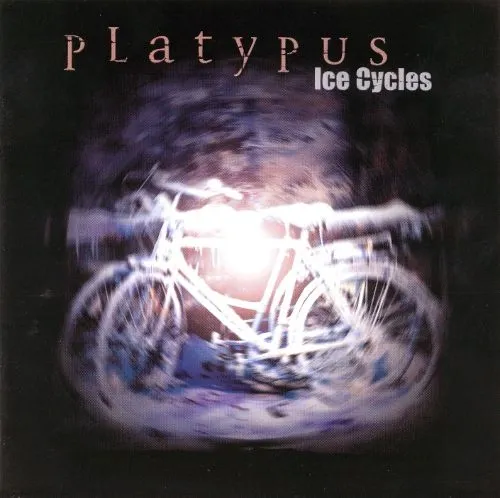
The recording credits trace the same process Myung described. Basic tracks were recorded at Millbrook, additional keyboards at the Leopard Room in Hollywood Hills, and the remaining overdubs and vocals at Alien Beans in Houston. Tabor mixed and mastered the album there, with Paul Orofino and Tabor credited as engineers. The production credit goes to the band. The bicycle photograph is Stefanie Veenstra’s, with design by Billi Bastelle and layout by Thomas Ewerhard.3
The sessions also preserved a connection that might easily have become awkward. Sherinian had left Dream Theater before the second Platypus record was made, yet he had already spoken about his continued friendship with Myung and the prospect of recording together again. In a separate 1999 interview, he identified May 14 as the planned start of the new writing sessions. Myung’s later recollection of two weeks in May fits that contemporary plan.45
Released in 2000, Ice Cycles became the quartet’s second and final album. At the time, Myung still expected a third, but the musicians’ next projects took different forms. By 2002 he described Platypus as having naturally developed into The Jelly Jam, the trio he formed with Tabor and Morgenstein. Ice Cycles therefore captures the last version of this particular four-way conversation, with Sherinian’s keyboards still an essential part of its sound.16
Footnotes
-
John Myung on the Ice Cycles writing and recording sessions, Theater of Dreams fanzine 17, 2000, Through My Words. ↩ ↩2 ↩3 ↩4 ↩5
-
Original album track listing, suite structure and lyric credits; original European CD and individual track indexes. ↩ ↩2 ↩3
-
Original IOMCD 056 recording, production, artwork and sleeve credits. ↩ ↩2
-
Sherinian discusses continuing Platypus after leaving Dream Theater, Prime Choice, 1999, Through My Words. ↩
-
Sherinian’s contemporary announcement of the May 1999 sessions, Hard RoxX, Through My Words. ↩
-
John Myung on Platypus becoming The Jelly Jam, Bass Inside, 2002, Through My Words. ↩