
Your rating
Your collection and ratings are saved in this browser and shown in My Dream Theater.
- Released (United States)
- 1999
- Label
- InsideOut Music
- Formats
- CD
- Genres
- Progressive rock, Jazz fusion
- Producers
- Platypus
- Recorded
- 1998
- Recording studios
- Millbrook Sound Studios, Millbrook, New YorkAlien Beans Studios, Houston, Texas
Side projects · Platypus · 1998
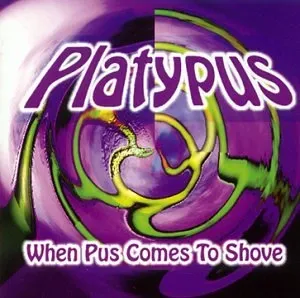
When Pus Comes to Shove
✎ Edit this releaseTracklist
- Standing in Line3:10
- Nothing to Say4:54
- Rock Balls/Destination Unknown7:40
- Platt Opus5:01
- I’m with You4:13
- Blue Plate Special7:21
- Chimes4:45
- Willie Brown5:03
- Bye Bye4:51
- What About the Merch?4:29
Personnel
Personnel
- Ty Tabor – Vocals; guitars; percussion
- Derek Sherinian – Keyboards
- John Myung – Bass
- Rod Morgenstein – Drums; keyboards on Chimes
Production
- Paul Orofino – Engineering
- Ty Tabor – Engineering; mixing; mastering
When Pus Comes to Shove wastes very little time making its intentions clear. “Standing in Line” is a proper rock song, with the organ and guitar carrying the opening and Ty Tabor giving the band an immediately recognisable voice. With John Myung, Derek Sherinian and Rod Morgenstein alongside him, there was plenty of room for the music to become complicated. But the interesting thing about Platypus is how comfortable these players sound when the groove is allowed to do the work.12
The project began with Myung. He had ideas waiting on tape and wanted to find a different setting for them, so he contacted Sherinian and the other musicians. Morgenstein lived nearby, and Myung first approached him about playing together in August 1997. Tabor brought both guitar and vocals from a rather different musical environment in King’s X. Apart from Myung and Sherinian, the players had not worked together in this combination, leaving them to discover what the group would sound like as they went.1
That uncertainty was part of the attraction. In their 1998 Gitarre & Bass interview, Myung and Tabor described a record that developed through jamming, with one person’s idea changing as everybody else found a place in it. Tabor pointed towards the music he had grown up with in the early seventies, particularly Jeff Beck, while Myung named Rush, Genesis and Jethro Tull among his favourites. The Beatles mattered to both of them. These influences help explain why the album can move between a direct vocal song and a much looser instrumental passage without sounding as though it has changed bands.1
Sherinian’s keyboards are an important part of that balance. Tabor explained that playing alongside a keyboard player changed both his choice of sounds and the parts he played. There was another instrument occupying the space around the guitar, and finding room for it became part of the writing. Sherinian, meanwhile, welcomed the opportunity to explore a bluesier, funkier approach than he normally used in Dream Theater.13
The running order makes good use of the contrast. “Nothing to Say” follows the opening rocker before the longer instrumental stretch of “Rock Balls/Destination Unknown” and “Platt Opus”. “Blue Plate Special” provides another extended instrumental setting, while “Chimes” brings a gentler change of texture, with Morgenstein contributing keyboards as well as drums. The return to vocal material in “Willie Brown” and “Bye Bye” keeps the record from becoming one long demonstration of what the players can do.24
Myung’s contribution is worth hearing in that context. When asked whether this music was more concerned with groove than Dream Theater, he described it as a different kind of interaction, with more of a blues feel. He also confirmed that he had planned to use Chapman Stick on “Chimes” but ran out of time before leaving for Europe with Dream Theater. The idea remained a plan, with bass used on the finished recording.5
The album was made quickly, with the musicians repeatedly describing the core writing and recording as roughly two weeks. Millbrook and Tabor’s Alien Beans studio are credited recording locations, and Tabor handled the mix. The original InsideOut edition appeared in 1998, followed by the US Velvel edition in 1999, with a different arrangement of the cover artwork. Both belong to the same record.46

There was enough enthusiasm to do it again. Even after Sherinian’s departure from Dream Theater, he spoke positively about working with Myung and looked forward to another Platypus session. That continuation would become Ice Cycles. Here, though, the appeal is already clear: a group of very capable musicians finding something enjoyable in the act of playing together, with the songs giving their different backgrounds a place to meet.6
Footnotes
-
John Myung and Ty Tabor, Gitarre & Bass, December 1998, preserved in Through My Words. ↩ ↩2 ↩3 ↩4
-
Contemporary track-by-track discussion and original InsideOut track listing. ↩ ↩2
-
Derek Sherinian, Images and Words fanzine 16, 1998, Through My Words. ↩
-
Album personnel and writing credits; original European CD documentation. ↩ ↩2
-
John Myung answers fan questions, October 1998, Through My Words. ↩
-
Derek Sherinian, Prime Choice, 1999, Through My Words; original US sleeve, production credit and alternate artwork. ↩ ↩2