
Your rating
Your collection and ratings are saved in this browser and shown in My Dream Theater.
- Released
- 23 Oct 2001
- Label
- Magna Carta
- Formats
- CD, Digital Media
- Producers
- Jordan Rudess
Solo albums · Jordan Rudess · 2001
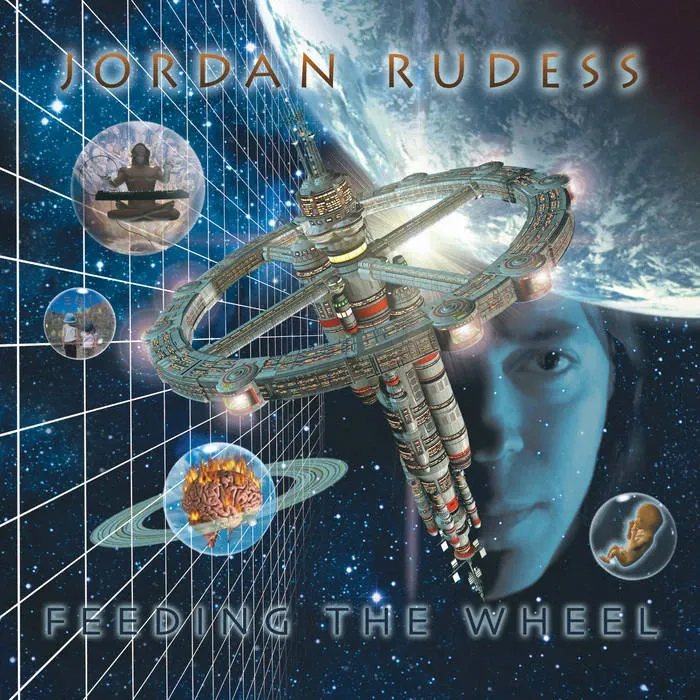
Feeding the Wheel
✎ Edit this releaseTracklist
- The Voice · Intro00:19
- Quantum Soup11:02
- Shifting Sands06:00
- Dreaming In Titanium04:08
- Ucan Icon05:41
- Center Of The Sphere01:37
- Crack The Meter06:13
- Headspace03:58
- Revolving Door08:33
- Interstices04:03
- Feed The Wheel10:12
Personnel
Personnel
- Jordan Rudess – All Keyboards; Electric guitar (Shifting Sands)
Guest musicians
- Steve Morse – Guitar solos (Quantum Soup, Crack the Meter)
- Mark Wood – 7-string Viper violin (Quantum Soup, Ucan Icon, Revolving Door, Feed the Wheel)
- John Petrucci – Guitar (Quantum Soup, Ucan Icon, Revolving Door, Feed the Wheel)
- Eugene Friesen – Cello and voice (Quantum Soup, Dreaming in Titanium, Headspace, Revolving Door)
- Terry Bozzio – Drums (tracks 2-7, 9, 11)
- Peter Ernst – Nylon String Guitar (Shifting Sands)
- Billy Sheehan – Bass (Crack the Meter)
- Barry Carl – The Voice (intro)
- Bert Baldwin – Keyboards Strings (Ucan Icon); Vocal FX
- Jordan Rudess – Vocal FX
Production
- Jordan Rudess – Producer
Feeding the Wheel is the point in Jordan Rudess’s solo catalogue where the guest list begins to look almost unreasonable. John Petrucci and Steve Morse on guitar, Terry Bozzio on drums, Mark Wood on electric violin, Eugene Friesen on cello and Billy Sheehan contributing bass: there was no shortage of players capable of making the music complicated. The more interesting question is how Rudess used their different sounds.1
Released by Magna Carta on October 23, 2001, the album followed his first studio record and extensive touring with Dream Theater. It is a Rudess composition and production throughout, with the visitors entering particular tracks rather than functioning as one fixed supergroup.1
Who plays where
“The Voice” introduces the record with Barry Carl before the much longer “Quantum Soup”. Bozzio supplies drums across eight of the eleven tracks. Petrucci appears on “Quantum Soup”, “Ucan Icon”, “Revolving Door” and “Feed the Wheel”, while Morse contributes solos to “Quantum Soup” and “Crack the Meter”. Those assignments matter, especially on an album where several pieces contain more than one distinctive instrumental voice.1
Wood’s seven-string Viper violin and Friesen’s cello give the arrangements colours that a keyboard patch could imitate but would not perform in quite the same way. “Shifting Sands” also brings in Peter Ernst on nylon-string guitar, with Rudess himself credited on electric guitar. “Crack the Meter” has Sheehan on bass. The point of the guest credits is the difference between the contributions, rather than a competition over the largest number of names.1
A large record in several sizes
The running order moves between substantial pieces and shorter changes of atmosphere. “Quantum Soup” runs around eleven minutes, “Revolving Door” more than eight, and “Feed the Wheel” around ten. “Center of the Sphere” and the opening “The Voice” occupy a very different amount of space. The title track is called “Feed the Wheel”, while the album is Feeding the Wheel. Keeping those titles separate avoids a small but persistent catalogue mistake.12
“Dreaming in Titanium”, “Ucan Icon”, “Headspace” and “Interstices” complete the program. It is tempting to describe an instrumental album through the players alone, but the changes in scale are just as important. A brief piece can reset the ear before another long arrangement begins. Without that contrast, even excellent playing can become one continuous foreground.2
Rudess’s keyboards remain the organising voice. That does not mean every guest has to play in the same manner as a keyboard solo, or that the acoustic instruments are present simply to make the sound more expensive. Their value is in providing different attacks, sustain and phrasing within music that could otherwise be dominated by synthesizers.
A solo record with a band-sized reach
The album sits between the more exposed piano recordings and the equally expansive Rhythm of Time. It is useful to hear it as one of several things Rudess wanted his solo career to accommodate. The piano did not disappear because he could now assemble this group of musicians, and the larger productions did not make the earlier records preliminary exercises.
The production makes a particular demand on the listener: there is a great deal happening, and much of it wants attention at once. The reward is in how the different instrumental characters interact. The credits provide a practical guide to those exchanges, without reducing the music to a checklist of famous guests.