
Studio albums · 2007
Systematic Chaos
✎ Edit this releaseTracklist
- In the Presence of Enemies : Part I9:00
- I.Prelude0:00
- II.Resurrection4:13
- Forsaken5:36
- Constant Motion6:55
- The Dark Eternal Night8:54
- Repentance10:43
- VIII.Regret0:00
- IX.Restitution5:15
- Prophets of War6:01
- The Ministry of Lost Souls14:57
- In the Presence of Enemies : Part II16:38
- III.Heretic0:00
- IV.The Slaughter of the Damned6:10
- V.The Reckoning9:17
- VI.Salvation13:12
Personnel
Dream Theater
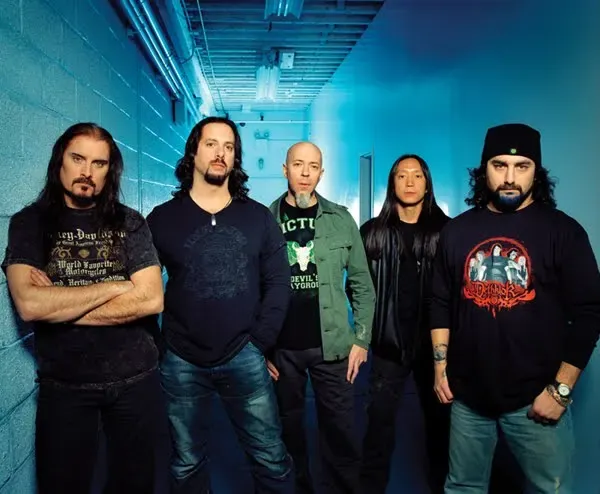
- Mike Portnoy – Drums, Percussion and vocals
- John Petrucci – Guitars and backing vocals
- John Myung – Bass
- Jordan Rudess – Keyboards and Continuum
- James LaBrie – Lead Vocals
Guest musicians
- Jon Anderson – Spoken word on "Repentance"
- Joe Satriani – Spoken word on "Repentance"
- Chris Jericho – Spoken word on "Repentance"
- Daniel Gildenlöw – Spoken word on "Repentance"
- Mikael Åkerfeldt – Spoken word on "Repentance"
- David Ellefson – Spoken word on "Repentance"
- Neal Morse – Spoken word on "Repentance"
- Steve Vai – Spoken word on "Repentance"
- Steven Wilson – Spoken word on "Repentance"
- Steve Hogarth – Spoken word on "Repentance"
- Corey Taylor – Spoken word on "Repentance"
Production
- John Petrucci & Mike Portnoy – producers
- Paul Northfield – sound engineering, mixing, vocal track co-producer
- Chad Lupo – assistant engineer
- Vlado Meller – mastering
- Hugh Syme – art direction, design and illustration
- Daragh McDonagh – photography
Systematic Chaos arrived in 2007 with a new record company and a very heavy guitar sound. For an album intended to reach more listeners, its opening is fairly unusual: the first nine minutes belong to a 25-minute fantasy epic about a man fighting an evil master. The band then moves through vampires, obsessive behaviour, Egyptian nightmares, Alcoholics Anonymous and the Iraq War before returning to the opening story. There’s no single concept tying the album together, but there’s certainly no lack of ideas.123
It was Dream Theater’s ninth studio album and their first for Roadrunner Records, ending their relationship with the corporate group that had signed them in the early 1990s. It also became their first US top-20 album, reaching number 19 on the Billboard 200. That mattered for a band whose concert audience had kept growing through the previous decade without another radio hit on the scale of “Pull Me Under”. Roadrunner didn’t change them into a pop band. It gave them the promotional support they’d been asking for.1245
About the album
Twenty years down, a different road ahead
The Octavarium period had ended in appropriately grand fashion. On April 1, 2006, Dream Theater performed its twentieth-anniversary concert at Radio City Music Hall, complete with orchestra, cameras and all the machinery required to make Score. It had been an expensive and ambitious way of putting a full stop at the end of the band’s first two decades. Then, unusually, the musicians went home. No summer festivals, no desperate attempt to fill every gap in the calendar, and no elaborate plan to spend the next three months playing in countries they had already visited twice that year. They took their first proper summer break from touring in roughly a decade.126
The break was welcome, but it was temporary. There was a new album to make, and for the first time in years there was also a genuine question about who would release it. Their deal with the Atlantic group had finally expired after Octavarium. It had started with ATCO, moved through EastWest and Elektra, and ended at Atlantic, with record-company executives and A&R staff changing often enough to make establishing a stable relationship rather difficult. The band could sell records, tour the world and promote itself online, but it had increasingly felt like its label was content to collect the proceeds without doing much of the heavy lifting.257
Portnoy was particularly outspoken about the situation. His complaint was not simply that Dream Theater wasn’t getting plastered across the front of every music magazine. He felt that the group’s unusually loyal audience had made it possible for the label to take the sales for granted. Whatever the band did, there was a dependable number of people who would buy the next album, and that apparently removed much of the incentive to do any serious promotion. A band that does its own promotion is a good deal for the record company. From the band’s point of view, it starts to look a bit one-sided.257
The important difference this time was that Dream Theater could actually leave. A number of companies were interested, and the group had enough of a following to approach the negotiations from a position of relative strength. They wanted people who understood metal, could work internationally and would make an effort beyond putting the CD into shops. Roadrunner looked like the right fit. It already handled a wonderfully diverse roster, ranging from established metal acts to bands that sounded nothing like Dream Theater but understood the value of having a distinctive identity.245
There was a familiar face involved, too. Derek Oliver, the A&R man who had helped bring Dream Theater to ATCO in the first place, had joined Roadrunner along with Dante Bonutto, another figure from the band’s earlier record-company history. That hardly hurt. But LaBrie made it clear in a contemporary interview that the choice wasn’t simply a sentimental reunion. Roadrunner’s track record, its communication between territories and its commitment to developing artists were what convinced them. They announced the new deal in February 2007. By then, much of Systematic Chaos was already recorded.246
That last point matters. Dream Theater didn’t enter the studio with a Roadrunner executive standing behind Portnoy’s drum kit, instructing them to add more growling and perhaps a nice single for the radio. The musicians started the album on their own initiative, funding the initial work themselves while the negotiations were taking place, with the expectation that the eventual label would cover the costs. When Roadrunner came aboard, it picked up that responsibility. They made the album on their own terms before considering how it would be sold.26
Back to Avatar, with no grand plan
Dream Theater reconvened at Avatar Studios in Manhattan in September 2006. It was the same New York recording complex that had housed Falling Into Infinity back when it was still known as the Power Station. The musicians wrote and recorded at the studio between September and February, working through the winter with enough time to develop the material properly. The basic method was familiar: get the band together, work up a composition, record it, and move on to the next one. With this lineup, it was a more productive way of making records than arriving with twenty songs prepared by separate members and then trying to stitch together something that sounded like a band.128
For once, Portnoy decided not to arrive with a neatly packaged album concept. Scenes from a Memory had been a full narrative, Train of Thought an exercise in unapologetic heaviness, and Octavarium an elaborate game involving musical octaves, cycles and the numbers eight and five. They had done the concept album, the metal album and the album about the number of albums they had made. They didn’t need to spend another month deciding on an overall concept before starting to play.238
Portnoy later explained that he’d entertained a few possible directions over the summer but deliberately kept them to himself. The band went into the room without a strict blueprint. This didn’t mean every artistic decision was suddenly being settled by majority vote, or that Portnoy had developed an aversion to planning. His requirements were still fairly clear. The result had to sound powerful, aggressive and contemporary. There was still room for melody, prog arrangements and slower passages. An album of delicate acoustic songs wasn’t the intention.238
Petrucci described the writing process in a 2007 interview with his former Berklee classmates. The musicians sat in a circle, developed ideas through jams, recorded promising fragments and used a board to keep track of what they had. Sometimes a musical idea was temporarily identified by the band it reminded them of. Riffs and chord sequences became sections; sections became arrangements; and only when the material had developed far enough did it make sense to call it a song. Portnoy tended to oversee the larger shape, while Petrucci and Rudess were heavily involved in building the actual musical passages. John Myung, less inclined to argue loudly about every arrangement, contributed ideas of his own and then had the unenviable task of learning some of the impossible-looking lines the others had created.29
The freedom produced a slightly comical result. Having made a deliberate decision not to build the album around a large concept, the band immediately wrote a 25-minute epic. The familiar habits were still there, despite the intentions. The piece eventually became “In the Presence of Enemies”, written as one continuous composition before the decision was made to split it across the beginning and end of the album. At that point, the band stopped worrying about making a concept album and concentrated on making seven independent compositions, one of which just happened to occupy nearly a third of the record.2310
A new engineer, and a more aggressive sound
The other significant change in the room was the engineer. Longtime collaborator Doug Oberkircher was not brought back for this album. Instead, Dream Theater hired Paul Northfield, whose credits included work with Rush, Queensrÿche and Porcupine Tree. It was hardly an obscure choice for musicians raised on progressive rock. Northfield had also been among the people considered during the Falling Into Infinity period, although Kevin Shirley had ultimately got that job. Nearly a decade later, the timing worked better.211
Petrucci and Portnoy remained the producers. Northfield handled the engineering and later the mixing, while also taking a more hands-on co-production role during the vocal sessions. Portnoy liked the idea of bringing fresh ears to the process without handing over creative control. He also wanted one person involved in recording and mixing, rather than finishing months of tracking and sending the results off to a mixer who hadn’t been present when any of the musical decisions were made. That was a sensible enough arrangement, especially when an individual Dream Theater song could involve more parts than some bands put on an entire album.211
Northfield’s account of the recording makes an interesting contrast to the idea of Systematic Chaos being a technological free-for-all. At Avatar, he recorded Portnoy through a vintage Neve 8058 console and spent a considerable amount of time choosing and positioning microphones so the huge kit sounded natural. He used Pro Tools for recording, editing and effects, but stressed that the room, the performance and the microphones remained the important things. He didn’t replace Portnoy’s drums with samples, although he did lightly reinforce the snare in appropriate places. There is a difference between making a drummer sound enormous and replacing the drummer with a spreadsheet.11
Northfield also explained that the drum recording took place in two blocks, with Portnoy temporarily taking his kit away for G3 commitments between them. Portnoy’s setup for the sessions was the large white Albino Monster kit from the Octavarium tour, rather than the transparent Mirage Monster constructed for the subsequent tour. The album was ultimately mixed at Avatar, including work in Studio G, and mastered by Vlado Meller. The resulting sound has considerable weight but doesn’t lose the intricate instrumental detail. Rudess’s keyboards sometimes sit deep in the guitar-heavy mix, then emerge with an enjoyably eccentric passage. That balance suits his role on the record.111213
Rudess admitted that the recording was not always an ideal environment for a keyboard player. There were moments when Petrucci and Portnoy were enjoying an especially heavy riff and he found there wasn’t much room left for him. His solution was to wait for a gap, then build an arrangement in his sequencer so the other musicians could hear the intended effect rather than just a piano approximation. The stranger instrumental section of “The Dark Eternal Night” benefited from that approach. After long passages of simple, heavy playing, Rudess would introduce something more demanding and make his presence clear.214
Seven songs, eight tracks and one particularly suitable title
Even though Systematic Chaos contains eight indexed tracks, Portnoy was adamant that it was essentially a collection of seven independent songs. “In the Presence of Enemies” was one composition divided in two. Unlike Scenes from a Memory, there was no single story running from the opening minute to the final chord, and unlike Octavarium, there was no larger musical-numbering scheme telling the listener which song belonged where. The subject matter jumps around, from fantasy and horror to politics and Portnoy’s personal life, and the music is just as unwilling to stay in one place.310
Petrucci’s lyrics contributed much of the supernatural material. He had spent the previous few albums writing about family, personal experiences and real-world issues, and this time he wanted the freedom to invent things. That meant a dark master, a vampire-like creature, an Egyptian horror and the strange drama behind “The Ministry of Lost Souls”. He didn’t suggest that every word was the expression of an intricate philosophical system. Sometimes the starting point was simply that an image, story or line of dialogue seemed particularly effective. The craft came afterwards. The distinction matters, particularly when fans start constructing an entire theology from the lyrics of a song about a monster.515
Portnoy supplied the two most directly autobiographical lyrics, “Constant Motion” and “Repentance”. LaBrie wrote “Prophets of War”, returning the album briefly to contemporary politics. Fantasy is a large part of the album, though that description alone misses its emotional range and the topical subjects. That contrast is part of what makes it work.216
The album title came surprisingly late. While mixing the record, Portnoy and Petrucci went through the lyrics looking for a phrase that felt suitable. The word “chaos” jumped out of “The Dark Eternal Night”, and the image of orderly disorder in “Constant Motion” helped them settle on its opposite. Systematic Chaos was not a title invented at the beginning and imposed on eight songs. It describes what they’d been doing for twenty-two years: carefully organising music that can sound close to falling apart, while keeping every note precisely placed.117
The sleeve, once again designed by Hugh Syme, followed that idea into a striking, slightly unsettling visual world. It was also the beginning of another set of stage visuals, with ant imagery appearing in the band’s live presentation during the subsequent tour. The album was issued in a standard CD edition and a special version with a DVD. The latter included the entire record in 5.1 surround sound and Portnoy’s approximately 90-minute documentary Chaos in Progress, which is particularly useful for understanding how these pieces evolved, and for hearing some of their gloriously ridiculous working titles. The working title “The Pumpkin King” adds some humour to what became a serious 25-minute story about spiritual corruption.18219
The songs
In the Presence of Enemies, Part I
Working title: “The Pumpkin King”. Movements I. “Prelude” and II. “Resurrection”.
They began writing with a piece demanding enough that most bands might have worked up to it later. A 25-minute composition, complete with recurring themes and a fantastical plot, seemed a perfectly normal way to start an album that didn’t have a grand concept. But it wasn’t initially conceived as two separate tracks. The split came later, after the piece had been written and recorded, when the band began thinking about how listeners would experience the finished record.210
Portnoy gave several explanations for the decision. Opening an album with the entire epic could be a lot to ask, especially when there were six other songs deserving attention. Putting it all at the end would be the familiar Dream Theater trick, something they’d already done with Six Degrees of Inner Turbulence and Octavarium. Dividing the song turned it into a frame. The opening section introduced its musical ideas and left the central story unfinished, while the closing section eventually paid everything off. It also let the album begin and end with some of its strongest material. If you are going to spend 25 minutes on a piece of music, you may as well get two important positions in the running order out of it.21014
“Prelude” gets the first nine-minute installment underway without anybody singing. It moves from the grand, deliberately theatrical introduction into increasingly complicated guitar and keyboard passages, with the sort of tightly locked unison playing that Dream Theater had spent years perfecting. The writing is unmistakably progressive, but the heavy guitar tone gives it a different character from some of the band’s earlier epics. When “Resurrection” arrives, the narrative finally begins to reveal itself. It’s a useful bit of pacing: by the time the listener hears the first significant vocal lines, the music has already introduced the world in which the story takes place.1020
Petrucci drew inspiration from Priest, the Korean manhwa by Hyung Min-woo, when devising the story. The song isn’t a faithful dramatization of the comic. Rather, it takes the idea of a protagonist confronting evil, and the realization that the struggle may involve a darkness within himself, and turns it into a Dream Theater fantasy. The Dark Master represents temptation and spiritual corruption; the protagonist is pulled into a conflict that initially seems to be outside himself. Petrucci enjoyed being able to write on this larger-than-life scale without pretending it was a confession about something that had happened on a particularly difficult Tuesday.215
The entire composition is worth hearing uninterrupted at least once. Its division makes sense as album sequencing, but musically the two pieces were designed together. The thematic connections, contrasting moods and final resolutions carry much more weight when experienced as one continuous work. During the tour, the band frequently did exactly that, performing the halves back to back despite their separation on the album. The published track structure is a practical decision, not evidence that there were two independently written songs.1014
Forsaken
Working title: “Jet Lag”.
After the epic introduction, “Forsaken” demonstrates just how much musical ground Dream Theater was prepared to cover in a single album. It begins with a comparatively delicate piano introduction and unfolds into a melodic, guitar-heavy song with a recognizable chorus. There are still plenty of instrumental details to keep the musicians occupied, but the arrangement has a much clearer route from beginning to end than the material on either side. Dream Theater was perfectly capable of writing a direct rock song when it wanted to. It just tended to regard that as an experiment rather than the default setting.216
The story is pure Gothic horror. A man is visited at night by a mysterious woman who offers him what appears to be escape, pleasure or some kind of transcendence. He doesn’t realize that the experience is a deception and that the alluring visitor is draining the life out of him. Petrucci described her in vampire or succubus terms. The song works because the music is almost romantic on the surface while the narrative is considerably less reassuring. It’s a seduction story with unpleasant consequences.1815
The accessible arrangement inevitably brought comparisons with bands such as Evanescence. That wasn’t entirely accidental in the broad sense. Rudess acknowledged that Dream Theater sometimes decided to explore an approach associated with other contemporary groups, and he was pleased with how successfully “Forsaken” achieved the sound they had in mind. He pushed back, however, against the suggestion that liking a particular style meant sitting in the studio copying somebody else’s chords. The similarities are there to hear, and there’s little point in pretending otherwise, but so is the band’s own approach to arranging.214
“Forsaken” eventually received one of the most unusual videos in the band’s catalogue. Japanese animation studio Gonzo produced an anime-style clip directed by Yasufumi Soejima, first broadcast on MTV2’s Headbanger’s Ball in January 2008. The visual story shifted the drama into a science-fiction setting, with an imprisoned young man and a mysterious android. Contemporary reports connected the video’s treatment with Ivan Turgenev’s story Phantoms. That literary connection is best understood as part of the video’s adaptation and imaginative development, rather than proof that every detail of the song’s original lyric was drawn from the nineteenth-century tale. It’s an elaborate promotional film, especially for a song that began with the studio title “Jet Lag”.21
Constant Motion
Working title: “Korma Chameleon”.
If anyone listening to the opening minutes was wondering whether Dream Theater had rediscovered its appetite for aggressive metal, “Constant Motion” settled the question. The song is compact for Dream Theater, with thrash-influenced riffs, a relentless rhythm section and instrumental passages that remain more complicated than they need to be. It was also the most obvious lead single on the album, which is not the same thing as saying it was designed for easy listening.516
Portnoy wrote the lyrics about his own constantly active personality. He had long been the person making setlists, managing fan-related projects, organizing documentary footage, planning releases, answering questions and generally turning a working rock band into a small industry. He described having obsessive or compulsive tendencies, but that should not be turned into a formal medical diagnosis simply because the lyric uses the language of obsession. His subject was the feeling of never being able to turn his mind off, with responsibilities and ideas competing for attention even when he was supposed to be relaxing.23
It is hard to think of a more suitable subject for Portnoy. During this period he was simultaneously a drummer, lyricist, producer, archivist, documentary filmmaker, organizer and an unusually active participant in online discussions with the band’s followers. He was also perfectly capable of taking all those jobs upon himself and then becoming thoroughly exasperated when the workload was enormous. “Constant Motion” treats that side of him with rather more force than a gentle piano ballad would have allowed. The racing pulse of the music is part of the description.312
The vocal arrangement became a talking point. Portnoy sang substantial portions of the heavier material alongside LaBrie, adding the harsher attack he felt the song needed. It wasn’t simply a matter of the drummer deciding to sing everything himself; the band was making a deliberate distinction between LaBrie’s theatrical range and Portnoy’s more rough-edged delivery. Some listeners loved the contrast. Others found the increasingly prominent drummer vocals rather divisive. Dream Theater fans disagreed over a vocal part. That, at least, was business as usual.216
Roadrunner made “Constant Motion” available as a free download on April 27, 2007, ahead of the album. The band also filmed its first traditional promotional video in roughly ten years. Portnoy had wanted videos for earlier songs, including “As I Am” and “I Walk Beside You”, but the old label had not been enthusiastic. Now there was a company that wanted to spend money showing the band to people who didn’t already own every concert DVD. The track also reached another audience through Rock Band, where its technical difficulty was entirely consistent with what anyone familiar with Dream Theater might have expected.2522
The Dark Eternal Night
Working title: “N.A.D.S.”
Of the record’s more aggressive songs, “The Dark Eternal Night” is arguably the one most likely to make a listener check that the correct band is still playing. The riffs are enormous, the grooves are deliberately ugly, and the distorted, guttural vocal passages were some distance from the approach that had made LaBrie famous on Images and Words. It also has one of their strangest instrumental breaks in years. Rudess’s experiments take it well beyond the straightforward heavy song it might otherwise have been.216
Petrucci’s lyric is built around a horror figure awakening from a dormant state and threatening the world around him. The Egyptian imagery and atmosphere are influenced by H. P. Lovecraft’s Nyarlathotep, with the song drawing from that story’s language and nightmare-like scenario. It’s another example of Petrucci choosing a fictional framework instead of writing directly about contemporary events. Not every song needs to be a political manifesto or a personal revelation. Occasionally the guitarist just wants something ancient and malevolent to crawl out of the darkness.1815
Portnoy supplied much of the harsher vocal color, with LaBrie contributing to the layered approach. Rudess admitted that some of it came as a surprise even to him. LaBrie, however, explained that the unusual treatment allowed the singing to support the character of each section. The voices were not meant to sound beautiful throughout. They were meant to sound appropriate to a piece of music that was practically growling on its own. The decision split opinion, as extreme vocal styles often do when they suddenly appear on a record by a band with a long-established singer.216
The instrumental middle section is where the composition becomes especially interesting. Rudess used his sequencer to develop sounds and arrangements that could make sense in the middle of the relentless riffing. Instead of merely doubling Petrucci or waiting politely for a solo, he added an almost cartoonishly frantic musical personality of his own. Petrucci later acknowledged that the group sometimes wrote without overthinking how an outside listener might react to each moment. “The Dark Eternal Night” offers fairly persuasive evidence. The piece goes wherever the musicians think the next good idea is, with comparatively little concern for whether every idea belongs in the same song.214
Repentance
Working title: “Fisheye”. Movements VIII. “Regret” and IX. “Restitution”.
There is an especially sharp contrast between “The Dark Eternal Night” and the song that follows it. “Repentance” is subdued, hypnotic, spacious and more concerned with atmosphere than speed. It belongs to Portnoy’s Twelve-Step Suite, the series of songs begun with “The Glass Prison” on Six Degrees of Inner Turbulence, continued with “This Dying Soul” on Train of Thought and “The Root of All Evil” on Octavarium. This fourth installment deals with steps eight and nine of Alcoholics Anonymous: recognizing the harm caused to other people and, where appropriate, making amends.23
The earlier installments were all energetic, confrontational pieces. Portnoy explained that he wanted a quieter section partly because he had always imagined the complete saga being performed as one continuous composition. An hour of hard-hitting material would have little dynamic range if there were nowhere for the listener to recover. More importantly, remorse is a different emotion from anger or determination. The music needed to express real reflection on his actions. More speed and force alone wouldn’t convey that.23
The result has more in common with the atmospheric side of Pink Floyd and Tool than with the band’s usual instrumental athletics. LaBrie found the low, restrained vocal treatment surprisingly difficult. In a contemporary interview he described working to avoid a lounge-singer quality and instead find a sombre tone suited to the lyric. That effort is worth hearing. The challenge wasn’t to reach some implausibly high note, but to find a voice that could carry the song without turning its confessional atmosphere into melodrama.1623
The most distinctive feature is its series of spoken-word contributions. Portnoy contacted friends and colleagues from across the music world and invited them to record reflections on regrets, apologies and things they wished they had handled differently. The resulting cast included Jon Anderson, Joe Satriani, Chris Jericho, Daniel Gildenlöw, Mikael Åkerfeldt, David Ellefson, Neal Morse, Steve Vai, Steven Wilson, Steve Hogarth and Corey Taylor. The idea sounds like it could have become a self-indulgent parade of celebrity cameos, but the voices are presented as fragments of different people’s private experiences. The fame of the singer or guitarist isn’t central to it.224
Some contributions carry their own little story. Steven Wilson used the opportunity to acknowledge that he had been dismissive of Dream Theater in past interviews, despite being on friendly terms with members of the band. Portnoy also approached several other prominent musicians who declined. The finished sequence is an interesting example of the band’s musical friendships extending beyond the normal business of sharing a festival bill. For ten minutes, the virtuosity takes a back seat to something considerably less comfortable: admitting that you’ve been wrong.224
“Repentance” also sets up the conclusion that would arrive on Black Clouds & Silver Linings with “The Shattered Fortress”. It is best understood as one chapter in a much larger musical and personal work, not simply as the album’s obligatory soft number. Those who only know Dream Theater from the spectacular technical sections sometimes overlook how much of Portnoy’s writing during this period was tied to experiences he was actively trying to process. Here, the connection is impossible to miss.23
Prophets of War
Working title: “Carpet Babies”.
James LaBrie brought the album back into the real world with “Prophets of War”, a song questioning the political motives behind the Iraq War. Its title plays on the sound of prophets and profits, the suspicion being that those who promise moral or strategic necessity may also have less admirable interests. LaBrie said he drew on former American ambassador Joseph C. Wilson’s book The Politics of Truth, and on the wider controversy surrounding the arguments used to justify the war. His lyric asks uncomfortable questions without pretending that a six-minute progressive metal song can untangle every contradiction in international politics.1826
Musically, it is an unusual entry in the catalogue. The introduction, the rhythmic feel and the prominent group vocals attracted comparisons with Muse, a band whose work Dream Theater members openly enjoyed. The track also has a comparatively direct melodic structure in between its heavier guitar passages. It would be pointless to deny the resemblance in places, just as it would be silly to pretend Dream Theater had somehow stumbled into this sound without knowing what contemporary rock music was doing. They were listening to it, absorbing ideas and making their own version.216
The particularly memorable recording story concerns the chants. Portnoy suggested that the band could either overdub their own voices repeatedly or invite actual fans into the studio. They chose the more entertaining option. He posted an invitation for a small group to come to Avatar Studios on Friday, January 26, 2007. Roughly 400 hopefuls reportedly turned up. The studio couldn’t accommodate anything like that number, so only a fraction got inside. A contemporary report in Mix identifies 40 fans as the group that recorded the chants in Studio B, although some later recollections give higher figures.61225
The participants shouted the song’s call-and-response lines, along with additional vocal sounds that could be used elsewhere on the record, including parts of “In the Presence of Enemies”. Considering how many of those fans would have been delighted simply to stand outside the studio hoping to catch a glimpse of the band, getting to participate in a Dream Theater recording must have been a fairly extraordinary afternoon. Portnoy had spent years cultivating a direct relationship with the online fan base, and this was a particularly literal way of letting that community into the music.61225
The chants give “Prophets of War” a different character from anything else on the album. The group voices sound like a crowd, not just one singer multiplied across 20 tracks. They also make sense of the lyric’s collective anger. The effect is theatrical and deliberately accessible, with the political point made through repetition rather than a ten-minute instrumental development. Whether one finds that approach effective is a matter of taste, but it is certainly not a case of Dream Theater producing the same song for the seventh time.616
The Ministry of Lost Souls
Working title: “Schindler’s Lisp”.
At just under fifteen minutes, “The Ministry of Lost Souls” is hardly an interlude between the album’s two halves of “In the Presence of Enemies”. It is one of the longest and most expansive pieces on the record, built around a lyrical, almost cinematic opening before it ventures into an extended instrumental section. The song has always stood slightly apart from its neighbours: it is less aggressively modern than “Constant Motion” or “The Dark Eternal Night”, and more interested in building an emotional story with a large musical payoff.220
Petrucci’s lyric concerns a man who sacrifices his life saving a woman from drowning. The woman survives but is overcome by grief and guilt, longing for the person who saved her. The song develops that idea into a supernatural story about death, reunion and the possibility of moving from one world to another. It is another piece of fiction, but one with a substantially more human emotional center than the dark-master tale that bookends the album. The contrast is useful: Petrucci was writing fantasy stories throughout this record, but he wasn’t writing the same kind of fantasy story every time.182
The structure gives the band room to operate on two levels. The vocal sections establish the story and the melodic core, while the instrumental middle introduces a barrage of tightly arranged guitar, bass and keyboard passages. The transition back to the opening material is one of the song’s most satisfying moments. It is a recognizable Dream Theater device, but it works because the initial melody is strong enough to survive being absent for several minutes. When it returns, the music feels like it has actually traveled somewhere rather than merely occupied the intervening time with technical exercises.220
The working title, “Schindler’s Lisp”, is a studio joke with no obvious explanation, even after some thought. It is tempting to search for some thematic relationship between that name and the song’s story. There isn’t a documented one worth insisting on. Dream Theater used silly provisional names for unfinished pieces because calling something “Song Seven, Section Three” became tiresome after months in the studio. The proper title arrived when the words and the concept did.19
The song also demonstrates how effectively Northfield could balance heavier and quieter material. The recording has enough separation to let the small melodic details breathe, but it can expand into a genuinely massive sound without losing the underlying structure. If “Forsaken” was an attempt to write a concise, contemporary rock song, “The Ministry of Lost Souls” was a reminder that the band remained quite comfortable with a piece lasting the best part of a quarter of an hour. They were not about to abandon that side of themselves merely because their new label had an interest in radio promotion.211
In the Presence of Enemies, Part II
Working title: “The Pumpkin King”. Movements III. “Heretic”, IV. “The Slaughter of the Damned”, V. “The Reckoning” and VI. “Salvation”.
After nearly an hour of unrelated material, the album returns to the composition that began it. “In the Presence of Enemies, Part II” lasts more than sixteen minutes and supplies the narrative and musical resolution withheld from the opening track. It is the longer half, not the equal-sized companion the old descriptions sometimes imply. The division is 9:00 and 16:38, a decision based on how the music worked in the album’s running order rather than a mathematical attempt to produce two matching halves.1810
“Heretic” brings the confrontation with the Dark Master into sharper focus. The protagonist’s apparent external enemy begins to reveal a more personal dimension, and Petrucci’s writing uses images of temptation, spiritual struggle and judgment. He later explained that some of the strongly religious vocabulary in this section reflected the dramatic power of that language, not an intention to turn the record into a religious sermon. He had a particular interest in phrases that create an immediate visual or emotional response. The narrative is better understood as fantasy using religious imagery than as a statement of church doctrine.15
“The Slaughter of the Damned” advances the conflict into a more aggressive, threatening passage. The music becomes increasingly forceful, with vocals and instrumental motifs working together to push the story towards its climax. “The Reckoning” gives the players another opportunity to use the rapidly shifting instrumental writing that has always been a trademark of the band. Themes introduced earlier in the composition are transformed and brought back into view, making the piece feel connected even as it moves through quite different musical territory. This isn’t a collection of four songs stacked together. It is one extended composition with named sections.1020
“Salvation” provides the final release, completing the protagonist’s struggle and giving the musical ideas somewhere to settle. That ending matters because of what came before it. Long Dream Theater pieces can sometimes feel as though extra sections were added for the enjoyment of playing, rather than because the composition needed them. Here the recurring material gives the length a purpose. The story has moved from apparent resurrection and confrontation towards a resolution, and the music follows it.1020
Portnoy argued in 2007 that if someone wanted a single introduction to all the different things Dream Theater did, they should listen to the complete “In the Presence of Enemies”. It is hard to disagree with the logic. There is heavy metal, instrumental gymnastics, progressive-rock structure, strong vocal melodies, quieter passages and enough dramatic changes of atmosphere to make a listener forget that the whole thing started as one of the first ideas at the sessions. It is also evidence that the decision to stop imposing a concept on the album didn’t mean the band had lost its enthusiasm for making large, complicated musical statements.10
Artwork, release and reception
A sleeve for controlled disorder
Hugh Syme returned to design the Systematic Chaos package after his work on Octavarium. The title offered a fairly broad invitation to explore the relationship between organization and disorder, and the resulting visual language was deliberately surreal. It was less concerned with explaining one fictional character or another than with creating an atmosphere suitable for an album that could jump from vampire fiction to political commentary without warning. Syme’s work had always been more interesting when the image carried its own unsettling implications instead of merely illustrating whatever happened to be in the lyric sheet.1826
The artwork and surrounding visuals also extended into the live show. When Petrucci was asked about the giant ants that appeared onstage during the tour, he recalled hearing that art students had helped produce the props. The theme had become something the band could use as part of the concert presentation rather than just a square picture in a record shop. Anyone who had seen the elaborate staging of the Scenes from a Memory tour would have recognized the impulse. Dream Theater rarely saw a reason to stop decorating an idea once it had started.15
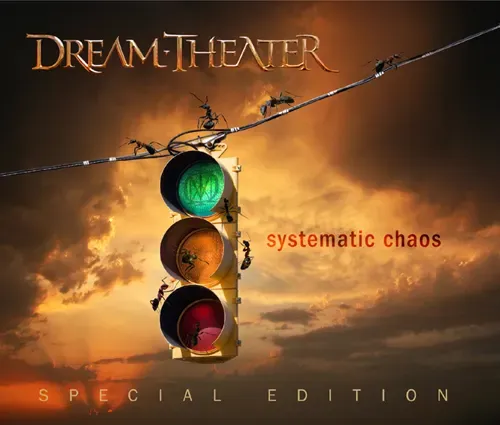
The standard CD was accompanied by a special edition containing the album and a DVD. The documentary Chaos in Progress: The Making of Systematic Chaos, directed by Portnoy, gave fans a roughly 90-minute look into the sessions. The DVD also contained a 5.1 surround mix of the complete record. The existence of a surround version was a particular selling point for an album with this many layered instrumental passages. The film is also the source for the album’s working titles, including “The Pumpkin King”, “Jet Lag”, “Korma Chameleon”, “N.A.D.S.”, “Fisheye”, “Carpet Babies” and “Schindler’s Lisp”. It’s difficult to imagine how solemn progressive-metal mythology might have been if every band had been legally required to retain its rehearsal titles.1922
At last, a record company that promoted the record
The difference Roadrunner made was apparent before the album even arrived. “Constant Motion” was distributed as a free download, the band recorded a proper music video, and the promotional machinery was more substantial than it had been for several releases. There were numerous interviews and an extensive international campaign. Portnoy and Petrucci both welcomed the attention, although the novelty was almost comical for musicians who had become accustomed to conducting so much of their own promotion. All of a sudden, the people at the label appeared to be doing the work normally expected of people at a record label.2522
The release dates need a small explanation. The original DT World database lists May 23, 2007, and a MusicBrainz release entry also records that date for Argentina. The widely cited European date is June 4, while MusicBrainz identifies an earlier European edition on June 1. The album was released in the United States on June 5 and in Japan on June 6. The band’s current official discography gives June 4 as its principal date. Rather than erase the original catalog date or pretend all territories received it on the same day, the frontmatter records the regional information separately.11827
The album debuted at number 19 in the United States, the band’s best Billboard 200 showing up to that point. It also performed well in several European markets. The chart position didn’t mean Dream Theater had become a mainstream singles act, nor did the positive reviews suddenly settle every argument in the fan base. Some listeners welcomed the heavier sound and the theatrical epics; others disliked the increasingly aggressive vocals, the obvious contemporary influences or the sense that the album contained several quite different versions of Dream Theater under one cover. The reviews were generally favourable, but it remained a record likely to divide people according to which side of the band they loved most.2526
In retrospect, the supposed conflict between being progressive and sounding contemporary was always a slightly artificial one. Dream Theater’s early records had combined influences from eighties metal with seventies progressive rock. By 2007, a band could be influenced by Metallica, Opeth, Muse and Pink Floyd without having to surrender the right to play in an odd time signature. The ingredients were changing because the musicians were still listening to new music. The important question was whether they could turn those influences into something recognizably their own. Systematic Chaos answers that question much more convincingly in some songs than in others, but it certainly wasn’t a group standing still.21416
A tour called Chaos in Motion
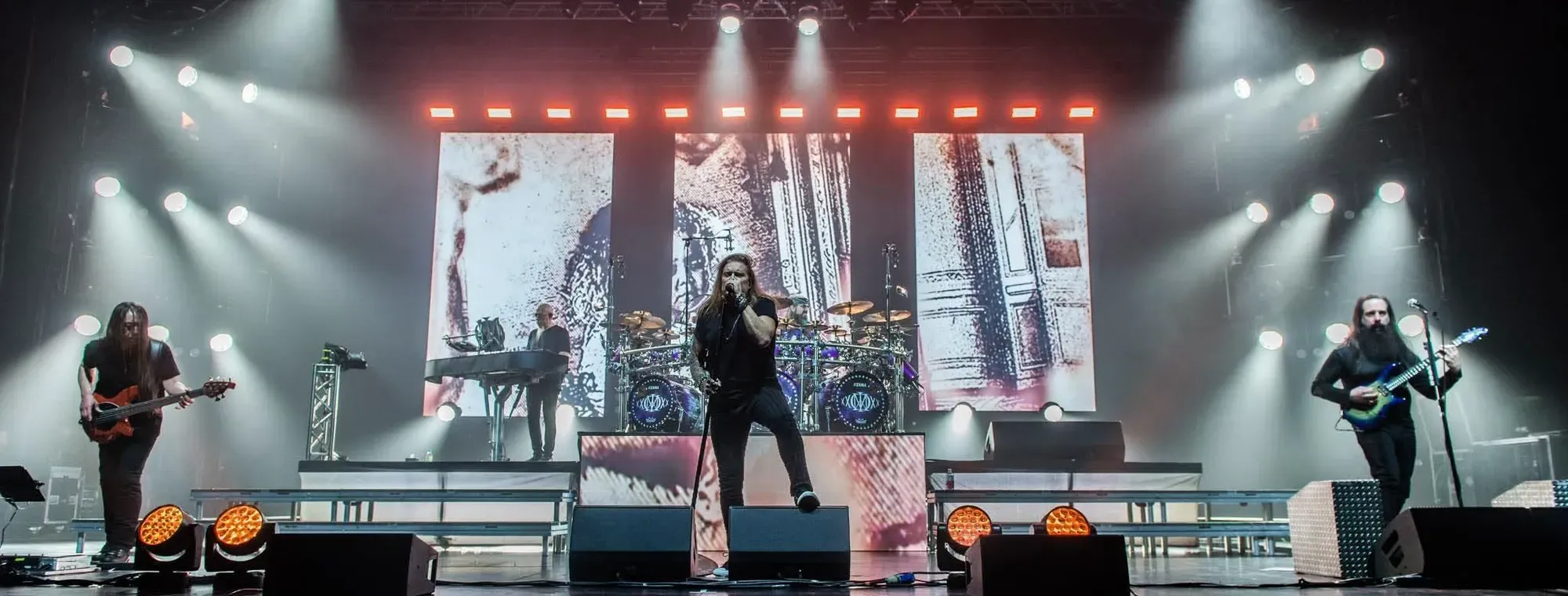
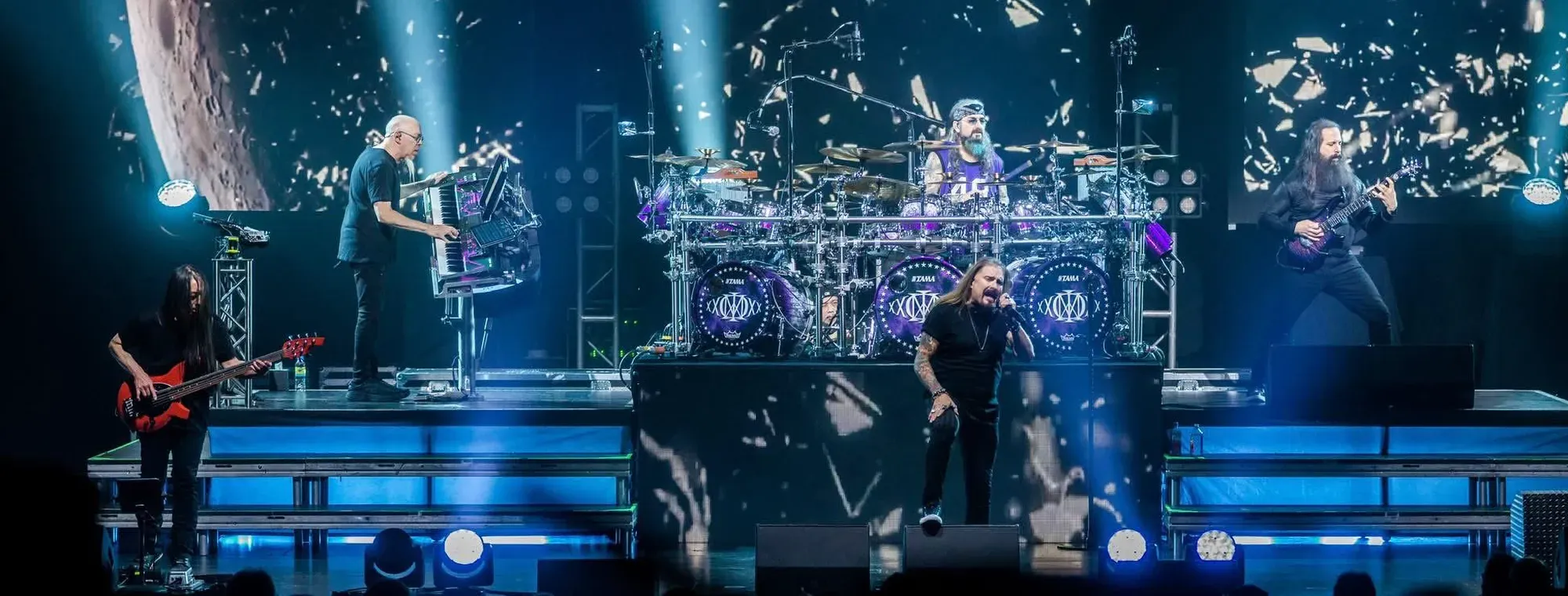
The subsequent world tour ran from June 2007 into June 2008, with the band playing 115 shows across 35 countries. There were major festivals, headlining concerts, the first Progressive Nation package and a substantial number of appearances in countries where the band had spent years building an audience. The touring lineup was unchanged, but the presentation had evolved, with new stage imagery and a mixture of old favourites and material from the album. “In the Presence of Enemies” was frequently presented as a complete live composition, undoing the split that had been so useful on CD.1528
The tour was eventually documented on Chaos in Motion 2007–2008, released in September 2008. Instead of filming a single concert in the style of Live at Budokan or Score, Portnoy assembled material from several shows and countries. The DVD also featured behind-the-scenes material, videos and additional footage. It felt appropriate for a period in which the band’s international following was particularly visible. The label had helped draw listeners to the record. The band’s strongest asset was still its ability to keep an audience returning for two hours of complicated music onstage.28
For a group that had spent much of the previous decade fighting to control its own career, Systematic Chaos represented an important change. They were still writing music on their own terms, but now they had an enthusiastic label trying to sell it. The first album of Dream Theater’s second twenty years wasn’t a reinvention so much as a demonstration of how many different directions the band could take without changing its central identity. The music can be enjoyably excessive, very strange or simply very heavy. Those extremes were central to what the band wanted to make, whether they work for every listener or not.235
References
Footnotes
-
Dream Theater, Systematic Chaos: official album discography. Confirms the album’s position in the catalogue, June 4 release listing, Roadrunner debut and September 2006 to February 2007 sessions. ↩ ↩2 ↩3 ↩4 ↩5 ↩6
-
Rich Wilson, Lifting Shadows: The Authorized Biography of Dream Theater, pp. 275–294, particularly the chapters covering the recording of Systematic Chaos, the Roadrunner deal, individual tracks, press reaction and the 2007 tour. Cited from the research copy supplied for this project. ↩ ↩2 ↩3 ↩4 ↩5 ↩6 ↩7 ↩8 ↩9 ↩10 ↩11 ↩12 ↩13 ↩14 ↩15 ↩16 ↩17 ↩18 ↩19 ↩20 ↩21 ↩22 ↩23 ↩24 ↩25 ↩26 ↩27 ↩28 ↩29 ↩30 ↩31 ↩32 ↩33 ↩34 ↩35 ↩36 ↩37 ↩38 ↩39 ↩40 ↩41 ↩42 ↩43 ↩44
-
Christa Titus, “Dream Theater: Mike Portnoy”, Blistering (2007). The absence of an overarching album concept, the Roadrunner agreement and “Repentance”. ↩ ↩2 ↩3 ↩4 ↩5 ↩6 ↩7 ↩8 ↩9 ↩10 ↩11
-
Dream Theater/Roadrunner Records, “When Dream Theater and Roadrunner Records Unite!” (February 2007 press release). ↩ ↩2 ↩3
-
Christa Titus, “Dream Theater: John Petrucci”, Blistering (2007). The former label, video promotion and the return to fantasy writing. ↩ ↩2 ↩3 ↩4 ↩5 ↩6 ↩7 ↩8 ↩9 ↩10
-
Phil Ashcroft, “Organized Chaos”, interview with James LaBrie, Fireworks magazine, issue 28 (2007). The record deal, financing, lyrics and fan vocal session. ↩ ↩2 ↩3 ↩4 ↩5 ↩6 ↩7
-
Morley Seaver, “Dream Theater: Mike Portnoy Explains Systematic Chaos”, Caustic Truths (April 2007). Roadrunner’s appeal and the band’s methods. ↩ ↩2
-
Dream Theater, Systematic Chaos: official album background. The approach to writing at Avatar, the deliberate lack of a predetermined concept and the required heavy sound. ↩ ↩2 ↩3
-
“Where the Metal Meets the Road: After 22 years together”, Berklee Today, Summer 2007. Interview with Portnoy, Petrucci and Myung about composition and the album’s musical character. ↩
-
Morley Seaver, “Dream Theater: Mike Portnoy Explains Systematic Chaos”, Caustic Truths (2007). The 25-minute original composition, the subsequent split and the seven-song description. ↩ ↩2 ↩3 ↩4 ↩5 ↩6 ↩7 ↩8 ↩9 ↩10
-
“Dream Theater”, EQ magazine (2007): Mike Portnoy, Paul Northfield and Eric Disrude interview. Primary technical source for microphones, consoles, recording methods, drum sound and mixing. ↩ ↩2 ↩3 ↩4 ↩5
-
“Recent Sessions at Avatar Studios”, Mix, April 18, 2007. Confirms the studios used, Northfield’s and Lupo’s involvement, and the January 26 fan session. ↩ ↩2 ↩3 ↩4
-
Eric Sands, “Dream Theater’s Mike Portnoy: Carpe Diem”, MusicPlayers, June 2007. Drum kits, studio documentary, the new label and the return of music videos. ↩
-
“Dream Theater: Interview with Jordan Rudess about Systematic Chaos”, Burn Your Ears, October 2007. Discussion of the record, song arrangements, and why the title epic was split. The archive translation is not a verbatim English original. ↩ ↩2 ↩3 ↩4 ↩5 ↩6
-
“In the Presence of Dream Theater, Part Two: John Petrucci”, New Voice fanzine, November 2007. Petrucci on fantasy lyrics, religious imagery, the album’s live presentation, the Roadrunner tour and “Forsaken” video. ↩ ↩2 ↩3 ↩4 ↩5 ↩6 ↩7
-
Steffi Mahsmann, interview with Mike Portnoy and James LaBrie, Terror Verlag (2007). Album sound, vocal character, lyrics and the original conversation behind the title. ↩ ↩2 ↩3 ↩4 ↩5 ↩6 ↩7 ↩8 ↩9 ↩10
-
Steffi Mahsmann, “Dream Theater (Mike Portnoy/James LaBrie)”, Terror Verlag (2007). Portnoy’s direct account of the naming of Systematic Chaos during mixing. ↩
-
DT World, Systematic Chaos: discography and original article. Original catalog metadata, personnel, track lengths, working titles, artwork and song narratives. ↩ ↩2 ↩3 ↩4 ↩5 ↩6 ↩7 ↩8
-
Chaos in Progress: The Making of Systematic Chaos (2007), the making-of documentary included with the special-edition DVD. For the release and contents, see the contemporary Roadrunner release announcement. ↩ ↩2 ↩3
-
Dream Theater, Systematic Chaos album credits and track divisions, MusicBrainz. Release-specific track structure, credited performers and recording details. ↩ ↩2 ↩3 ↩4 ↩5
-
“The Making of Dream Theater’s ‘Forsaken’ Video”, Blabbermouth, January 29, 2008. Gonzo, Yasufumi Soejima, the MTV2 premiere and the Turgenev connection to the video. ↩
-
Contemporary Systematic Chaos release announcement, April 17, 2007. Confirms special-edition documentary, surround audio and video plans. ↩ ↩2 ↩3
-
Steffi Mahsmann, interview with Portnoy and LaBrie, Terror Verlag (2007). LaBrie explains the challenge of finding the restrained voice for “Repentance”. ↩
-
Dream Theater, Systematic Chaos personnel and recording credits, Encyclopaedia Metallum. Spoken-word performers on “Repentance”, recording location and mastering credit. ↩ ↩2
-
Mike Portnoy, various comments and January 2007 studio invitation, archived by Through My Words. Contemporary announcement of fan chants and venue details. ↩ ↩2
-
DT World, 2007 Systematic Chaos materials and artwork credits; and Wilson, Lifting Shadows, pp. 289–294, for reviews, promotion and chart results. ↩ ↩2
-
MusicBrainz, Systematic Chaos release group. Regional release records, including Argentina, Europe, the UK, the US and Japan. ↩
-
Dream Theater, Chaos in Motion official discography. Tour dates, 115-show scope, countries visited and documentation of the tour. ↩ ↩2