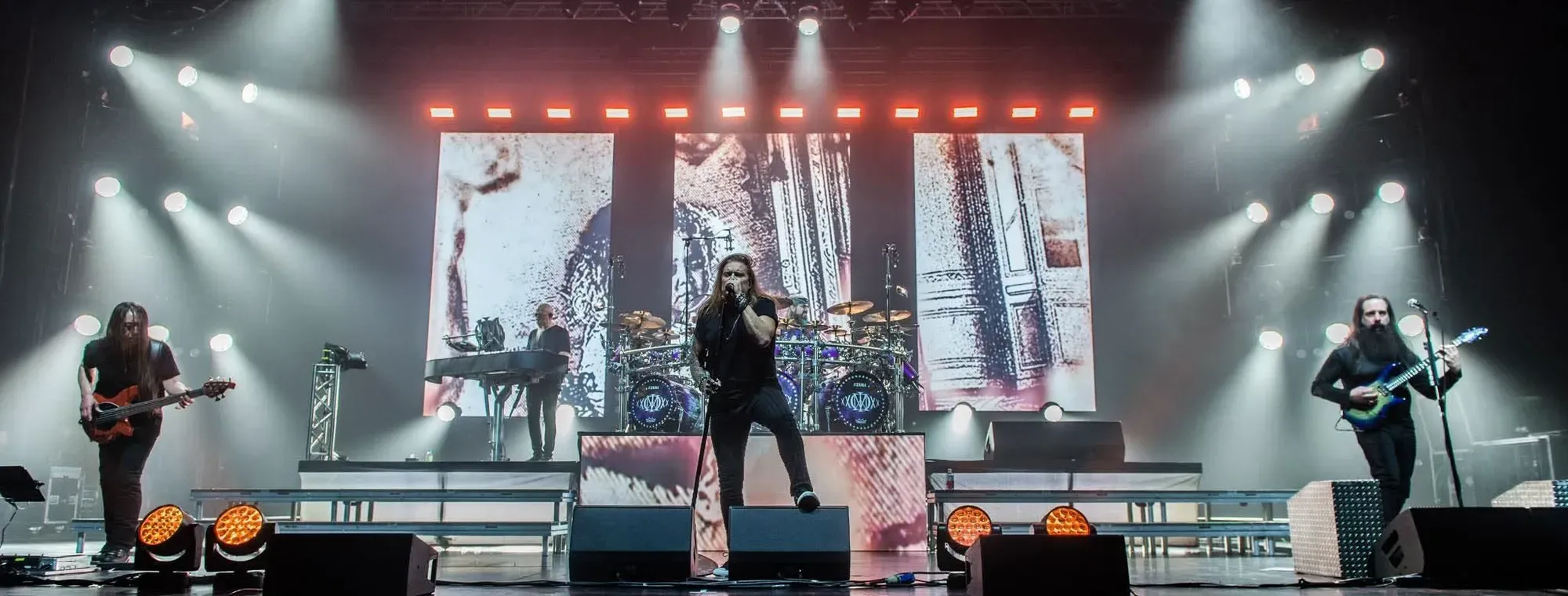

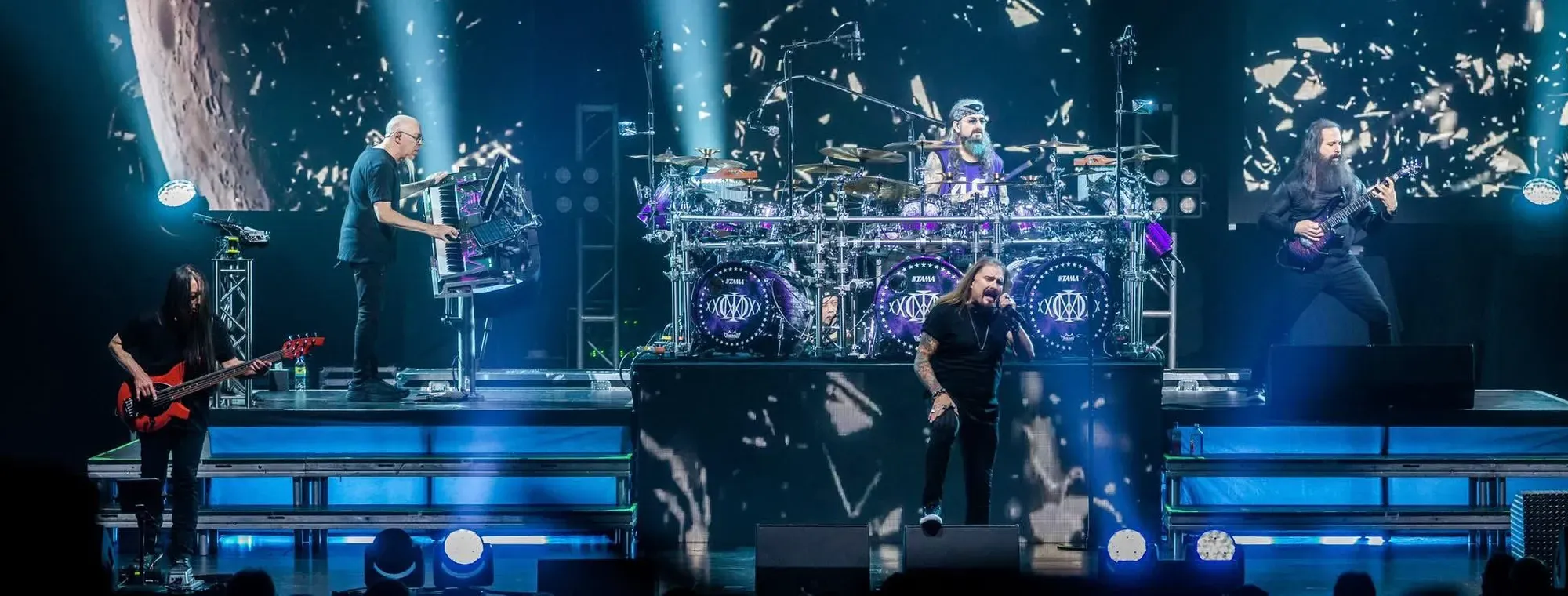
Gavin Harrison
Gavin Harrison can make a rhythm difficult to count without making the song difficult to follow. His work with Porcupine Tree, King Crimson and The Pineapple Thief has given that ability several very different settings, from a single drum kit inside a rock band to arrangements shared between three drummers. Dream Theater listeners also know him through OSI, where he followed Mike Portnoy on Blood and Fire Make Thunder. The players changed, but the recordings still required somebody who could make precise decisions about what the music needed.12
Early life
Jazz in the house
Born in Harrow, Middlesex, on May 28, 1963, Harrison grew up around his father’s jazz records. Bobby Harrison was a professional trumpet player, and music was part of family life well before Gavin had a professional career to consider. Steve Gadd and Jeff Porcaro became important reference points for the way a drummer could shape a song.34
The rhythmic ideas associated with his later work weren’t developed in isolation from groove. In his Modern Drummer interview published in 2006, he discussed the musical background behind his playing, with jazz and a close interest in how notes sit within the beat informing the more elaborate concepts. The pulse still had to make sense to the listener.4
He began working professionally in 1979, still in his teens. Renaissance took him to North America in 1983–84, and a 1986 Iggy Pop tour provided a very different working environment. A long session career was already underway before the progressive rock bands for which he became best known.5
Learning different jobs
Harrison worked across pop, soul, rock and instrumental music, including Lisa Stansfield, Level 42, Paul Young, Claudio Baglioni and Incognito. His playing on Incognito’s Inside Life belongs to the early 1990s, including the period of the group’s success with “Always There.” There was no single progressive rock apprenticeship followed by a sudden change of direction.56
The common requirement was learning how to make somebody else’s music work. A drummer can have a very recognisable sound while changing the amount of space occupied by the part. That distinction becomes particularly useful when comparing Harrison’s later OSI recordings with the much larger role he took in King Crimson.17
His 1997 solo album, Sanity & Gravity, also makes it clear that composition was part of his interest. With contributors including Mick Karn, Richard Barbieri, Jakko Jakszyk and Dave Stewart, he approached the drums as an expressive and melodic instrument within songs. The record wasn’t organised around demonstrating how many things he could play in succession.8
Porcupine Tree
Joining in 2002
Harrison joined Porcupine Tree in 2002, replacing Chris Maitland as the band made In Absentia. Steven Wilson’s increasingly heavy guitar writing gave him another setting for the combination of power, detail and rhythmic displacement he had been developing. His relationship with bassist Colin Edwin helped keep the songs grounded while the arrangements changed above them.23
Deadwing followed in 2005, Fear of a Blank Planet in 2007 and The Incident in 2009. The records required both large dynamic changes and attention to small variations within a repeated figure. A passage could become more intense through the placement of an accent or a change in cymbal sound, without needing a completely new drum pattern.34
The concert film Arriving Somewhere… gave listeners a particularly clear view of that band relationship. Harrison’s 2006 Modern Drummer profile places the technical concepts within the live group: the details mattered because the musicians could turn and stop together. The exercise had become part of an arrangement.4
Returning with Closure/Continuation
After the long break following The Incident period, Porcupine Tree returned with Closure/Continuation in 2022. The studio group was now Wilson, Barbieri and Harrison, with Nate Navarro and Randy McStine joining the live lineup. Harrison was part of the album’s creative core, as well as its drummer.9
Closure/Continuation.Live documents the November 7, 2022 show at Amsterdam’s Ziggo Dome, combining the new material with earlier songs. The recording preserves another stage in his relationship with music he had first played twenty years before.10
The rhythmic ideas, explained
Harrison developed an educational career alongside the recordings. Rhythmic Illusions and Rhythmic Perspectives examine ways of shifting or reinterpreting a rhythm while keeping track of its underlying position. His instructional films Rhythmic Visions and Rhythmic Horizons brought those ideas into performance and demonstration.2
Rhythmic Designs, with transcriptions by Terry Branam, followed in 2010, linking written parts with Harrison’s explanations and performances. His work with 05Ric supplied particularly demanding material to examine. The point of a transcription was to understand the decisions, as well as find out where all the notes had gone.2
The same interest in communicating the instrument reached a much wider television audience on August 23, 2011, when he appeared during David Letterman’s Drum Solo Week. The solo setting put the drums entirely in front, rather than asking viewers to find them within a rock arrangement.2
OSI and the Dream Theater connections
Blood and Fire Make Thunder
Jim Matheos and Kevin Moore brought Harrison into OSI for Blood in 2009. He returned for Fire Make Thunder in 2012, co-writing the instrumental “Enemy Prayer.” His role was as a recording collaborator around the continuing Matheos and Moore partnership.111
That makes the Dream Theater connection quite specific. Portnoy played on OSI’s first two albums, and Harrison on the next two. It wasn’t a transfer between Dream Theater drum chairs. In his 2008 Heavy Music interview, preserved in Through My Words, Portnoy explained that he had stepped away from OSI and regarded Harrison as a good fit for the project.12
The music combined live performances with programming and substantial editing. Harrison’s ability to record at home let him contribute between other commitments, without a block of shared studio time. For Fire Make Thunder, the drums were recorded in London, while Matheos and Moore worked in their own studios before completing the record together.11
The collaboration continued outside OSI. Harrison plays on “When Snow Falls” and “Under the Sun” on Fates Warning’s Long Day Good Night in 2020. Ray Alder’s track commentary and the contemporary Prog feature describe how the contributions helped complete the record during its disrupted pandemic recording schedule.13
A connection through Tony Levin
King Crimson provides another direct link, through Tony Levin, the bassist and Chapman Stick player in Liquid Tension Experiment. In his 2021 Metal Express Radio interview in Through My Words, Levin explained how Crimson’s three drummers rehearsed their parts together until they were extremely tight. In-ear monitoring let him hear what he needed despite the distance across the stage. The large lineup depended on very practical preparation.14
King Crimson
Two drummers, then three
Robert Fripp invited Harrison into King Crimson in 2008, joining Pat Mastelotto, Levin and Adrian Belew for the short American tour. Fripp had already seen his playing when supporting Porcupine Tree. Harrison hadn’t grown up immersed in the Crimson catalogue, which Fripp regarded as an advantage: he could approach the pieces without years of expectations attached.7
When Crimson returned to touring in 2014, Harrison helped develop the arrangements for the three-drummer front line with Mastelotto and Bill Rieflin. Jeremy Stacey later entered the group as its personnel changed. Making that many kits work together required written and rehearsed relationships between the parts, rather than hoping everybody would leave a convenient gap.7
His role also included the solo in “21st Century Schizoid Man,” an exception within a lineup that generally avoided putting one instrumentalist permanently in front. The wider arrangements are documented on releases including Radical Action to Unseat the Hold of Monkey Mind, Live in Chicago and Music Is Our Friend. They show a different application of his rhythmic thinking from the single-drummer rock bands.7
Other writing partnerships
05Ric and the solo records
The collaboration with singer and extended-range bassist 05Ric produced Drop in 2007, Circles in 2009 and The Man Who Sold Himself in 2012. Harrison’s 2010 interview published by Hudson Music describes an exchange of rhythmic and melodic ideas, with neither a record company nor an outside producer deciding how far the pieces could go.215
Cheating the Polygraph in 2015 approached a familiar catalogue from another direction. Working with arranger and bassist Laurence Cottle, Harrison reworked eight Porcupine Tree pieces for a jazz ensemble. The arrangements changed the harmony, orchestration and rhythmic setting, rather than simply adding brass over the original rock parts.8
His later partnership with Antoine Fafard produced Chemical Reactions in 2020 and Perpetual Mutations in 2024, extending the instrumental collaboration into another combination of drums, bass and ensemble writing. Early Mercy, with guitarist Nick Johnston, followed in 2025 under the Harrison/Johnston name.1617
The Pineapple Thief
Harrison first recorded with The Pineapple Thief on Your Wilderness in 2016, joining the subsequent tour and becoming a regular member. Dissolution in 2018, Versions of the Truth in 2020 and It Leads to This in 2024 developed the relationship with singer and guitarist Bruce Soord.318
The partnership gave Harrison a growing role in the writing, with drum ideas helping determine what happened in the guitars and vocals. By Far and Wide in 2026, he and Soord were describing a close exchange of ideas, rather than a completed song being passed to a drummer at the end.19
In an October 2026 MusicRadar interview, Harrison also described Porcupine Tree as an ongoing concern, with further music being written. Finding room for several bands still required careful scheduling and time to change his concentration between them. The different musical roles remained useful precisely because they asked different things of him.20
Photograph by Davide Leonardi.21
Sources
Footnotes
-
OSI, history and original album personnel references. ↩ ↩2 ↩3
-
SONOR, official Gavin Harrison artist biography. ↩ ↩2 ↩3 ↩4 ↩5 ↩6
-
Gavin Harrison, birthdate, Porcupine Tree chronology and The Pineapple Thief recording history. ↩ ↩2 ↩3 ↩4
-
T. Bruce Wittet, Gavin Harrison interview, Modern Drummer, published December 15, 2006. ↩ ↩2 ↩3 ↩4
-
Gavin Harrison, artist clinic biography, Adams Drumworld. ↩ ↩2
-
Gavin Harrison, career biography and Inside Life credits, AllMusic. ↩
-
Sid Smith, official Gavin Harrison biography and King Crimson history, DGM Live. ↩ ↩2 ↩3 ↩4
-
Gavin Harrison’s own statements on Sanity & Gravity and Cheating the Polygraph, Kscope. ↩ ↩2
-
Closure/Continuation, official Porcupine Tree personnel and credits. ↩
-
Closure/Continuation.Live, official Porcupine Tree concert and lineup details. ↩
-
OSI, Metal Blade’s official Fire Make Thunder recording history. ↩ ↩2
-
Mike Portnoy interview, Heavy Music, 2008, Through My Words. ↩
-
Ray Alder’s original track commentary on Long Day Good Night; contemporary Prog interview, official Fates Warning archive. ↩
-
Tony Levin interview, Metal Express Radio, 2021, Through My Words. ↩
-
Roberto Baruffaldi, Gavin Harrison interview, Batteria & Percussioni, January 2010, reproduced by Hudson Music. ↩
-
Perpetual Mutations, official artist edition and account of the preceding Chemical Reactions collaboration. ↩
-
Nick Johnston’s official Harrison/Johnston interview, August 2025; Early Mercy, original release date and recording credits. ↩
-
Your Wilderness, original expanded touring edition and Harrison’s participation, Kscope. ↩
-
Gavin Harrison discusses writing Far and Wide with Bruce Soord, MusicRadar, October 13, 2026; The Pineapple Thief, official current album. ↩
-
Gavin Harrison interview on Porcupine Tree, King Crimson and scheduling, MusicRadar, October 31, 2026. ↩
-
Photo: Gavin Harrison at a drum clinic in Verona, 2011, Wikimedia Commons, by Davide Leonardi (Drumfan IT), CC BY-SA 3.0. Cropped to a square and resized; the adapted photograph retains that license. ↩

Releases
- BloodSide projects · 2009 · Drums
- Fire Make ThunderSide projects · 2012 · Drums; co-writer of Enemy Prayer
- For Nothing (Music Video)Side projects · 2012 · Drums; co-writer of Enemy Prayer