
Jim Matheos
Jim Matheos has spent much of his career finding different ways to make a guitar part serve a song. With Fates Warning, that has meant intricate heavy arrangements, extended compositions and considerably more restraint than the progressive metal label sometimes suggests. With OSI, it could mean sending a recording to Kevin Moore and hearing it return in a shape he hadn’t imagined. The acoustic solo records, Arch/Matheos, Tuesday the Sky, Kings of Mercia and North Sea Echoes give the same writer rather different surroundings. Dream Theater has been part of that wider story since the musicians were still calling themselves Majesty.12
Early life
Guitar before a career plan
Born in Westfield, Massachusetts, on November 22, 1962, Matheos grew up with an older brother who played guitar and listened to Black Sabbath and Emerson, Lake & Palmer. His father bought his first guitar, and he began playing at about nine or ten. The mixture of heavy music and progressive rock was there from the beginning.34
In his 2006 Metal Express Radio interview, he recalled leaving school at around fifteen, already determined to work in music. Looking back, he was rather less impressed by the educational logic of that decision and had spent time studying independently. His parents had offered music school as well, but he hadn’t wanted that route either.3
The guitar became his principal instrument, although he found that writing on something less familiar could be useful. Sitting at a keyboard meant stumbling into ideas he might never have tried on guitar. Limited technique could occasionally do the imagination a favour.3
Fates Warning
Building the writing voice
Fates Warning formed in Connecticut in the early 1980s, with Matheos, guitarist Victor Arduini, singer John Arch, bassist Joe DiBiase and drummer Steve Zimmerman establishing the original recording lineup. Night on Bröcken appeared in 1984, followed by The Spectre Within in 1985 and Awaken the Guardian in 1986.45
Those records developed from a recognisable heavy metal starting point into more involved structures, with Arch’s distinctive phrasing moving across Matheos’s arrangements. The increasing complexity still had to work beneath a singer. There was a vocal line to accommodate, rather than simply another instrumental part to double.56
Ray Alder replaced Arch before No Exit in 1988. Perfect Symmetry followed in 1989, with Mark Zonder bringing another rhythmic character to the band, before Parallels in 1991 and Inside Out in 1994 gave the more concise side of Matheos’s writing considerable room.5
The shorter songs weren’t a concession he felt obliged to make. In his 2016 Noisefull interview, he explained that he enjoyed concise writing and sometimes found it harder than an extended piece, precisely because it imposed more limits. He could be interested in a two-minute song as readily as one lasting twenty minutes. A long running time didn’t automatically make the job more demanding.7
A Pleasant Shade of Gray and Disconnected
A Pleasant Shade of Gray, released in 1997, took the opposite scale: a single work divided into twelve movements, with Terry Brown producing and Moore contributing keyboards. Matheos’s contemporary Guitar World comments describe the importance of Rush and the slightly intimidating experience of first working with their producer. By this record, he had become more comfortable with Brown behind the desk.6
In Sea of Tranquility’s 2000 interview, Matheos described the work’s central situation as a person lying awake through the early hours, dealing with different aspects of life. He preferred to leave much of its meaning open. The structure could move between those thoughts without explaining each one in an accompanying set of instructions.8
Disconnected in 2000 retained that darker atmosphere while bringing more aggression into the writing and production. “Still Remains” dealt with aspects of his father’s death; “So” took a more direct look at feeling the need for change. Those explanations show a personal basis beneath the arrangements, without requiring every listener to arrive at exactly the same interpretation.8
The Dream Theater relationship
An early recommendation
Matheos was an unusually early public supporter of Dream Theater. Asked about promising new bands in Loud fanzine in 1988, he recommended Majesty, still unsigned, and predicted that the Long Island group would make an impression. The short exchange survives in Through My Words. He was following them before the release of When Dream and Day Unite.9
The shared history developed through records as well as touring. Moore contributed to Perfect Symmetry while still in Dream Theater, then returned for A Pleasant Shade of Gray and Disconnected after leaving. Ray Alder’s 2000 HardRadio interview describes the value of that contribution to Fates Warning’s sound. Moore was a guest player, with his own musical life elsewhere.10
The bands also knew each other on the road. Guitar One’s 2003 roundtable with Matheos, John Petrucci and Michael Wilton, preserved in Through My Words, took place during the Dream Theater, Queensrÿche and Fates Warning tour. Matheos described being treated as a friend on the bill, and the discussion quickly found common ground in Rush, Yes, Genesis, UFO and other influences. Shared musical interests had become working relationships.2
Working with Portnoy
Mike Portnoy’s admiration for Fates Warning made a collaboration with Matheos an obvious prospect. The first OSI sessions provided it, while John Arch’s 2003 EP, A Twist of Fate, put Matheos, Arch, Portnoy and Joey Vera together on “Relentless” and “Cheyenne.” It was a substantial return to recording for Arch, on two compositions long enough to give everybody something to do.1112
Portnoy later described his friendship with Matheos as the original attraction of OSI. His 2024 Sweden Rock account in Through My Words also makes clear how Moore’s arrival changed their planned project. Matheos was willing to let the material move away from the more conventional prog-metal band they had first envisaged.11
OSI
Allowing the recordings to change
OSI released Office of Strategic Influence in 2003, Free in 2006, Blood in 2009 and Fire Make Thunder in 2012. Portnoy played on the first two; Gavin Harrison recorded the next two. The continuing writing partnership was Matheos and Moore.1
The guitar could supply a heavy riff, an acoustic passage or a sound to develop. Moore’s editing and electronics changed the function of those recordings, while his vocals gave the music a different centre from either Fates Warning or Dream Theater. Matheos had found a setting where a guitar part didn’t have to remain recognisably guitar-shaped to be useful.13
In his 2012 MetalTalk interview, he described remote collaboration as a preference as well as a necessity. He liked time to explore an idea alone before exposing it to another musician. He also kept a running collection of fragments, allowing them to develop before deciding which project suited them. The different bands didn’t require a completely separate imagination for each one.13
Other partnerships
Arch/Matheos
The renewed work with Arch developed into Arch/Matheos, with Sympathetic Resonance in 2011 and Winter Ethereal in 2019. These were new recordings built around their current writing, rather than recreations of the first three Fates Warning albums. The band’s personnel and drum credits belong to those sessions; Portnoy’s earlier appearance on A Twist of Fate doesn’t extend to them.112
Acoustic music and Halo Effect
Matheos had already made room for a different kind of playing on First Impressions in 1993 and Away with Words in 1999. The instrumental solo records brought acoustic guitar and other textures forward, away from the demands of a metal band arrangement.1
Halo Effect in 2014 went further into processing. Matheos’s own release notes identify a 1973 Alvarez classical guitar as the source of every sound. Separately improvised tracks, sometimes made without a fixed key or tempo, were edited and layered into the pieces. The apparent electronic setting came from an acoustic instrument with old strings. No keyboard was required.14
Tuesday the Sky
Tuesday the Sky gave the instrumental and ambient writing its own name. Drift appeared in 2017, followed by The Blurred Horizon in 2021 and Indoor Enthusiast in 2025. The third record includes drummer Dennis Leeflang on three tracks, with the emphasis remaining on Matheos’s instrumental atmosphere and guitar work.115
Kings of Mercia and North Sea Echoes
Kings of Mercia brought in FM singer Steve Overland, with Vera on bass and Simon Phillips on drums. The 2022 debut and Battle Scars in 2024 put Matheos in a more direct melodic rock setting. He still had a substantial rhythm section available, but the songs called for another kind of space around the voice.116
North Sea Echoes reunited him with Alder, this time away from Fates Warning’s usual guitar arrangements. Really Good Terrible Things arrived in 2024, followed by How to Cast a Shadow in 2026. The partnership remained familiar while the sound moved towards layered guitars, electronics and more restrained singing.17
That range makes the apparent split between the heavy guitarist and the ambient musician less mysterious. Matheos has repeatedly changed the setting, the singer or the treatment of the recording while keeping his interest in how a song develops. The Dream Theater connections are part of that history, from recommending Majesty to working with Moore, Portnoy and Harrison in very different recording situations.2913
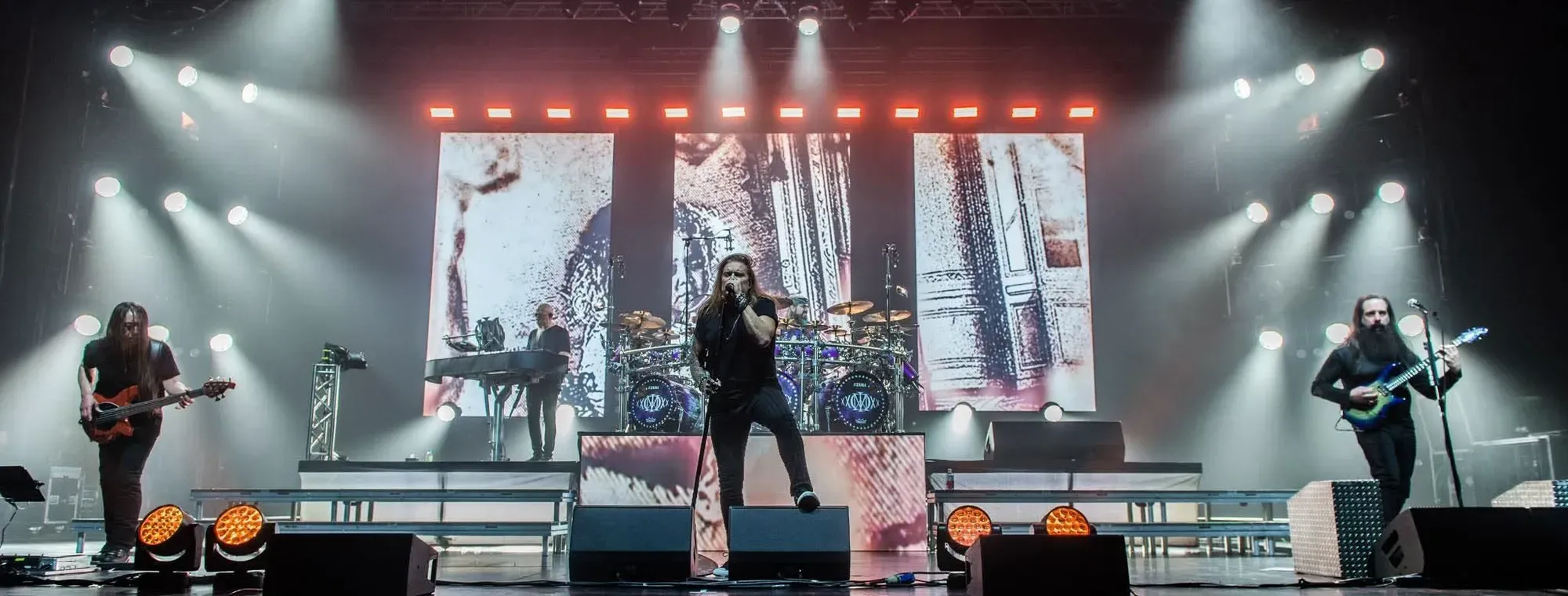
Photograph by Stefan Brending (2eight).18
Sources
Footnotes
-
Michael Mueller, Guitar One roundtable with Matheos, Petrucci and Wilton, 2003, Through My Words. ↩ ↩2 ↩3
-
Zoltan Koncsok, Jim Matheos interview, Metal Express Radio, 2006, official Fates Warning archive. ↩ ↩2 ↩3
-
Jim Matheos, biographical dates and original Fates Warning lineup references; Fates Warning historical overview. ↩ ↩2
-
Joe Lalaina, Guitar World feature on A Pleasant Shade of Gray, October 1997, official Fates Warning archive. ↩ ↩2
-
Chris Karadimitris and Nikos Katapidis, Matheos interview, Noisefull, June 15, 2016, official Fates Warning archive. ↩
-
James Bickers, Matheos interview, Sea of Tranquility 6, autumn 2000, official Fates Warning archive. ↩ ↩2
-
Martin Popoff, Ray Alder interview, HardRadio, 2000, official Fates Warning archive. ↩
-
Mike Portnoy interview, Sweden Rock, 2024, Through My Words. ↩ ↩2
-
Original A Twist of Fate credits and programme; Matheos discusses the later Arch collaboration and its separate recording history, Metal Underground, 2011. ↩ ↩2
-
Matheos interview, MetalTalk, May 18, 2012, writing methods and separate projects. ↩ ↩2 ↩3
-
Tuesday the Sky, official project history and Indoor Enthusiast announcement. ↩
-
North Sea Echoes, official project information and How to Cast a Shadow, 2026. ↩
-
Photo: Jim Matheos with Fates Warning, 2017, Wikimedia Commons, by Stefan Brending (2eight), CC BY-SA 3.0 DE. Cropped to a square and resized; the adapted photograph retains that license. ↩

Releases
- ParallelsSide projects · 1991 · Guitars
- A Pleasant Shade of GraySide projects · 1997 · Guitar, Guitar Synthesizer
- DisconnectedSide projects · 2000 · Keyboards [Additional], Sequenced By, Noises
- Office of Strategic Influence (Promotional Sampler)Side projects · 2003 · Guitars; keyboards; programming; Engineering
- Office of Strategic InfluenceSide projects · 2003 · Guitars; keyboards; programming; Engineering
- A Twist of FateSide projects · 2003 · Guitar, Keyboards
- Live in AthensSide projects · 2005 · Performer, Guitar
- FreeSide projects · 2006 · Guitars; keyboards; programming
- Free (Music Video)Side projects · 2006 · Guitars; keyboards; programming
- re:freeSide projects · 2006 · Guitars; keyboards; programming
- BloodSide projects · 2009 · Guitars; keyboards; programming; Mixing
- Fire Make ThunderSide projects · 2012 · Guitars; bass; keyboards; programming; Mixing
- For Nothing (Music Video)Side projects · 2012 · Guitars; bass; keyboards; programming; Mixing