

Originally published in Drum! magazine 99 · July 2004
Mike Portnoy: Brand New Strategies
by David Weiss
InterviewMike Portnoy16 min read
Why dedicate any more ink to Mike Portnoy? The rhythm master for Dream Theater has been acknowledged time and again as one of Western music’s super drummers, balancing huge amounts of speed, agility, strength, and innovation to power his band for 19 years running. Maybe we should make room for someone else in these pages.
Or maybe we shouldn’t, because “Iron Mike” Portnoy is at an interesting point in his life. Making a living as a musician is a given, and being famous for what he does is no longer an objective, it’s simply a benefit. Furthermore, he really doesn’t have to prove himself anymore; not to other drummers who must acknowledge the depth of his skill, no matter how they feel about Dream Theater’s insanely intense prog approach; and not to himself, either. Portnoy kicks ass by design.
“My playing has never been compromised,” Portnoy says from his home in rural Pennsylvania, decompressing in between legs of the world tour supporting the album Train Of Thought. “I’ve always been able to go to the fullest, take my playing to over-the-top levels, and make it as complex or as simple as I like. I always do it for the best purposes of the song. As far as my drumming on Train Of Thought goes, my approach was the same that it’s always been, which was to try and take my playing to its fullest potential. Being in a band like Dream Theater gives me that opportunity every time.”
For a large part of their careers, Dream Theater was dropped into the prog-rock category, a genre that can translate into positives like extra levels of virtuosity, attention to detail, and a musical kind of science fiction, or negatives like overt self-indulgence and cartoonish clichés, depending on your tastes. But Train Of Thought isn’t just prog-rock, it’s prog-metal, and it’s an intriguing beast. “Every time we make a Dream Theater record, we try to do new things, go new places,” says Portnoy. “But most important to us is to still maintain our sound and style that we’ve established throughout all these years. So this time around we wanted to take our sound and style into a heavier direction, and make a very dark, intense heavy album. We’ve always had heavy songs throughout our whole career, and this was an attempt to make a concise, heavy album from start to finish.”
Portnoy had a powerful motivation to go in this direction at this particular time. “I’ve always been slightly turned off that most of my favorite bands kind of lost their intensity as they got further into their career – mainly progressive bands. The Rushes, the Yeses, and Genesis, they all kind of softened up. Even the heavier bands, the Iron Maidens and the Metallicas, lost their intensity as they went later. Here we are, 19 years into our career, we’re all in our forties or entering them, and it was a conscious decision not to sound like our age. We wanted to make an album that was as vital, if not more so, than anything we ever made, and make something that sounded incredibly heavy and intense, as if we were as hungry as in our twenties.
“I just had to put my metal hat on, which meant a lot of double bass. But, you know, musically within this preconceived direction, we still were the Dream Theater we’ve always been. There’s odd-time signatures throughout everything, the songs are long in length and structure. From the get-go, we wanted to go new places, but always maintain our existing sound and style. I’ve never been good at putting labels on things. All I know is we’re usually just too progressive to be called just a metal band, and too metal to be called just a progressive rock band. We’ve never been able to fit just into progressive rock or metal genres, so we kind of sit in the middle, utilizing the best or worst of both worlds. Through years and years of being labeled, ‘prog-metal’ seems to be the most accurate, but we surely didn’t invent it.”
While his band may have turned another page in their evolution, Portnoy actually doesn’t feel like making the same declaration about himself “To be blatantly honest, I don’t see that much change,” he reflects on his drumming style. “I think I developed a style years ago, and I basically stuck to that and honed in on tightening it the best I can. Fortunately, I’m involved in many other projects as well – just last year I released six CDs – and in some of my other projects I get to try different things. But with Dream Theater I have a definite style, which I’m expected to deliver. Have I developed? I don’t know. I always tried the best I can.
“But you know what? I respect and admire people that do evolve, like Virgil Donati or Neil Peart when he was working with Freddy Gruber. These guys are pushing the instrument to all new levels. I’ve said this before, but at 37 years old, with a wife and two children, I just don’t have the time or desire to play drums for six hours in my basement. I spend my whole life out there, whether on tour, in the studio, or doing clinics or videos. That’s my livelihood, and at this stage of my life, when I’m out on tour for eight months out of the year, when I finally do get home, my priority is to spend time with my kids. I wish I had the time to sit and further hone my chops. I know my weaknesses and I know still what can be developed, and frankly, I’ve never said I’m the greatest drummer in the world! I’m flattered when I win all these awards, but to be honest, I’ve never asked for it. If anything, it puts such high expectations on me, that it’s a tremendous pressure to try and live up to.
“To take this one step further, when making a record, the drums are just one minor aspect of my focus. I’m the band’s leader, the band’s co-producer, I’m a big part of the writing team – the music, the melodies, and the lyrics. When we’re making a record, the drums just happen to be one of 20 things that I’m concentrating on, and I put just as much time and effort into the other things as I do the drumming.”
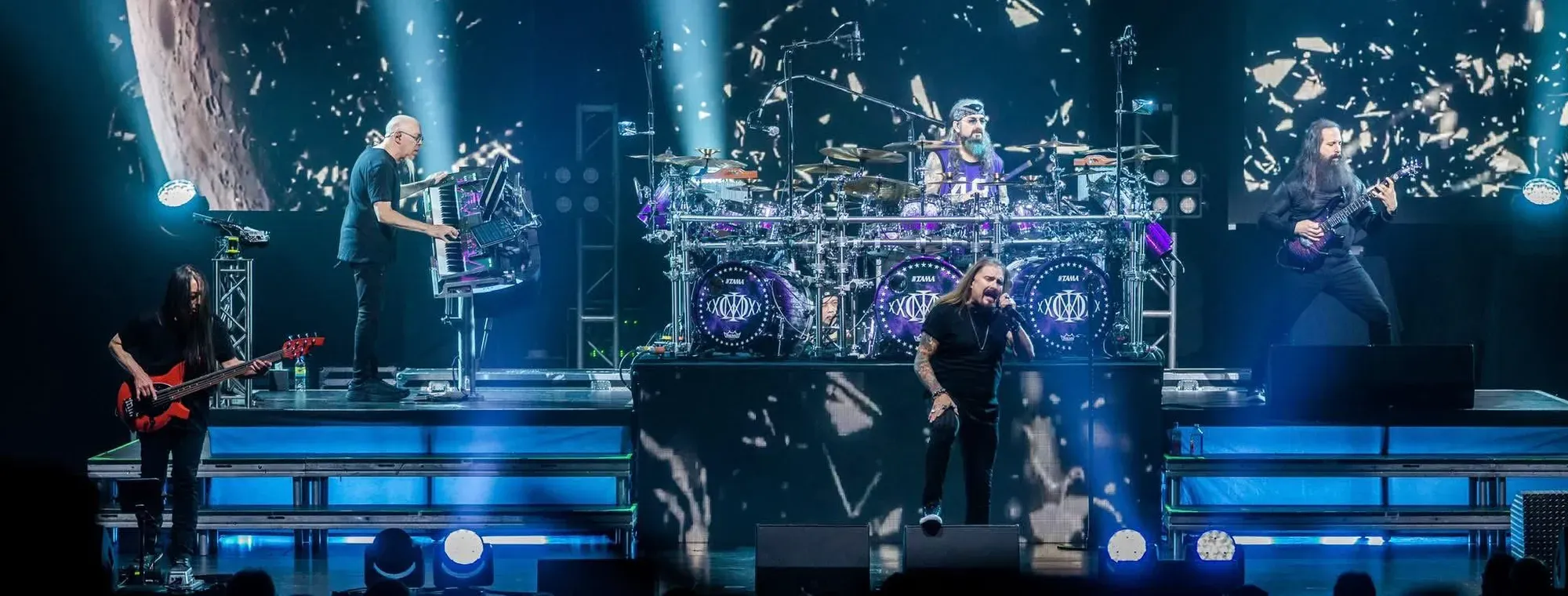
While studio wizardry is a Dream Theater hallmark, it’s a mere stepping-stone to what the group accomplishes live. Catching a recent show that DT put on in NYC’s Theater at Madison Square Garden revealed a stage show that is truly state-of-the-art; a tasteful balance of lighting and video production that demonstrates, not overshadows, the full power of Dream Theater’s battle station. The four hour mini-marathon saw Portnoy and his bandmates – vocalist James LaBrie, bassist John Myung, guitarist John Petrucci, and keyboardist Jordan Rudess – deliver a blisteringly satisfying set to a large theater full of fans of all ages, providing a hugely enveloping experience.
No matter how diehard the fans are, Portnoy starts out by making sure that they see a Dream Theater show unlike any they’ve ever seen. “We’ve been doing ‘An Evening With Dream Theater’, doing two sets with an intermission, which covers a lot of music. Some nights will be short of three hours, other nights will be almost up to four hours. One of the most important elements of our live show is that the set list changes completely from night to night. That’s something I pour a lot of time and energy into. The last feature that DRUM! did with me followed me on tour, and it really covered the fact that I look at the set list previously from each city, and make sure not to repeat it. If you see us from tour to tour, you’re going to get very little material repeated. The same goes night-to-night if you’re within driving distance. From New York to Philly, there were 35 songs played show to show, and 28 were completely different – the others were from the new album. A big part of our live show is the musical variety, another aspect is throwing in the unexpected: an obscure cover song or one of our B-sides. I try to model the set list after a lot of bands I admire, like Phish or Pearl Jam, that do different set lists each night. I really respect that as a fan, and that’s a big part of Dream Theater’s presentation.”
High-tech without being overly glitzy, Dream Theater’s set features niceties such as small video cameras affixed to the end of Rudess’ keyboard or right over Portnoy’s hi-hat, displaying on three large screens give their musically adept audience an up-close look at the band’s technique. “The primary focus is about the music with us,” Portnoy says of the onstage concept. “That’s the way it always has been and will be. That’s what our fans are most interested in – the musicianship and how that comes across. That’s always the priority, and everything else is icing on the cake.
“This last tour we were really able to present a video show on the level that we’ve wanted. I think the best part of it is the ability to really show us playing: A big percentage of our audience is musicians and they’re coming out to see us play. So the screen gives the ability to the person in the 45th row to see a guitar solo or keyboard solo like they’re sitting on the stage. The same goes for my drums, with cameras on the right side and left side of the kit, so we can incorporate playing aspects, and also incorporate computer graphics, movies, and conceptual footage. The best thing is we have three screens, each of which is completely independent, so we can have three images going simultaneously. We turned what’s normally a five-ring circus into an eight-ring circus! It’s run by a combination of two people. Our lighting director Ben Richards, who’s been on a couple of tours with us, has worked with Yes and Metallica on previous tours, and he’s really great with this kind of music. We sit in the middle of those two bands. Another big part of the video presentations is Bert Baldwin, who was also with us on the 2000 tour triggering video images.”
Onstage, Portnoy is a whirlwind of activity and endurance that would make the cast of Survivor proud, playing his tail off around his double drum set without a falloff in energy, even as the set approaches the 240-minute mark, with a 20-minute intermission in the middle. So how does he manage to pull it off? “That’s the same question I’ve been asking myself,” Portnoy admits. “If you were to ask me to run around the block, I couldn’t do it without passing out, but you put me in front of a bunch of people onstage, wind me up like the Energizer Bunny and I can go for hours. The energy comes from the audience. There’s times when I’m sitting in the dressing room and I can’t even get my ass out of the seat, and when I hit the stage I come alive. It’s based purely upon the adrenaline of the band – and maybe a couple of Red Bulls thrown in for good measure.
“I think the intermission is important not only for us to catch our breaths, but also the audience. It’s demanding, not just for us to play, but of the fans to sit through. That’s why we needed to give people a chance to take a break. That’s also why I became a drummer – so I could sit through the whole show!”
Prog-rock bands have been tagged with the stereotype that they’re overly self-indulgent and self-involved, and maybe some of them are, but nobody who watches Dream Theater at work can reasonably level that accusation against them. Petrucci constantly scans the audience to match their rhythm, while Rudess spins his keyboard 360 degrees to see anyone and everyone, and Portnoy constantly waves drumstick-extended arms at seemingly each individual person in the audience. In the heat of the performance, such efforts go a long way towards bringing the house together and raising the intensity of the show.
“The interaction between us and the audience is absolutely mandatory,” Portnoy explains. “There are other drummers who shall remain nameless that I’ve seen live and they won’t even look up. To me, the live show is not about the artist sitting there perfecting their art: That’s a selfish act. The live performance is all about the interaction. These people are paying money to see you live, and you want to be able to connect with them.
“I leave the perfectionist in me in the studio. When we’re making a record, I’m very concentrated and very much a perfectionist when it comes to the drums. Live, that’s on the back burner and the most important priority is connecting with the audience. I’ll spend the whole show standing, throwing sticks, and nailing my parts is not even part of my concentration. Luckily, I’m able to nail my parts now, of course, out of habit. The playing becomes second nature to me when I’m touring, and the priority is the people who’ve come to be entertained. The Rushes and Yeses of music have the stigma of being very sterile and very stiff live, and I wanted to make sure I always had that Lars Ulrich/Keith Moon mentality where I’m able to play accurately and technically, but also play with the balls and the adrenaline of an entertainer.”
While Portnoy has a general interaction going on with the thousands of people in the audience, he has a much more detailed thing going on with the four people he’s sharing the stage with, starting with his guitarist. “One thousand percent, I’m most closely in contact with John Petrucci,” Portnoy states. “He and I are the driving force. I feel a very close connection with him musically. I think it’s a similar connection to James Hetfield and Lars Ulrich, both creatively and onstage. A big part of the mix in my ears is guitar. John’s so highly regarded as a lead player, but I think his rhythm playing is often overlooked. That’s one of the reasons I love playing and writing with him, because he is an incredible rhythm player, he can lock into all the rhythms and the odd-time signatures, and I feel really tight with him. I feel like we’re the rhythm section, instead of the traditional rhythm section.
“I feel closest to him musically and personally, but it’s important to try and interact with everybody live. It’s hard, because everyone has their different personalities in the band. Some guys like to stay in their own world, like John Myung. Myung is the mystery man, he’s the anchor, he’s the classic Bill Wyman/John Entwistle shadow figure. Not many people can appreciate the level of his importance, because he’s so understated.”
Although the band prides itself on it’s super-tight status, they’re also sure to execute a plan for throwing themselves off balance, with Portnoy and Rudess engaged in a nightly musical duel that ensures something totally fresh happens. “We try to have at least one section per show that’s completely spontaneous and improvised. It works 95 percent of the time! I think Jordan is probably the best improviser in the band, and a big element of his improvisational skills, along with mine and John Petrucci’s, were utilized on the two Liquid Tension Experiment albums we did. Just on this tour we decided to start finally incorporating a lot of that spontaneity in the live shows, flying on the edge of our seats. We try and confuse each other. I love it – it’s my favorite part of every night.”
If you see Portnoy pull off one of his famous solos these days, however, it’s only because you’ve gotten extremely lucky. ‘‘I’ve gotten away from solos the past two tours,” he confirms. “I felt they had become too clichéd, redundant, and also expected, and I had never wanted the Dream Theater show to deliver the expected. Since then it’s become expected for there not to be a drum solo, so I started throwing them back in. The way I do a solo, I’m basically improvising and jamming.”
At Dream Theater’s New York City show, Portnoy got some help for the drum solo he performed there, pulling one lucky fan out of the first few rows, and then locating another one in the very back of the very large room to join him on his kit. “The audience participation has become a big part – and the most enjoyable part – for me. Drum solos are just like masturbating: It’s fun, you can get yourself off, but to me it’s not my favorite part of the live show. I would rather do things that interact with the audience.
I’ll generally watch the people in the front row and see who’s air drumming, so I get a good gauge of who’s a drummer. But in Madison Square Garden, I thought it would be a cool thing to pull somebody off the very, very back row. I was able to look back there and see people in the back waving and cheering as if they were in the front. They’re in the worst seat in the house and having a great time. I don’t care if the person’s a drummer or not, because it’s more about the personality than the technique. When I’m up there banging on the tom on the front of the stage, there’s nothing technically impressive about it, it’s the energy and the entertainment value.”
Whether he’s using it in the studio or onstage, Portnoy’s massive three-kick kit, The Siamese Monster, inspires jealousy, awe, and/or disgust, depending on what school you come from (see the whole blessed thing on page 64). If you want to know if he really needs a setup like that, you’d best get in line. “I get asked that every day,” he shrugs. “I joke that I have it A) because I don’t pay for it, and B) because I don’t have to set it up! But seriously, one of the benefits of having a great endorsement deal is building the drum set of your dreams, anything your imagination can conjure up. If I were playing in AC/DC it wouldn’t make sense, but with Dream Theater and the ‘more is more’ mentality, a kit like that makes sense. But everything I’ve done outside of Dream Theater – Transatlantic, OSI, my Zeppelin and Beatles tributes, the G3 tour – it’s always been on a very small kit.
“The three bass drums give me a second kit. Realistically, my Siamese Monster is two kits, so when people come and see that kit, they’re initially blown away or completely skeptical. They say, ‘How the hell is that guy going to play that? He only has two feet.’ I don’t play the whole kit at once! I jump back and forth. There’s actually two stools behind the kit. It gives me the ability to mix and match the sizes for the show, or an album if we’re in the studio.”
For those who are fans of Dream Theater, they’re aware that this band is still making big strides in its sound, even with nearly two decades under their belts. Those who love to hate prog-rockers would be well advised to experience Dream Theater live before making a final judgment, although Mike Portnoy is fully aware that he and his band will always be a target for the firmly opinionated. “I know Dream Theater and bands like us are not for all tastes, and prog-rock has had a negative stereotype,” he says. “I know there a lot of other readers or drummers in DRUM! magazine who can’t stand us, or hate everything I stand for. All I can say is that I think that’s sad. One of the most important things about being a musician is keeping an open mind. When I grew up, I wasn’t just listening to King Crimson. I was listening to the Ramones, Beatles, Elton John, Kiss. It wasn’t only bands playing in 11/16th times. The same goes for me now. I don’t just sit in my house and listen to old Yes albums. I love bands like Weezer, Coldplay, Radiohead, A Perfect Circle – I could give you a list of a million bands that are not necessarily progressive or technical that I love. I have a major appreciation for all kinds of music.
“When bands like Dream Theater get taken apart because we’re all about technique, I really disagree. Dream Theater is all about songwriting, and when you listen to our albums there are really melodic passages, and the priority for us has always been the songs. It’s just our songs take longer to express! You have country, rock, classical, jazz, progressive, punk rock, but I think it was Frank Zappa who said that really there’s only two kinds of music: good and bad. Every one of those genres will have good and bad. I don’t pay attention to the genres. I pay attention to the quality, regardless of the genres.”