

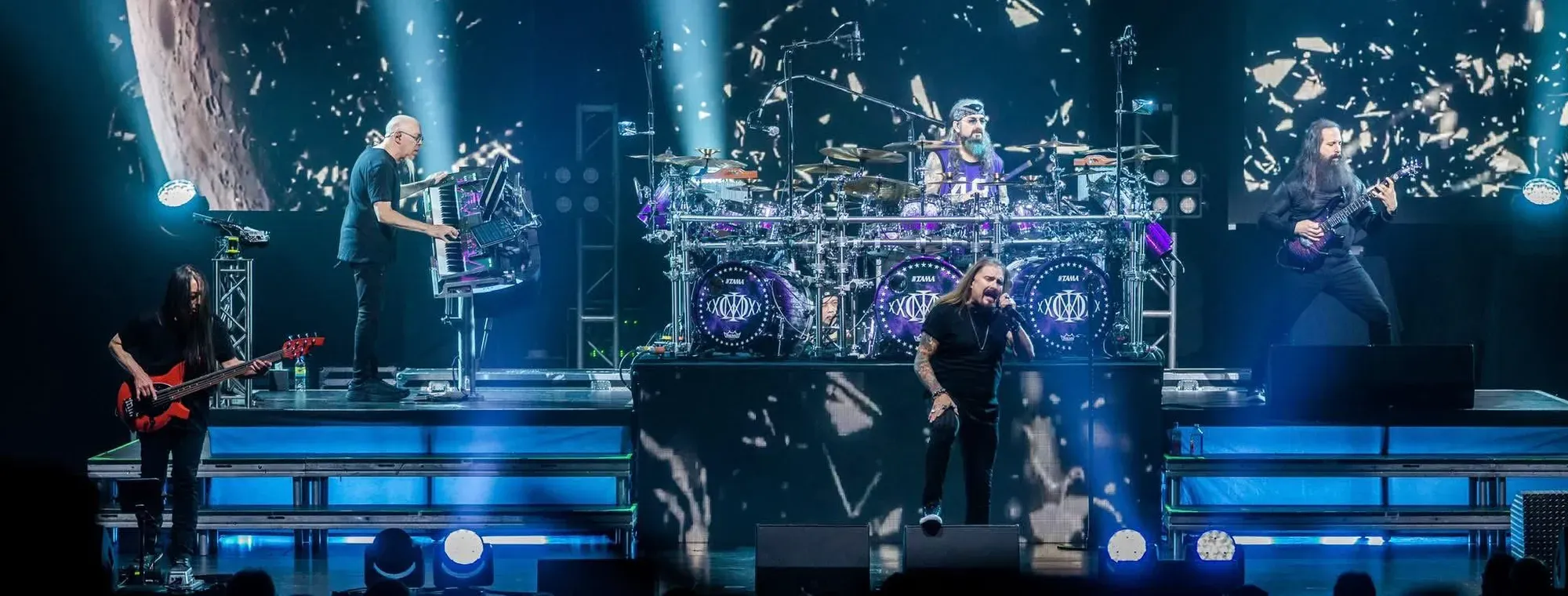
Originally published in Drumhead magazine · May 2011
Mike Mangini: A Dream Come True
InterviewMike Mangini45 min read
Interview: Jonathan Mover
The Dream Begins
Jonathan Mover: How did you first hear about the gig and what led to the audition?
Mike Mangini: Like most everyone, I saw that Mike Portnoy quit from his online announcement. About two weeks earlier, my nephew Luke emailed me, “You know, your friend Mike Portnoy is in this band Avenged Sevenfold. When he goes back to Dream Theater, maybe he can help you get in with Avenged.” And at the same time, coincidentally, I was very seriously putting the word out there that I wanted to be in a band again.
JM: Perfect timing, I know you wanted to move on from your stint at Berklee.
MM: Yeah. At one point it hit me that I wanted to do what the performance oriented students are going there to learn to do—have the time and resources to practice seriously and get paid well to play, record and tour the world. I reflected on the multitude of positive experiences I had touring and recording with Annihilator, Extreme and Steve Vai and used those thoughts as fuel to try to get that life back. I hadn’t even worked with my own drum tech [Magee] in a decade. I missed his ripping on me 11 times a day. (Laughs)
Prior to my teaching full-time, the reason for me leaving the touring world [Mangini’s last international tour was in 2000] was because I wanted to try to have a family. I was in LA, post [Steve Vai’s] Ultra Zone tour and thought, “I’ll just go back home and see what happens.” I had not yet left Vai’s band because supposedly ‘we were just finished touring [for a while].’ The last time we took a break, it was for over a year and a half, so I assumed that was the case again. It turned out that a previously cancelled tour leg was alive again, so I got the call to go out. However, one thing led to another and I ended up working at Berklee instead. Years earlier, Dean Anderson [former Berklee Chairman of the Percussion Dept.] had seen me at a PASIC event and said that he wanted me to teach there under him and be a part of a great group of teachers he was putting together. I accepted in 2000, and simultaneously got more offers than ever before for short-term band and clinic tours. Working part time at Berklee was just enough to fill the gaps of my main income work. I was able to make up classes easily. The Percussion Department’s collective talent is astounding. I was able to absorb it all and most importantly, I had autonomy to responsibly balance my profession and teaching duties. I never messed with that trust and I liked it there. The thing that’s important about my profession is that it allowed me to also connect students in a way that I could get them gigs, and that made for a great rapport with the students because I really, really enjoy teaching.
Then I got married, and by the time we were pregnant with our second child, I was teaching full time, which turned out to be a mistake. I didn’t realize what it really involved and the effect of that on my profession, as well as some other things that changed, resulted in Berklee just not being for me anymore. I discussed this with a small number of friends and colleagues for quite a while. My wife and I also talked about it. She knew I really wanted to be in a band situation where my pay would allow me to practice my instrument and not have to work extra jobs, burning the candle at both ends trying to feel secure. She said, “You know, no one’s going to call you. Go out and get it.” So I started putting the word out there before I let other things corrode the professional connections I had worked hard to make.
Then, what I thought could be the worst thing in the world that could happen, happened, and turned out to be a blessing: my right knee finally gave out after 30 years of meniscal tears and sports injuries. I’m told that when you have an injury like that, the leg signals the brain to tell it to shut the leg down so you stop the madness. “Go rest” is what the brain tries to tell the leg. But being athletic, always running around, playing the drums and working on the house or whatever, somehow kept the leg alive. Not strong, but at least alive.
Eventually, the meniscus and the muscles just went and I fell in my garage. All I did was step on a ladder and I just lost my leg. The way my body landed, I twisted it and heard it rip.
No Easy Feet
I was on the floor in my garage and called one of my best friends, Dana [Spellman], a physical therapist and a former student, who’s now playing with Gary Cherone in Hurtsmile. He immediately knew what it was and helped me get on a waiting list for Dr. Richmond, the doctor that helped repair Kevin Garnett’s [Boston Celtics] knee.
I asked Dana to come over, have a look at it and take me to the hospital. Instead, he picked me up, took me to the nearby docks with two other friends, put a beer in my hand and said, “We haven’t hung out in a long time, we’re going fishing!” They put me in a wheelbarrow and carried me to the boat. I’m actually very lucky that I went along because I ended up moving in a way I would not have and it popped my meniscus back. I could at least straighten out my leg! (Laughing)
The meniscus in each knee has two unconnected parts, like two horseshoes facing each other, so I had surgery on my right knee and removed 40% of the meniscus from one and about 15% of the other. But the part of the meniscus that’s left is frayed.
I went on this whole recovery thing. I did rehab when I could, and hobbled around campus on crutches while still keeping in touch with people. It was pretty tough with a new baby at home, a full-time job and answering an ungodly amount of emails.
Going after it paid off, and in 2009 I got a call from [keyboardist, violinist] Eddie Jobson, who needed to replace Simon [Phillips], because Simon was going out with Toto, I believe. So, while I was trying to rehab and prepare for Eddie’s UZ band, I dumped all kinds of other tasks and started practicing much more than I had in years. At that point I couldn’t hit the kick drum well with my leg. I couldn’t play much of anything, but at least I knew that my new leg was finally correct. So I put lots of my normal tasks on the shelf and practiced more responsibly from February [2010] to May than I had in the previous ten years combined.
JM: Still teaching at Berklee, but not playing.
MM: Yes, teaching full-time.
JM: You said ‘practiced until May,’ was that when you were going out with UZ?
MM: I finished at Berklee on May 6th, and May 7th I was on a plane to do two different clinic tours in Europe. I went ahead and did them, then came home in June and learned the rest of the UZ stuff in a relatively short amount of time, although I was listening to it while away. I worked hard warming up before the clinics, and I practiced all that I could.
On a technical level, I can tell you flat out that my legs could not play sixteenth notes at 100 beats per minute at that time. I had no muscle in my right leg. I just couldn’t do it. It wasn’t because I was hurt; that’s why I couldn’t play at all. It was something about what I had done to my legs because I learned a poor technique. I don’t know how I was able to play the stuff I did in the last decade. And the poor technique explains why I was not able to sustain it. There were nights where I could play at a certain tempo, and then I couldn’t hit it for three more weeks, never mind three more nights. So, I just started all over again, and that led me to develop a new practice system where I wired up all 24 of my limb combinations [www. youtube.com/watch?v=y2SqiHWf2Xc&feature=related].
I learned all 24 configurations in a simultaneous nonstop way where I immediately went from one pair to another with at least one number combination from 1-20. I went through everything, very slowly, around 50 beats per minute. That wired my legs with balance and strength that I never had in my life, ever. When it came time for me to learn the new UZ tunes, and to keep up with Marco Minnemann, who’s gig it was, I couldn’t fully keep up. He’s gotten insane with his feet over the last couple of years. But I got close enough so that I was able to play “Caeser’s Palace Blues,” although I was shy of some of the tempos that Marco was able to attain. Sorry, I couldn’t do it. (Laughs) I made no bones about it. More than once I said, “I’m not getting that for another year.” That’s all part of the process.
UZ was a great experience all around, and it also gave me the opportunity to play with [bassist] Billy Sheehan again, who obviously needs no introduction. Eddie was having trouble getting in touch with Billy, so I called him and basically said, “Look, I’m on a new path in my life and I need you to be here with me,” and Billy didn’t question a thing. It wasn’t about the money, it was about friends playing together. That meant the world to me.
It’s important to know that Eddie Jobson is a key here, because eventually, somebody in Dream Theater contacted Eddie, or vice versa, about drummers. I don’t know who or what was said, but Eddie did support both Marco and me.
JM: For the DT audition?
MM: Yes, Eddie supported us both. In fact, Eddie really transformed the way I look on stage and how I present myself. Being so used to drum clinics, I didn’t shy away from shorts and that whole athletic thing. He said, “The stage is important. It’s a theatrical thing. You should look the part, and with my band, I’d like you to look a certain way.” I showed my wife his email and she was so thrilled, “Thank God! Finally, someone to straighten you out so you don’t look like you’re going to an ice hockey game or about to step on the field with the New England Patriots.”
Eddie was a great help. He saw things that I could do that he wasn’t even aware of and said, “Man, you’ve got to make a big deal out of those hands and do this and do that. You’re going to start the show and you’re going to go nuts!” He didn’t judge my playing on the YouTube acrobatics. He took everything into account and supported me in displaying the things I could play that are entertaining and said I should go for it. That’s a far cry from being in environments where I had to hear about ‘feel’ all the time from those who absolutely never stood in front of PA system feeling double-bass rolls that would move a liver to where the kidneys are. Feel that! He also helped me gain a lot of confidence to just do what I do and be happy. It’s hard to believe that secure and sharing individuals are so rare.
JM: Well, from Zappa to UK, Eddie doesn’t have anything to prove.
The Dream Continues
JM: Okay, so back to your nephew...
MM: (Laughs) Oh yeah, sorry. My nephew’s saying, “Maybe your friend Mike can help you when he goes back to Dream Theater.” Or did he say ‘if?’ Either way, it really put a bug in my head, “Nah, it’s when, not if.”
So I contacted Mike, and he was, as he always has been, very kind to me. He responded right away that he was staying with that band [Avenged Sevenfold]. He didn’t say he was leaving it, he didn’t say anything like that, he just said that he was staying there for as long as possible. It was very nonchalant. Then, shortly after, BOOM, “Mike Portnoy quits Dream Theater,” and my jaw hits the floor. Oh, one other thing: What Mike wrote to me led me to believe he was very happy. And that’s important, because it made me feel that I wasn’t doing anything wrong in going for the audition. He not only quit, he posted a hundred things online about being happy with Avenged.
So I sent James [LaBrie] a short email, “Hey James, I’m interested, just so you know.” And he didn’t really respond much other than, “Well, we’ll contact you,” that kind of a thing, which is fine. I would never ask him to reveal anything. I wouldn’t use his friendship. I just put it out there because I was advised to. More than a few friends said, “You should just call him.” I thought, “He’s my friend, he’ll call me.” But everyone said, “No, you have to go get it. You have to go get stuff and make it happen.”
JM: When you finally got word that they wanted you to audition, what happened next?
MM: I didn’t say anything really, just, “Okay. When do you want me to audition?” They said the auditions would take place in what was roughly about a month. I looked at my knee and said, “Oh no. Oh no, no, no, this can’t be happening now. I’m not back yet.” I looked at my schedule and freaked, “I have three weeks before the audition. My first week is entirely gone because I’m going to be back at Berklee and very busy. I’ll have no time to practice as usual. Great! Then I go to South America for eight days after that.” I just kept saying, “No, this can’t be happening.” So I just listened to the tunes: “A Nightmare To Remember” was the first song, “The Dance Of Eternity” was the second song and “The Spirit Carries On” was the third.
Now, “A Nightmare To Remember” is 16 minutes long. I heard this thing, and again, went, “Oh no.” Then I heard “The Dance Of Eternity” and went, “Oh no” with six exclamation points! “Mike [Portnoy], what did you do this for?” Because, his parts—no matter what he says—are not easy to play. But I listened to it and wrote out my version of transcribing, called ‘block form’ [see chart pg 25].
I didn’t have much time, period. By the time my wife and I had the two kids [ages 1 and 4] ready in the morning, I was able to play my drums for 90 minutes, or, at most, a little over two hours. I had to blow off all work related emails. That’s all I got on the days that I was home, and, I couldn’t play at night because both my kids sleep below my studio. Plus, I had lost part of my muscle memory from not playing. So I slowed the songs down to half speed. I wrote out every blessed note and I just didn’t think about how screwed I was. I did my work, and I filmed it. Fortunately, Mike’s parts came extremely naturally to me.
Note For Note
JM: And it was your decision, or did they put it out to you that they wanted you to replicate exactly what Portnoy had played?
MM: They didn’t put anything out to me, I just received a link to the three songs.
What I felt was this: I respect what’s there. I know if I’m going into a gig, no matter what I play, it might not be right to them because it’s not what they’re used to. Plus, I like the music of the bands I’ve auditioned for. I like the drum parts, and I try to respect the composers, respect the musicians in the band and respect the fans. That’s what they’re used to. Who am I to go in and change it? That’s my attitude. Also, to me, band auditions are more than just for a gig—they’re family auditions.
So I learned the DT drum parts note-for-note as much as I could. But, with learning songs, you pick something up and then three months later, hear it and think, “Where’d the ride bell come from?” It’s like your brain creates these blind spots. So I just went at it, and it would take me god knows how long to get through 15 seconds of music. I was trying to get every note right.
I went off to do the clinics, and there I was with the headphones trying to listen in every spare minute. But you know what it’s like on a clinic tour: sometimes a piece of gear is missing and it takes extra time to set up, you have to talk about so much, and then the dinners afterwards, go to bed at two in the morning and have a flight the next day. Still no quality time with the tunes. Also, I was thinking about the other drummers asked to audition. They can all play something that I do not, will never or cannot yet play. That weighed on me every day.
Now, it’s a week before the audition and I still have to go back to Berklee after South America and I’m very tired. Don’t ask me where the time came from, but I worked every morning, and listened to the stuff every night and on the weekends. I just immersed myself in it and put everything aside, including family time. I wrote and wrote and wrote notation and listened.
Then I went online after I knew the songs a little bit to see what Mike was playing. My heart sank because I saw him playing things different from the exact studio parts that I learned. I didn’t know what to do. I’m thinking, “What do these guys want?” I emailed John Petrucci, just kind of feeling him out for some feedback and direction. Thankfully, he responded with what DT was looking for in a drummer: “We want you to have a metal sound. We’re a progressive band, and we’re looking for this and this... and we want to see how you play the preexisting drum parts.” And that helped. To me, what he said meant that they want to hear Dream Theater, not some new guy’s interpretation of it... ultimately for the fans’ sake. It makes sense, because I’m a fan of the band too. And, if I was one of the rabid fans that goes and watches them all the time, I would probably want to hear things exact. I know that feeling; I’m as big a Rush fan as there is. If Neil doesn’t play the parts on the record... you know, you want to hear the fills from “YYZ” and the fills in “Hemispheres,” you want to hear that triangle hit. What if he didn’t hit the triangle?
JM: Neil’s parts are as much of the composition as Geddy’s vocals.
MM: Yeah, and like yourself, as you’re an influence on me, Neil is one of the seven drummers growing up that I copied, so much so, that I’ll never be anything more than a derivative of him and the other guys I copied and continue to copy. Hey, I was born when I was born. They came before and they’re better: end of discussion.
JM: And it’s also fun to copy something note-for-note and nail it.
MM: Yeah! It’s a wicked lot of fun. But my intention here is for the band to be comfortable, for the fans to be comfortable and also for me also to feel good because that’s what’s on the record. I want to learn it, and that’s what I tried to do.
Learning Curves
Learning Mike’s parts is harder to do than anyone online, fellow drummers and even he says it is to do, as noted by his posting after he quit DT. My view is that something may not automatically be able to be categorized as ‘easy’ just because it makes sense. Remembering all those parts is a lot more difficult that it appears to be.
Auditioning for a band isn’t about could. This particular audition to me was about playing the pre-existing material spot on for the whole song, no stops, no mistakes, no mishaps. It was the most difficult song playing I’ve ever learned in my life.
So, I come back from South America, prepare, and the next thing I know, it’s two or three days before the audition. It’s the weekend—meaning my audition is on a Monday—and listen to this: I’m the first.
As of that Friday, three days before the audition, I didn’t know “The Spirit Carries On.” I didn’t even know one of the songs! I spent time with “The Dance Of Eternity” before I left, in fact I made sure that I could play it front to back, note for note, with nothing out of place. With that out of the way, I was working with “A Nightmare To Remember,” and then going back to play “The Dance Of Eternity” realizing, “Wait a minute, he hits the cymbal over here.” So, I got it together by the end of Saturday, and Sunday, I left home with my head up feeling, “I can play the stuff, and I know I know every note. I know every single stinking note. And I’ve reviewed enough online, that if they’ve changed something, I’m going to be able to adjust to it.” The way I learn songs, I learn everybody’s parts. So, if they throw me a curve ball I’m going to be ready for it.
Ready, Set, Go
JM: So let’s talk about the audition itself. What you were faced with, how it went down and you mentioned something about having to go through a series of tests.
MM: The tests were the last third of my audition, which is something we were not informed of prior to the audition.
So, with regard to preparing for anything and everything that could happen, I did what was kind of a personal ‘what if.’ My warm-ups for being prepared for anything consisted of my limb combinations and polyrhythmic combinations. In case they threw something at me, I wanted to be ready for any combination of all numbers from 2 to 19.
I got there and going first was the worst. I had to set up the drum set, and was the one to find out what was missing. But I was ready because I made a few lists. On my preparation list was a section of notes to myself to write out everything that could go wrong: What if I have no warm-up? What if I have to use one pedal? What if they don’t have this kind of a drum? What if the stands don’t reach? I wrote down an answer for everything. And above all, my attitude related answer was to simply shut my mouth and make things work as best as possible. I also wrote a list of what to put in my duffle bag. I took an extra extension cord, I took two pairs of ear monitors, I took headphones, I took iPod headphones, I took earplugs... I thought, “What are all of the possible scenarios that could happen in that room, and what will I need if they happen?” I ended up with a few pages of notes written down about things to be prepared for.
I get there and sure enough, there’s only one cable hi-hat. Of course, I couldn’t even reach the two Octobans because of the hardware and my need to place my cable hat a certain way, but I wrote that stuff down as possible things that could go wrong, so I was ready. And to make matter worse, when I walked in, they were all in there setting their monitors and doing whatever they were doing, so I couldn’t even run through the songs. I couldn’t practice or privately warm up... period.
JM: No opportunity to just clear your head and prepare.
MM: No. I just walked in with a great feeling and greeted everyone, “Hi guys, I’m ready for this.” I was absolutely ready to go in there and not make one stinking mistake. In my mind, I had to be like that. This was important to me. I just had too much interest in these people and in this music to blow it. I was not going to blow it.
So there I am. I play the tunes and everything is just forward-motion for me, meaning, I wasn’t thinking, “Oh my gosh, this is an audition!” It was more, “Okay, I’m going to count here, I’m going to look at Jordan [Rudess] there playing the keyboard line, JM here, JP there, JL there, etc.” I was in the moment. My eyes were picking up everything they were doing. It was like I knew everything they did. For example, if John Myung played something different in “The Spirit Carries On,” I was ready. I was watching, listening and feeling everything they were doing like my life depended on it. When Jordan or John did something in a solo, I followed it. I thrived off that ‘one’ guitar riff I just had to catch. I would look at them and let them know that I knew what they were doing. JP picked up on everything.
We were on the same page 100% it seemed. They kept coming over to me and saying the nicest things, acknowledging what I was doing. I don’t want to sound broken or needy, but I needed them to say these things. I believe we all can use acknowledgement and a dose of niceness with what we really love to do. They knew that I respected them and appreciated being there.
Testing: 1, 2, 3
Anyway, I did the three songs and it just went perfectly. And then the tests came into play. They said, “Well let’s jam.” Again I was first. I don’t think that they played together for a long time, so I was just following along while they went places. I was just kind of going with the flow, responding to what they were doing. Well, we just kept going and going and going and I’m thinking, “Boy, I could get used to this,” (laughs). Everything just seemed natural. I don’t know what it was, but I knew what they all were going to play. Maybe it was slowing everything down, maybe it’s just the way I am with listening to people, and looking at people. I don’t look at myself, I’m looking at Jordan and his fingers, or John P’s fingers and Myung’s leg, following his foot. I could see where he was feeling the beat.
We jammed for I don’t know how long... it just kept going. Then they said, “Well, we’re not quite finished yet.” John and Jordan put this sheet music up, and I thought, “Oh great. These guys are going to read this. What’s going to happen to me?” They just hit me with this stuff and said, “The time signatures in this piece are as follows: 2/4, 7/16, 3/4, 4/4, 9/8,” and so forth. “And then it all happens again except instead of the 5/8, it’s a 7/8 this time.” I looked at Jordan and he asked if I wanted to write it down. I put my glasses on, grabbed the pencil and said, “Just tell me once. Please give me the numbers.” It took me a few seconds to write it down, I stuck it on my drums, and said, “Count me in. Go.” And killed it.
And then every test they gave me: that’s what happened. I was smiling. I had so much fun. I just can’t describe the joy of being in that room and feeling like these guys absolutely and completely, not only get this stuff, but they’re great musicians. I felt privileged to be there. Wow.
And that’s what happened. I think that everything they gave me went as well as it could possibly go. The audition lasted 2 or 3 hours, and to my knowledge, I didn’t make many, or any mistakes. Now, did I hit every single drum that I was supposed to? I might have hit a 10” tom when I should have hit the 12, whatever, but I didn’t make any song mistakes.
So I finished the three audition parts [playing the songs, jamming and reading] and then they questioned me. They got me in the middle of a circle, sat around me and asked questions.
JM: For example.
MM: Hmm, it’s funny, I was there for about four hours... I can’t remember (laughing)
JM: Just feeling out your personality and what you were looking for.
MM: Yeah, all that stuff. I told them how I felt about Mike P., the opportunity at hand and what I was bringing or not bringing to the group if they chose me to be a part of their family.
JM: And that was the entire audition.
MM: Yes. When I finished, I walked out of there and thought, “Someone is going to have to walk on water to take that from me. Done.” I walked out with my head up high. And I had to, as I could not bear the thought of returning to a life without being in this band.
JM: Did you know any of the other guys that were there right behind you?
MM: I knew them all except Aquiles [Priester, Angra] and Peter [Wildoer, Darkane].
JM: Two or three guys each day.
MM: Yeah. My audition was at 2:00 p.m. Derek [Roddy] followed me. And it was weird for me when Derek came in because I simultaneously wanted to give him a big hug to say hello, but at the same time take him to the Empire State Building, not to throw him off, but to get him out of there, so that he couldn’t audition! (Laughing) I felt that way about all of the drummers. Who wouldn’t? And I’d like to add, if I haven’t said it already, that I really like the fellow auditioning drummers that I know.
JM: What kind of kit was there?
MM: It was just a rental, although Zildjian sent all my cymbals. Double bass, four rack toms, two floor toms, gong drum, which I didn’t set up; there wasn’t any room for it once I put together the main kit. That’s the other really difficult thing about going first: there wasn’t time to move the whole kit and set it up perfectly. Taking it apart and moving it would’ve physically fatigued me and been a pain. So I didn’t use the gong bass, since I didn’t normally use one anyway, but the two Octobans were underneath one of the cymbals because the hardware didn’t mesh with my set up preferences and angles. I had to reach under to try and play some of the things that Mike does. I thought, “Oh great, what else? I’ll be okay though.”
JM: Because you were ready.
MM: Yep, I was ready for anything that could be a problem or go wrong.
Great Expectations
JM: What are you expecting from the gig?
MM: I just expect to be able to play my drums, get along with the guys and please as many fans as I can by respecting Mike’s parts and by doing what I do on our upcoming recording. I want to practice, grow on my instrument and play as well as I can for the band. I am welcomed as a DT family member, able to be sustained by this one job rather than Berklee, the clinics, sessions and short run gigs.
JM: Knowing you for as long as I have, that all goes without saying.
MM: Thank you. I just wake up every day and am thankful that I’m with these people. They have an ideal recording and touring situation as far as I’m concerned.
JM: Yeah, they’ve got a machine and get to call their own shots.
MM: And I recognize that. Part of my joining any band, or going for any drumming position, is me just letting what is, be. I don’t want to change anything that’s going on. I just want to play my drums. That’s it, that’s what I want to do. It’s been too long (laughs). All I’m expecting to do is to be able to have the opportunity to come up with the greatest drum stuff that I can come up with, along with respect to what Dream Theater is already. What Mike Portnoy has made for Dream Theater—and it’s not hard for me to like that—is a great thing. Any song by anybody is difficult for me to play. You know, when I learned “Walk This Way,” I didn’t take it lightly. Joey [Kramer, Aerosmith] has a certain groove and I don’t think that’s easy to replicate. I had to do it in order to play a one-off gig with Steven Tyler. There’s no way I’m going to guess or interpret anything about what Steven is used to except how it is already in stone. You have to learn how to sound close to somebody, because you can’t sound like somebody. But with respect to what Mike did, it’s not only hectic drum stuff, it has a sound, and his sound stems from some similar influences. We both love Rush and Metallica, so it’s feeling natural for me to do that. I want to continue to replicate that kind of a vibe, as well as to offer a new drum thing that I have been working on that is Dream Theater.
Fan To Fan
JM: When you join a band, it’s not unlike getting married to several people. You’ve been through band situations before and you know what marriage is all about. There are people that might go into a gig like this thinking, “This is my opportunity to do all of the things I want to do that I couldn’t do before in such and such a place.” Or, people can go into it thinking, “I’m just going to count my lucky stars every day, shut my mouth and do whatever I’m told.” Either way, like it or not, this is going to be a hard sell for a lot of people.” It won’t matter if you’re as good, or better than, cuter, or whatever; Mike Portnoy has his place in the Dream Theater empire.
MM: (Laughing) I know that all too well. His work ethic and playing are both inspiring and great.
JM: What I’m getting at is: you’re going to come out there blazing—and I know how you blaze—and there are still going to be kids in the audience putting you down. Are you prepared for all of that? And are you looking forward to it? Trying to win them over.
MM: I’m prepared for it and I’m looking forward to it. What a great thing to bring up. What a great, great view on this. I’m ready, since I’ve known Mike Portnoy, I have been very, very consistent to him, privately and publicly, letting him know how much I admire what he’s done.
I am a fan of this kind of music and of the things that he’s played. So there’s a genuine appreciation and respect. I feel like one of the fans, because for whatever it’s worth, I am one. And I’m approaching it as they would. I am that person in the crowd saying, “Who is this new guy? Alright...” I’m prepared for that in various ways.
Number one: I’m showing up prepared as I always have. I am going to believe that I know every note. I’m prepared for that and I am prepared to hear people say: “We miss Mike,” or “You stink,” or whatever it is I might hear. And the thing that helps me prepare for that and really, almost expect that—definitely expect that, I just don’t know how many are going to be mean to me—is that human nature isn’t my business. I’m just a person myself. I didn’t create people. People are people, they work how they work, and I have no right questioning it. I’m just going to try to react well to it. That’s all that I can do. I’m going to be as consistent as I ever have been with paying respect to Mike, period. And I don’t have to fake it.
Mike was one of the last people I communicated with before they called me, so I don’t have to fake anything here. I’m going to allow people to miss him and not like me if that is the case. I’m going to try to learn from it. And if I’m not doing something that they need from me, I’ll figure out what it is I’m not doing and deal with it.
Now, if they just don’t want me to be there and they want Mike to be there, at least my logical mind will know, “Well, this makes sense. They won’t like anybody, no matter who it is.” Or, someone in the crowd is one of the six people out of 287,000 that I met in my life that probably wants to see me tarred and feathered and will always hate me for something I did or said or implied. But at least I can understand it, “Oh, okay. I pushed that person away from me in some way because they crossed a boundary and don’t like me for it... that’s why.”
If I can play everything right, I think most people will recognize that, and most importantly, the band will.
No Clams
JM: I know you’re friendly with most, if not all the others that auditioned. Post audition was there any communication with each other? Any talk about how it went?
MM: Just one group email, so not really. It was so tense. It was the worst ‘X’ number of days afterwards, waiting. I don’t remember how many days it was. I actually want to block it out because I was... you see the ocean over there? [Mike points out his window to the Atlantic Ocean.]
JM: Ready to jump in.
MM: I was actually talking to my wife and said, “If this doesn’t happen for me, I’m driving in and I’m not coming out.” I told her, “I’m going to sleep with the clams.”
JM: (Laughing) I can just see you saying that because I know you.
MM: My sense of humor is zany, you know that. You and I are Bugs Bunny and Three Stooges fans, so you know what I mean. But my wife, she’s not like that, she’s a lot more serious. She just looked at me and said, “Do you really mean that?” I was like, “No, I don’t mean that, but I’ll want to. This opportunity is it. It is the answer to my daily prayers.” And the reason I felt ever so strongly is because I missed those guys after the audition. Everything was so natural. Nothing was contrived, like what I know now, because I studied all of Mike’s DVDs. I know what he’s playing, all over the place. I know what he says. I think I know what he thinks. It kills me that he wanted to go back. I really, really believed he was happy away from DT.
Anyway, I studied the man. I look back now and think, “Gee, if I knew all this [before], the audition could have even gone up a notch.” I was playing things that Mike does, and I didn’t know it. It was all very natural.
I really started to reflect on the audition and all that stuff afterwards. I reflected on them, on the fact that these guys are all the best, and they’re genuinely nice human beings. I just wanted them to feel like I wouldn’t get in the way of how they do things if they asked me to join, which was not an expectation, but I guess it was. That was something I thought about: what am I going to be to this? I’m going to be somebody that is out of the way, and that’s not what they’re used to. You know, Mike was very involved with things.
JM: Mike is very present.
MM: Very present, yeah. I’m going to not do that. In fact, I’m going to just sit and see what they feel like. John Petrucci and John Myung have been there for 25 years. I wonder what they want to do. It’s not about me. As a fan, I thought, “What are they going to come up with, just them: John [Petrucci] and Rudess together for crying out loud, Myung throwing in his prowess and LaBrie doing his thing with that voice... that’s going to be sick.” As a fan, I want to stay out of the way.
So, there I was missing them. I lost sleep. I was back at Berklee teaching and actually had to walk out during the third audition day. I walked outside and almost threw up.
JM: Just from nerves and waiting.
MM: Yeah. The auditions were still going on. During my breaks [from teaching] I walked across the street to the church, and I just sat there quietly.
Am I Dreaming
JM: How long was it from the audition until you actually got the call?
MM: Oh man, like I said, I blocked it out. It seemed like a lifetime.
JM: There was a rumor going around that they were going to see a second set of guys.
MM: From what I’m told now, that is nonsense. Whether I got it outright or got it by a hair, I did get it. All is fair, right? And the rumors of, “They’ve been rehearsing with someone for months...” Well I’m that person and they weren’t rehearsing with me.
I mean, I have the fear of God in me when it comes to auditions—I always have my whole life. I’ve been through 40 something of them and that includes 15 or 16 hardcore classical environments where I had to compete to get the first chair. I always think there’s someone else out there working harder. Especially coming from here [Boston]. Our hometown is a breeding ground for healthy competition and incredible players. You started your first major pro gig at 17? See!
JM: Yeah, but this is about you, not me.
MM: Yeah, but the issue is in doing something with your talents. You were there in London, and I was still home picking my nose for crying out loud.
JM: But, you’re there now, not in the sense of playing professionally, but you’re one of the few ‘super drummers’ out there that now has a home where you’ll be able to display what you do on a mass level. No disrespect to some of the other monsters out there, but similar to a lot of the records that you’ve played on, they don’t necessarily get into the hands of the masses. You’re in a great place, having been able to spend many years honing your craft, teaching your craft and now having a platform to show it to the world on a larger scale than before.
MM: Well that’s why I’m pinching myself. I wake up most mornings thinking about my personal playing growth and Dream Theater. I have a smile and it’s amazing what a great day I have when I acknowledge what is happening to me. How did I end up here? Whoa!
It comes down to your heart, following your calling. We should all do that. “What am I doing this for in the first place?” We’re thinking about and we’re accounting for what other people think, and we have to do that. Any successful business, if it doesn’t adjust to its environment, won’t succeed. That’s Management 101. If a business does not adjust to its environment, it’s doomed. So we think about what people think and what they say. And it’s aggravating when somebody doesn’t know what you can do, or a group of drummers feel a certain way about what they like in drumming and say something behind your back that leads you to believe that they haven’t even heard your catalog. Many have a lot to say about groove, but have never tried to play for five minutes with a click track, recording in a studio and not make one mistake. They need specific chops for that. We all do! To me, they appear to not know the difficulty associated with many aspects of executing something perfectly on the drums. I hate to admit that it affects, but it does. And it is what it is.
As far as where drumming has gone and is going, I ended up in that batch of people branded as a chops player, happily by the way, and I had to keep up with a lot of athletically oriented players. That’s what I did and that’s how I made money. Between, teaching and drum clinics, sessions, and tours sprinkled m, frankly, I had a ball.
JM: Speaking of work and getting back to Dream Theater... those guys do a lot of touring. You’ve got two little kids and a wife at home.
MM: It’s perfect because they’ve accounted for having family time involved in the decision making. This band, for me, is perfect. It seems like those daily prayers in all that Boston traffic got through. I’m getting up every day saying these are genuinely humble and really nice people that are going to teach me a thing or two about a thing or two. They’re coming up with new material, and the flow—the actual genuine flow of Dream Theater’s music with all of its insanity—is blowing my mind.
The Writing’s Off The Wall
JM: What’s the process as far as the writing of new material?
MM: I’m staying out of the way right now.
JM: Are they sending stuff to you? And if so, is it with a click, a drum machine, programmed, raw...?
MM: The same track with and without drum machine, which is what I asked for.
JM: Who’s programming?
MM: John Petrucci. I told him that I wanted to know what he was thinking and feeling with the drums. I want to know where he’s feeling things that go with his guitar. I’m learning everything and I’m coming up with stuff. I’m actually going back and forth, and back and forth with the thought: “What would the fans like here? What would Mike normally do? What would I do that’s different? What would I do that’s the same? Let me try this; let me try that.” I’m allowed to actually live with it for a minute and I’m glad for that.
JM: Have you recorded anything yet and/or presented ideas to them?
MM: John sent me a demo. He didn’t ask me to do anything, he just said, “Check it out.” I grabbed it and thought, “I’m going to get back to him quicker than he thinks I am, and I’m going to get back to him with more than he’s expecting. I’m going to go the extra 17 miles.” So, I transcribed it, got into my studio and recorded it, tried stuff and just did a take. And it was okay. I listened to it and thought to let my wife hear it, and she said, “You’re holding back.” She’s not a musician, but she said “I know you. You’re holding back.” And she was absolutely right. I said, “You know what, I’m afraid of doing something wrong or doing too much.” Anyway, I did another take and I kind of let go. Again, because everything happened so naturally in the audition, that’s what I needed to follow as a feeling: just be me. Not think too much about this, that and the other thing, and just go with what’s coming out naturally. If it’s not the right thing, he’ll tell me.
Fan To Fan
JM: So, here we are, a few weeks away from starting to record. What’s the game plan? Rehearsals, pre-production? Are you getting together beforehand, or is it all going to be done in the studio?
MM: It will all be done in the studio. I will show up prepared as far as my interpretations go. JP will clear me up on what he thinks and I’ll do my best to play what is needed.
JM: So then the songs will all be mapped out and ready.
MM: Yep. Pro Tools files with markers and scratch tracks to play to.
JM: That was their way of wanting to do things or...
MM: Both. I was thinking about this: I actually didn’t want to be in there during the creation of this new record, and they didn’t want anybody in there as well. We agreed. The reason that I didn’t want to go in is because my mind would get in the way. I just wanted to experiment in private with drum parts so I could show up having lived with the material and that’s what JP wanted too.
JM: It sounds like a dream gig, no pun intended.
MM: Again, I’m operating from a perspective of: what does my heart tell me and what’s the right thing when I have a choice. That hasn’t steered me wrong yet. Even leaving the touring world, I started a family and I was able to be more stable for a while. I ended up making almost triple the income once I moved towards working at the school part time, and then, taking on more lucrative gigs like clinics and sessions: I started making loot. This [house/family] wouldn’t exist without it. Definitely not.
JM: So what’s the schedule and game plan from here?
MM: It will be touring first, on the old material.
JM: You’re going to record the new record and have it on the shelf waiting?
MM: Yes, we start touring as early as July 4th.
JM: And then the record will come out and you’ll go right back out on tour.
MM: Yes, at some point. I cannot wait!
The Dream Kit
JM: Let’s talk about this new drum kit that you have. You said it’s been sitting in the can for a long time and is designed for this gig.
MM: Absolutely 100%, I can be specific about it too, especially for Dream Theater ‘in the know’ fans. Mike’s [Portnoy] drum set evolved over the years. His kit started out with 24” kick drums and then went to 22s. He added a small bass drum to the right, and then he used a 26. For years, I’ve been a huge fan of rap and hip-hop programming, and drum programming in general once the electronic and ‘drum & bass’ thing happened. I thought, “This is really cool because there are no tom toms. No fills. And there are different toned bass drums.” As a musician, we can take one bass drum and get different sounds out of it—I get that. There are players that do that; use a very small kit and could sit there all day getting all kinds of tones. It’s cool; I love that. However, I am a classically trained musician and I did do the whole drum-corps thing. I competed at all that stuff, so it’s part of me. I started thinking, “Whoa, I could have marching bass drums that could shake people’s insides, this is going to be great.” I thought about setting up different sized bass drums and different hi-hats, and two snare drums. I’ve been nurturing it. My apex tom-toms come from wanting to follow solo guitar riffs with similar ascending and descending runs being able to hit one note per drum.
Back in the ‘80s, I learned how to play lefty; I had everything flipped. Just putting pedals up on a drum kit is not lefty playing. Hitting something with your left foot or left hand is not lefty playing. Even putting a ride cymbal on the left—because Simon [Phillips] was an influence—it’s still not lefty playing. You’ve got to reverse it. Simon once pulled me aside after a drum clinic and said something about him wanting to do it, but he didn’t or couldn’t put in the time. He tried to flip the feet and clearly saw what I saw about the time it takes to pull it off with comfort.
Now, I wanted to run the other way too, but the difference between us is, he was a working musician, and when you’re a working musician, you don’t have time for all this other stuff. So that’s clearly why he just couldn’t go ahead and dedicate that amount of time. But for me, I had time to do that. I put six years into it with multiple practices per week, and even started to play some gigs that way. I completely went into that zone.
Then I started studying cognitive science and found out that it’s actually harder to do that than it is to start from scratch. It’s so difficult, because you have sound associations. For example, if you’re a righty, the sound association of ‘psssttt’ to the hi-hat, makes your right foot shoot out to hit the kick before your left follows to close the hi-hat. To reverse that is humbling and embarrassing. It’s harder than starting from scratch because you can’t rewrite memories. We can’t just drag a bad memory to the trash: we’re stuck with it forever. So it was harder than I thought, but I stuck with it.
It took me six years before I felt comfortable playing a gig lefty. I went and auditioned for a cover band with a little four-piece drum set: 20” kick, two Rototoms, 18” hi-hats with my right foot and a cymbal. They didn’t know anything about me, that I had already done the Annihilator record and stuff like that. But prior to that, it was six years before I could play an AC/DC song and feel comfortable that my left foot was my bass drum foot.
But, back to the kit. I thought I would like to have multiple snare drums and multiple bass drums, because I have to quickly switch the sound association in my brain to really fully play lefty, which is where the big bass drum is. Anyway all that work would pay off, because it just barely gave me enough to play that kit. It was just enough to get me where I could open and close the hi-hat [with either foot] and it didn’t feel weird. And my left foot is actually so much stronger than my right now, due to the bad technique and the surgery, but I’m still not fully there.
So, now, here I am studying all of Mike Portnoy’s evolution, and lo and behold, “Wow, he had to choose between putting either the small or the big kick drum to the right. Whereas for me, they’re both already within the design of my kit and my playing.”
There I am seeing this evolution, and I’m looking at my drum set going, “This is perfect. It’s so meant to be. There’s Six Degrees Of Inner Turbulence here on the right side, here’s Octavarium on the left side.” And what’s cool about it is I don’t have to get up off my seat—everything is right there. Also, the drum kits that I am going to use for Dream Theater are all going to have mahogany in them. So those 22s can sound like 24s but play a little bit more like a 22. And since I’m about two and a half feet tall, 24” bass drums were always a tough call for me. That’s why I played the Rotos so long ago: the tom toms were just too high.
So all the lefty practicing and just following my heart with the development of this drum set is paying off, even if there was a lot of criticism at times. At clinics I’d hear, “Why do you need four hi-hats? You’re joking, right?” I’d say, “I’m trying to make some music. All my notes, all my polyrhythmic studying, all my limb development, everything is for a musical reason. Sorry and forgive me, but I actually do have to practice it first.” And yes, I’m going to get caught on film playing stuff that is for entertainment purposes only—it’s not supposed to be musical when it is supposed to be visually entertaining, if that’s what I want. Sometimes, I can’t make it musical yet anyway. I don’t have the ability yet. I haven’t earned it. I have to practice it onstage because I have to practice it, period. And where else am I supposed to earn it? There are eight million YouTube clips of me doing all this stuff and most of the comments are: “He can’t groove,” “He can’t play...” I wonder if they were on the panel that judged me for all my jazz band auditions? Can you imagine?
JM: Yes I can. My only gripe about YouTube is the fact that people can post comments. I remember reading some negative comment a while back about Vinnie [Colaiuta] in the studio recording a Hendrix track. What do you say to someone who posts a comment about Vinnie that says, “This guy is ruining the song,” or someone who posts a comment about Dave Weckl’s hair? I read that shit and want to throw my computer out the window: I’d shave my f*ck*ng head to play like Weckl.
MM: I’d shave my head just to carry Vinnie and Dave’s stick bags!
Anyway, You’re 100% correct. And those commenting online can also be 10 years old and nobody knows. YouTube is rough like that. It’s rough on me to a point.
JM: Well, none of us are immune to that. We’re not only human, we’re artists.
MM: The last few years of my life as an artist have been more difficult than most people, except those that are with me all the time, are aware. I’ve had a very, very hard time because I haven’t been happy because I haven’t been able to play. I’ve not been able to practice correctly for a decade due to working so many hours. And that’s just not me. That’s not my calling. I’m not well with that. It’s just how it is.
Although even without a practice routine for a decade, I was hugely affected by my clinic camps with the Drummer’s Dream guys. I concentrated on the musical usage of my chops as well as focusing hard on Latin playing via about 30 clinics with Horacio [Hernandez]. I started playing multiple cowbells for all my limbs. A lot of late night talks with Dennis [Chambers], Raul [Rekow], Giovanni [Hildago] and Horacio in subsequent camps really affected me and absolutely changed me.
A Dream Opportunity
JM: Well, you never know when “it” is going to happen. Most of the world would look at you and think, “Mangini has it all.”
MM: Given my family, friends, health and work, it now appears that I do. I’m looking back going, “Well, how did it happen.” I know how it happened: I got angry and decided to not let anything or anyone prevent me from using the gifts I was given or from developing them. I consider that an obligation as long as one has freedom of choice with such things. I put my head down and did my work, but I had to be reminded to do such things by those close to me. I realized that I needed to be with people playing music and/or that are secure and want me to be the best of the best I can be. Even with all the drum clinics that I love to do and still want to do, my thoughts are, “I want to play with people.” It’s lonely being a solo artist. It’s been tough to follow through on creating a new work environment, and it’s taken some people in my life, like Eddie Jobson, and you, for inviting me to be part of the magazine. You didn’t forget me. Pearl, Remo, Shure and Zildjian didn’t forget me even though I didn’t have a high profile gig in the 2000s. That support matters. It matters when there’s somebody out there that remembers and doesn’t kick you when you’re down. And that happens: people sometimes like to kick each other when they’re down. So when someone does something for you, like you, Eddie Jobson, or Marco Minnemann, a fellow drummer like yourself helping me; he put in a good word for me with Eddie and has just been a gentleman through and through. Virgil [Donati] has also been very supportive. We talk quite often about our life paths. We speak about what we’re working on next and it’s just a world that not everybody would believe or see, unless they just sit and understand, “Everybody’s a person first.” Everything’s difficult. I can’t play stuff unless I work on it. If there’s something that I can’t play, I either make the decision to try to do it or accept the fact that I’m not going to get it until I try. And then it doesn’t bother me so much. Anything that eats at me under my skin, I have to try. What helps so much is having others that get what personal progress is all about and applaud it.
So, how did it happen... I prayed daily and I just put my head down and said, “I can do this. I cannot fail those who also believe that I can do this. It’s for my family, extended family, friends, fellow drummer friends, endorsement companies and students that also believe that I’ll make good on the gifts I’ve been given. And finally it’s for the Dream Theater family for giving me the opportunity.