

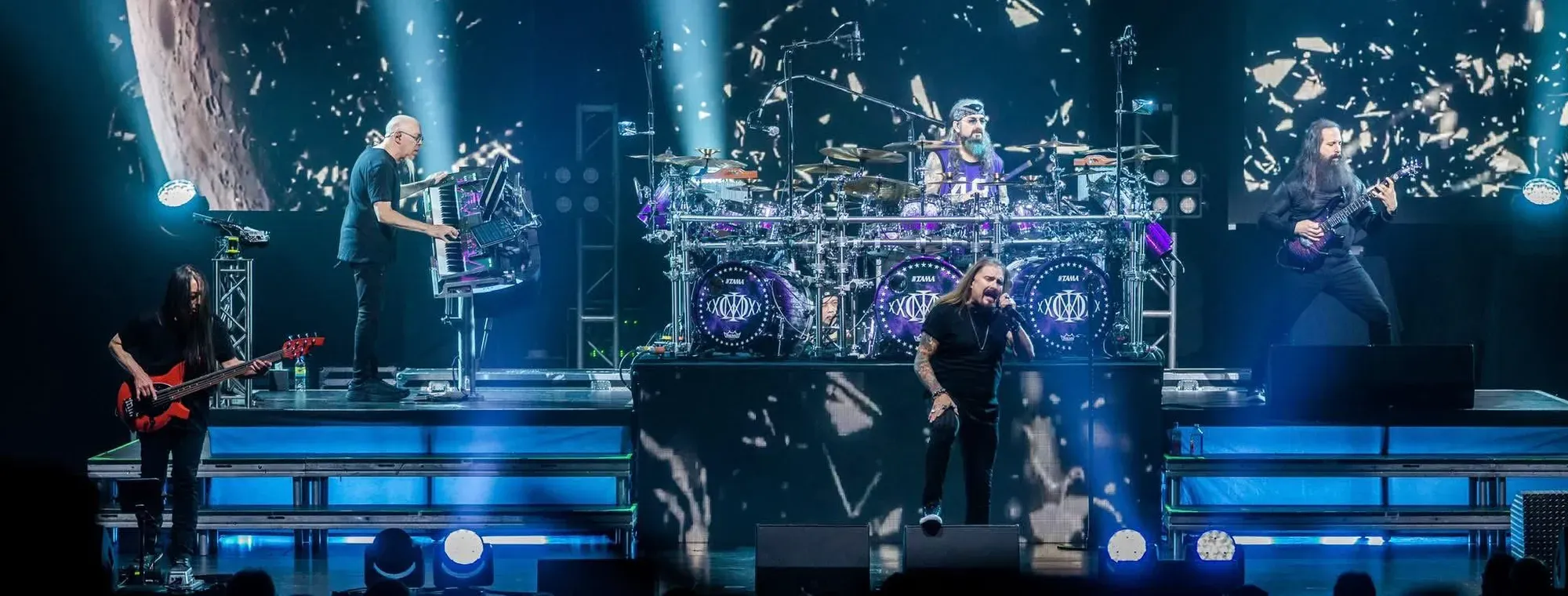
Originally published in Rock AAA.com · July 2011
Mike Mangini interview
InterviewMike Mangini8 min read
Rock AAA: This new album is called A Dramatic Turn Of Events, and we’re going to see it at the shops in September?
Mike Mangini: September 13th, it will be out.
RA: Tell us about it. Is it going to surprise us?
MM: It’s going to, I think, satisfy you, and that is because of the extreme dynamics on this record and because, mainly, Jordan and John Petrucci were able to compose with no drummer. So you’re gonna hear the way that they’ve always been, except with them and with John Myung kicking in a lot of ideas – he’s been very active of late – and James singing melodies and things like that. The point being that without a drummer in the room... like when I compose, I, as a drummer, it’s interesting because if I’m in a room as a drummer, I don’t consider myself a composer. If I’m just telling somebody, “Hey, play eight of these, let’s go to this section,” that’s arranging and just messing. But when I compose at home on other instruments, it’s interesting that I like to have the breath without the drums being done yet so I can make the ideas flow. And when they sent to me the demos, I was taken back. I was almost worried that I was just too happy in general and that I would like anything that they sent to me. But it wasn’t just me – it’s that everything flowed. So what’s gonna happen that I think is gonna be so satisfying is you’re going to hear these guys do their core stuff, and they’ve been very successful so far, so I can see no other reason but for everybody to really like this.
RA: You did a couple of loosely termed warm-ups this week here in the UK over the last few days, and you had the support band on featuring a lot who comes from Glasgow, which is where I come from, a band called Eden’s Curse. I just wonder if you managed to see any of their set and if you rated them.
MM: They were unbelievable. Their songs are so good. I’ll tell you flat-out that when they started playing and I was walking in to catering to get a bite to eat, I sat there and didn’t say a word and I just listened. And then I looked up to the crew guys that were in the room and said, “Are you hearing this?” They’re all like, “Yeah, they’re really good.” There’s no bigger compliment I could give, and it’s honest – that’s what we thought.
RA: They’re from all over. I think there’s a couple of Americans, there’s an Italian, and Paul, the bass player – I think he’s the main songwriter – he’s from Glasgow. You’re headlining the prog stage here at High Voltage. Is that a festival you were aware of in the past?
MM: Oh yeah, and the only reason I haven’t been a part of these things for the last decade is because I made a conscious effort to try to make a family. I even had to find a wife first, so I really needed to do that for me. I grew up in a family, and you have family and more family, and you hang out and eat food, and I was out and about for a long time, and I really wanted to establish that for myself for the rest of my life. And it turned out to be the right thing to do. So I haven’t been a part of it for a decade, but I follow when I hear. [laughs]
RA: The history of you, as far as being a drummer is concerned – I know the aficionados will be aware of your history – but for casual listeners, tell us what you’ve been doing before you joined up with Dream Theater.
MM: If I work my way backwards, I have been a professor at Berklee College for ten years, and it went very well there. I got asked to do a lot of important jobs above my own. For example, I was the adviser to all the students, so all the students could come talk to me to find out how to deal with their life issues, their career issues, and it was a big, big position, and I enjoyed it because I love teaching so much. So that was the core. But I have grown in the drum clinic world to be able to tour by myself in four continents and at least fill a small venue alone, just going up there and playing drums. So that’s the core of it. Now lately, or let’s say the last four or five years, my wife noticed I was just really not myself completely without being in a band, so she said, “You better go out and get it. Go!” And because of that, in 2010, after my knee surgery – which was a big deal too, because I had to get all fixed up and it took a year to get that right – I teamed up with Eddie Jobson from UK and did a tour with him and some other lesser-known people. So that’s the most recent. Before then, I was with Steve Vai for five years. I was with Extreme for three years, with Annihilator – well, I still work with Annihilator on and off – those are main things. And I also did some touring with Missing Persons on and off. So that’s the stuff people would know.
RA: Back to Glasgow just for a moment: another friend of mine who has played drums for many, many a long year and is a very good friend of mine – I wonder if you’re aware of his work, Ted McKenna.
MM: I am not, but it’s not because of any other reason than, again, I’ve been out of it for a while. For example, look, anybody that has kids knows what I’m about to say, but you’re so darn tired. Our kids are maybe two and a half years apart – so we really didn’t have a break. And my wife needed support too, and it’s not easy to carry around a human inside you and do all that stuff. So I’ve been so darn tired that the stuff I keep up with is only what my students will tell me about somebody, or I’ll come across it – just go online. So I just didn’t come across him.
RA: Ted originally played with The Sensational Alex Harvey Band back in the ‘70s. Then he played with Gary Moore, played with Rory Gallagher, played with Ian Gillan, he played with the Michael Schenker Group – he’s been around.
MM: Well, then I know his drumming.
RA: Two more questions for you, Mike, and I know you’ve got to get ready to go on tonight. Dream Theater as a band have always been comfortable in recording other people’s songs as well as your own songs. I’m just wondering if that will continue now with you being the new boy and what cover you’d like them to record.
MM: Well, I’ll tell you what – I actually can’t speak for the band because I’m not quite sure about it all, but I’m pretty sure that came from Mike, because I am not into that with these guys because they create so much music, and now we’re creating together, and there’s such a database that we just wanna play our stuff. So I really think that that’s the main difference there. But if we did a cover, I mean, these guys can play anything, so I really don’t know. I’m sure everyone has personal preferences, but maybe covering a Rush song would be fun.
RA: Neil Peart fan?
MM: Oh yeah, come on, you gotta do it. Well, that’s dangerous too because no one can really sound like somebody else. You know, on American Idol, there’s this thing that happens where the judges will often say to a singer, “Don’t pick a song by Mariah Carey if you can’t sound like Mariah Carey – that’s just dumb.” And so when I think of covering a song like with Neil, I’ve done it before on a Rush cover record, but it’s kind of impossible, so it’s almost like, why bother?
RA: I think my favorite Dream Theater cover was when they did ‘Perfect Strangers’ from the Perfect Strangers album – the [Deep] Purple one – but they’ve also done Who songs, Elton John songs, all sorts of things over the years and always did it well.
MM: Yeah, I know. They’re really good. Like I said, they can play anything.
RA: ‘On The Backs Of Angels’ is the first song that we’re getting to hear from the new album. Do you know much about what the song’s actually about?
MM: Lyrically? Well, John wrote the lyrics to that, so again, you have to ask him the full idea of what he was trying to [convey] – I don’t want to speak for him. But I can tell you about the playing. As far as the playing is concerned, I have some extremely pleasurable moments in all of the tunes, but in speaking about that one, my style is such that when the other players are doing something of a certain nature, which I can’t describe, I get out of the way. I let them be heard a little more. I don’t really play over everything. But by the same token, when there’s something extraordinarily complex that they’re doing, I play everybody’s parts. So it’s almost like I play a lot less and then a lot more, but not so much in the middle, and that’s the difference. For example, in ‘On The Backs Of Angels,’ there’s a part with John Petrucci and John Myung playing a complex bass rhythm. It’s very staccato and rhythmic. I’m doing that with my feet while playing a completely opposite rhythm that Jordan Rudess is playing on his keyboards with one hand on a little tight cymbal, and my snare drum is keeping a beat in the middle. So that’s me using all of my skills, so that’s extremely satisfying. And at the same time, there are other sections where I just want to bash out straight – it’s almost like let the actual sound of the keyboard come through, and if I’m hitting too much stuff, it’s going to cut out the frequencies. Is that interesting? Because I think it’s providing some concrete information as to the difference that people are gonna hear.