

Originally published in Guitariste.com · September 2020
Interview John Petrucci (Dream Theater)
Laurent Reymond - September 22, 2020
InterviewTranslatedJohn Petrucci41 min read
Translated from the original language with DeepL, so the wording may differ from what was actually said.
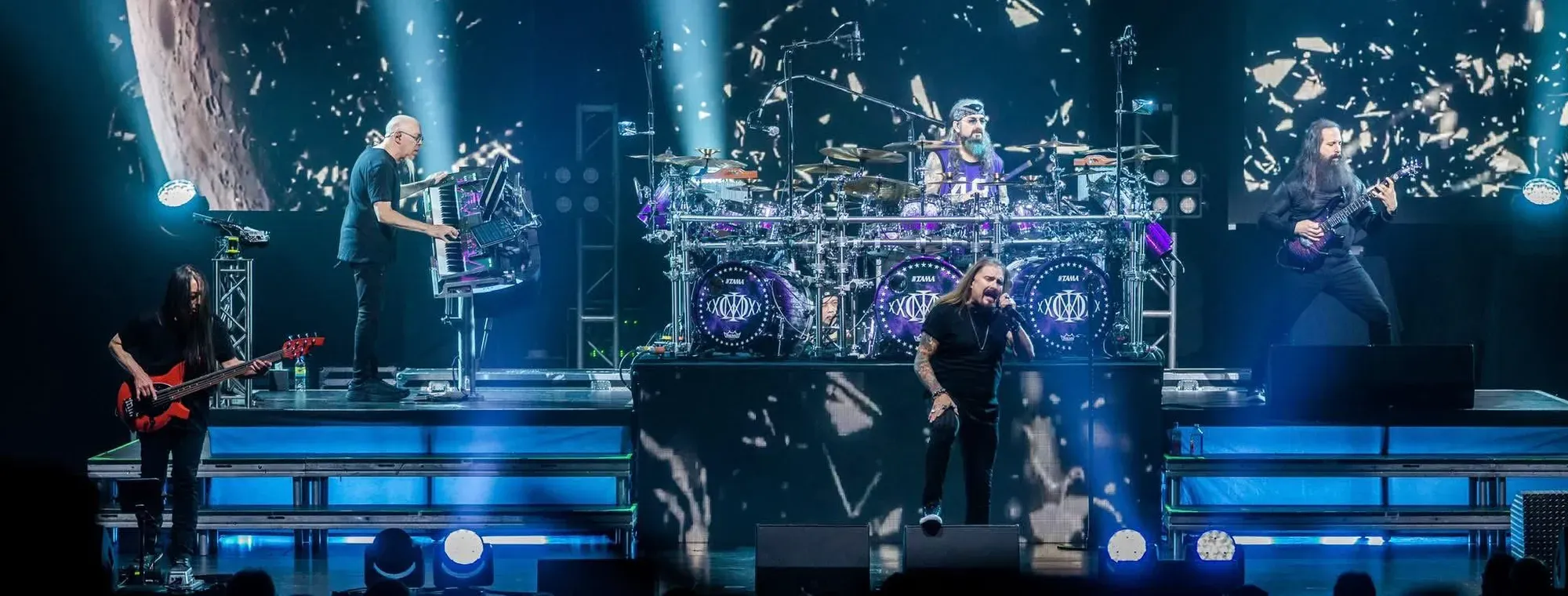
Dream Theater played at the Seine Musicale in Boulogne-Billancourt on January 26th as part of a tour celebrating both the 20th anniversary of the cult album "Metropolis Part 2: Scenes From a Memory" and the band's latest album "Distance Over Time". We took the opportunity to talk to John Petrucci about these two albums and also to talk about the material he uses, while concluding with a nice tribute to the late Neil Peart of Rush. Note that John Petrucci has just released his second solo album entitled "Terminal Velocity" (already available in digital format, to be released in "physical" format on October 30, 2020), fifteen years after "Suspended Animation" and which materializes the reunion of the guitarist with drummer Mike Portnoy!
"Distance Over Time" (2019) is your most concise album since "Images And Words" (1992). Is it in reaction to its predecessor "The Astonishing"(2016), a conceptual double album, or is it simply due to the 2017 tour where you performed "Images And Words" in full to celebrate its 25th anniversary?
John Petrucci: Both aspects were influential. The "Images And Words" 25th anniversary tour clearly brought us back to the particular spirit of those songs and our old way of writing. Isolating ourselves as a band, writing and playing together without outside distraction also had a big impact on the new album. Then we also had a conversation with our label and told them that we were coming off a pretty experimental double album and wanted to go back to something more direct. We wanted to make an album that was an hour long and just had good songs that you could listen to on a car ride or in a gym. We were focused on that and if there was a concept, it was to keep it to one hour. It was good for the album to have that plan in mind.
Is it a challenge for Dream Theater not to make an album or songs too long?
It can be sometimes. It depends on the songs. It's easy to keep a song like "Paralyzed" concise because you can't really take that kind of song very far in its development. It's a pretty straightforward style. It's not the same for songs like "Barstool Warrior" and "Pale Blue Dot" because they're much more progressive and experimental and you never know how far they're going to take you and where you're going to stop (laughs). You have to consciously stop the development of these kind of songs if you want to get a digestible result. My job as a producer is to make sure we keep that in mind because we can easily get lost in those situations.
Dream Theater has always made two types of albums: on the one hand, albums with a more "classic" style and on the other hand, more experimental albums. At this stage of your career, is it more complicated to innovate and risk offending your fans or on the contrary to deliver something more characteristic of the band while keeping a certain freshness?
That's an interesting question and I'm not sure I have the right answer. I look at our career as a kind of long history and every time we create something new, I always think back to what we've done before, the directions we've taken and where we could go. You can always experiment but the challenge is that the characteristic elements of the band are present so that the fans can adhere and like the new songs without thinking that they are like prefabricated or that we are pretending to give something new and that it is still the same thing (laughs). That's the worst thing anyone can say to me about our music because we don't pretend, we really work hard, we make decisions on absolutely every note, every chord, every rhythmic signature and every riff! We are aware of all this and we don't want to rest on our laurels and say in the studio "this is good, this is good enough". The question is always whether this simply does the trick or if there is a way to do better. Part of the job in the studio is also due to the sound of the album itself, the people we work with and the recording techniques used. It's a big part of adding freshness to an album. You're always learning new techniques, using new equipment, meeting new people, and that goes a long way to adding freshness to your music. In the case of "Distance Over Time", we are often told that it is one of the best sounding Dream Theater albums and I totally agree with that. Our sound engineer Jimmy T and Ben Grosse on the mix really managed to get a great sound for "Distance Over Time" and it was the first time we had them working together. The way you record and all the other work in the studio is essential to bring in the freshness, it's not just about the composition.
You play the whole "Metropolis Pt. 2: Scenes from a Memory" (1999) on this tour to celebrate its 20th anniversary. You already played it in its entirety at the time but were there some songs that were complicated to relearn?
Oh yes of course! There are songs that we have played many times in our career like "The Spirit Carries On" or "The Dance Of Eternity" and it was obviously not complicated for those. On the other hand, I personally felt a bit rusty as a guitarist for some other songs. I think in particular of "Beyond This Life" which is a very complicated song! When I listened to it again, I said to myself: "What the hell was I thinking playing like that back then? It took me a long time to relearn and practice the parts of that song and it was hard at first but not anymore because we've played that whole album a bunch of times through several legs of our tour and I'm obviously very comfortable now. But at first I thought on a lot of these songs, "what was I thinking at the time?" (laughs). It wasn't like "Images And Words" anyway, although the album is older, because we really played most of the songs on that album a million times. "Beyond This Life" or "Finally Free" for example have not been played live much in our history.
We just mentioned some very popular Dream Theater albums. If you had to rehabilitate a Dream Theater album that went unnoticed or that you consider as underestimated, which one would you choose?
I would choose "Systematic Chaos" (2007) without any hesitation. First of all, I love the sound of the album, especially the guitars, which I find phenomenal! We are playing "In The Presence Of Enemies - Part I" on our current tour. The direction we took for this album is really a good mix of all the elements that make up Dream Theater in my opinion. There is the metal side that is quite pronounced with big guitar riffs but there is also a really epic aspect to this album coupled with some really crazy instrumental parts that are technically very melodic! I've always considered this album to be a perfect blend of all these elements and I think it's well balanced. It's our most underrated album in my opinion. I actually listened to it a few times before doing "Distance Over Time" because I liked the mindset we had on that record. It has that extra something for me.
You are often recognized for your speed, precision and technique with sometimes the very melodic, expressive and dynamic elements of your playing taking a back seat for some fans or detractors. Is it frustrating sometimes to be seen only as a shredder while you are also a guitarist with a very emotional and touching playing?
First of all, thanks for the compliments! No, it's not really frustrating because of what you just said. I know that some people see me only as a technical shredder, but I also know that many understand the whole picture of my playing and they tell me so. The melodic aspect is a very important part of my playing. I was very influenced by Pink Floyd and Journey growing up and a lot of other very melodic stuff and I've always found the guitar to be the most expressive instrument in that context, in playing as if it were a voice. The dynamics are what make the music interesting. I'm glad to have all these different tools at my disposal because sometimes a song needs spectacular technique and other times you need more of a melody like a vocal line and it's not the same discipline at all because you're going to need in a melodic context to play more on the phrases, on the touch of your vibrato, on your bends and on your ability to play the right notes at the right time. I've always had a natural sensitivity to those things. It has a special resonance for me and when I hear a guitarist express himself in a very melodic way, I just melt! It's one of the coolest feelings! So I realize that some people think I'm only interested in technique, but that doesn't frustrate me at all because I also know that many people know that melody is really my thing!
A question that may seem silly. Your muscles have grown considerably over the years. Does it affect your playing?
People often ask me that question! I would say that it doesn't affect the muscles used to play the guitar and it doesn't affect my stamina either. I have much bigger biceps than I used to and much more developed shoulders, but other than maybe hitting the strings harder, it doesn't really impact my playing. The main difference is the way you feel the guitar against your body. I was pretty skinny when I started and now my body is much thicker and I don't feel the guitar the same way, but it would have been the same if I had just gotten fatter! The guitar feels smaller and lighter than before. That's the main difference. I know that a lot of guitarists are doing fitness like me and I advise them to be careful with some things. I always pay close attention to my hands, wrists and forearms. I don't do any exercise that could potentially damage those parts of my body. I always stretch my carpal tunnel, put straps on my wrists and don't carry heavy weights on my forearms. I'm also conscious of my age and don't do anything that will hurt my back. The good thing about fitness is that it makes you a stronger individual and better in your body. You just feel better in general actually, but no particular interest in the guitar.
You have released with Music Man new models of your signature Majesty guitar in 2019 and 2020. First up are your new DiMarzio signature pickups, the Dreamcatcher and the Rainmaker. Can you tell me about them?
I'm really interested in helping develop new musical instruments and continuing to make the guitar sound better or more comfortable. The same goes for amps, I loved starting with a classic Mesa Boogie amp and ending up with all the possibilities my signature amp offers. Improving the tools I use is a constant quest. It's the same thing when I make a Dream Theater album, I always ask myself how to improve things and that goes through my equipment too. For "Distance Over Time" the main change was my new signature pickup set. The design of the Majesty guitar hasn't changed in a long time, there are always new models coming out, and that's the case for this year 2020, but it's more about new colors or variations of wood species used for the body and that kind of stuff. The only thing that's really changed since 2019 is the mics. I've had several signature pickups from DiMarzio before but the Majesty was my first guitar based on a mahogany through neck and we opted at first to put some of my signature pickups in like the Illuminator and the Sonic Ecstasy. Then I started thinking that these pickups were not designed for a mahogany neck-through guitar since that's not what I was using at the time. I remember being in France the day I called Steve Blucher and said, "Steve, our pickups were not developed specifically for a mahogany neck-through guitar. What would you say if I sent you my new guitar and you put yourself in my shoes and know my needs to imagine new pickups specially designed for this guitar? Steve had to make only 3 different sets of pickups and I swear to God when I plugged in the guitar that was equipped with the set that would become the Dreamcatcher and Rainmaker, I played a chord and was immediately blown away by the vocal quality, expression and vibrancy that these new pickups gave to the guitar. Steve nailed it! It's really an example of how to take things to the next level. Never be satisfied and think about how to make things better. The Majesty guitar was a great instrument, but these specially designed pickups made it even better! I tell myself every night on stage playing all these new Majesty's that we've really managed to make things sound better. The guitar now does everything I want it to.
Do you leave the old pickups on your old signature guitars?
Yes I leave them as is, the Dreamcatcher and Rainmaker were really made with the neck through the head. Now someone could always experiment and install them on an old guitar. I will say that the Dreamcatcher and Rainmaker have a little bit lower output level, which gives them more dynamics and a more expressive feel, even though they are really not vintage pickups. But they are a little less powerful and have a more open sound.
The controls on your signature guitar are always placed on an ergonomic arc that seems to follow perfectly the arc of the hand and this is strangely quite rare. This is not a coincidence is it?
Absolutely, it's an ergonomic design that I really care about! There are a lot of things that have always bothered me on other guitars. When I play a Les Paul, my palm hurts because the bridge is too sharp, the bridges are not rounded enough. When I play a Strat, I always find that the volume control is too close to my pinky. Then there are many guitars where I find the switches or other selectors too far on the body of the guitar. How can I catch them in the middle of a song? So I've always had the philosophy of placing the controls on all my guitars in the logical direction of the arc of the hand in an ergonomic way so I don't have to struggle to manipulate them. I want them to be within immediate reach in the spirit of a stage performance. I want everything to be usable when you are in the thick of battle and trying to play your best in front of thousands of people! I have two switches, one to toggle between the magnetic and piezo pickups, and the other to toggle between the different pickup configurations just like on any guitar. We purposely placed these switches at an angle that follows the logical arc of the hand instead of from top to bottom. These are small details but they are important to me.
What are the extra functions on your volume and tone pots?
I use push/push knobs because I hate push/pull! It's so uncomfortable to have to lift a knob up when you're in the middle of a solo (laughs)! A push/push on the other hand is much more suitable for a stage performance because you just have to tap it to turn it on or off. So I have a boost that can go up to 20db on the volume pot. You can choose the level of boost you want, nothing requires you to go up to 20db. That can make it possible to obtain a sound which twists a little more on a clear channel and on a saturated channel that acts simply as clean boost, it is very transparent. When you are in the central position, the push/push tone pot allows you to use the 2 microphones in a simple parallel configuration. It is then the 2 coils located towards the center of the guitar that are activated. There are many different sounds and possibilities on this guitar. You can of course spend most of the time on the humbucker in the bridge or neck, but the split sound in the center position with the boost activated on a clean channel is a pretty cool sound for example.
There are many different wood combinations for the Majesty body. Is it just an aesthetic element or do you hear sonic differences?
For me it's mostly a difference in sound. The basswood versions with the opaque finish have a more metal sound, they are more precise with a particular bite that reminds me of all those guitars from the 80s. The ones like the Tiger Eye that have the alder neck through wings have a more complex sound, like a Bordeaux wine with complex aromas (laughs). The all mahogany versions have more punch and a thicker sound.
Can you also tell me about the Asian versions of Sterling By Music Man?
The versions that are released by Sterling By Music Man are licensed versions of my guitars made by a factory in South Korea. They have a more affordable price. In dollar terms I would say my Music Man's range from $2500 to $5000 while the Sterling By Music Man's range from $899 to $1200. There is actually a new line of my signature guitars at Sterling By Music Man in 2020 that feature my signature pickups for the first time (note: the Crunch Lab/Liquifire set), ebony fingerboard and stainless steel frets, which makes these models the closest to my Music Man models to date. These are great guitars that are more affordable and accessible to more people; they are not at the level of my American versions but they are still very good guitars. I recently shot some promotional videos with these guitars and when I played the first one I had in my hands, I said "are you kidding me? These guitars are awesome!". They sound really good and are very comfortable. Almost too much in fact!
Mesa Boogie is not very used to signature amps but you have had your own for a few years now with the JP-2C. You've used a lot of Mesa Boogie amps in your career and it seems that the Mark IIC+, around which your signature amp is based, is your favorite. The last stock Mesa Boogie you used was the Mark V on which you could get the IIC+ sound on channel 3. One can imagine that the starting point of your signature amp was to get the IIC+ sound on channel 2 for your main crunch sound and really leave channel 3 dedicated to your lead sound, right?
Indeed the Mark IIC+ was my favorite Mesa Boogie amp and when I was playing on the Mark V I quickly thought that it would be cool to modify it so that the channels 2 and 3 were identical. But when the opportunity came to create the JP-2C, my request was mostly to make it a reissue of the Mark IIC+ with several improvements. It's not a modern amp like the Mark V, it's really a IIC+ with the same circuit and the same type of transformers as the original one but we made it 3 channels and added a lot of useful options. Instead of offering a simple control panel common to the 2 channels and a graphic equalization as on the original IIC+, the JP-2C offers 3 totally independent channels and 2 graphic equalizations as well as a mode called "shred" that can be activated and which gives a different voicing to the amp. There is also a MIDI interface and an integrated CabClone with a loadbox, a headphone output, a spring reverb and an effects loop. We really thought this amp through to make it the ultimate IIC+ with lots of useful features! This is obviously for me the best Mesa/Boogie amp ever made. Everything I need in an amp is in the JP-2C and it sounds amazing!
Mesa/Boogie has just updated its speaker simulator by releasing the CabClone IR. Are there any plans to update the JP-2C CabClone in the future?
Maybe, I'd have to talk to them about it but at the time of this interview I haven't tried the CabClone IR yet (editor's note: John has since tried it and seems to love it from this video).
IR speaker simulations are more popular than ever. If we look at the NAMM 2020 releases, many predict the end of amps with all the modellers available on the market. I personally wouldn't go that far, but except for pros like you, it's quite possible that speaker simulations will mean the end of cabinets for most guitarists. Are you following all this closely?
Yes I see it all and modeling amps or simulations are clearly the trend of the moment. I personally use both cabs and the CabClone. When I play live I still plug my cabinets with real microphones but I also send the CabClone sound live so that our front of house sound engineer has both signals at his disposal and can mix them at his convenience. I don't really have any speakers on stage anymore, they're hidden in the back and mic'd up there and I use an in-ear system combined with returns where we send a really loud guitar sound (laughs)! It's really a combination that I love. I have both a very high quality, studio-quality mix in my headphones and the power, feel and air movement generated by my monitors, it's an absolutely great combination that I highly recommend! It's really great to have both a clean and precise sound in my ears and still be able to feel in my legs the power of a big riff played on a 7 string guitar! In the studio, I wrote "Distance Over Time" using only the CabClone's live signal on monitor speakers and it sounded really good. I did all my demos this way and was quite impressed with the result. That being said, when we ended up putting a mic in front of a real speaker... it was night and day (laughs)! So we kept the traditional approach to recording the album, but I have no problem using the CabClone for songwriting or recording demos, so I'll try the new one, the CabClone IR, and see how it goes.
It's common knowledge that you've renewed your friendship with Mike Portnoy over the past few years. It would obviously be quite disrespectful to Mike Mangini to fuel speculations about a return of Mike Portnoy in Dream Theater, but is there any possibility of you activating your other band Liquid Tension Experiment again?
There's always a chance that things will happen in life. We've talked about it together actually and with Jordan Rudess as well. It would be really cool to do something with Liquid Tension Experiment again and I know Mike can have a lot of projects going on at the same time, but even though we are all on board with the idea, we are also all very busy. Dream Theater is on tour all the time, so is Mike with all these different projects. And don't forget that Tony Levin also has a very busy career. So there's a possibility that it could happen, the door is clearly open, but we'll have to find the right time, when all four of us will have a few months off from our different projects at the same time to devote some time to Liquid Tension Experiment. But it's a project that's very close to our hearts, we had such a great time making those two albums and it was also a defining moment in Dream Theater's career because it's from that project that Jordan Rudess joined the band. So those albums were very important to me (editor's note: since this interview, John Petrucci has been working on his new solo album "Terminal Velocity" with Mike Portnoy on drums during the lockdown!)
Neil Peart passed away on January 7th and since Rush's music has greatly influenced Dream Theater, we thought you might want to pay tribute to him.
The older we get, the more musicians we love pass away and it's really sad and it really hurts us when we loved their music. But there are some for whom it hurts even more, because their music had so much meaning and impact on your life, and that's exactly how I felt about Neil Peart. I was devastated, I didn't even know he was sick actually. Rush is simply my favorite band of all time and genres. They are my biggest musical influence and it was also through Rush that I met John Myung and Mike Portnoy at Berklee. We met because all three of us were Rush fans. I would go see them every time they came to New York, buy all their albums, their t-shirts, worship the songs and try to learn to play them by emulating their guitar sound. But there is another side of things to consider with the fact that writing lyrics for our songs is my other passion and Neil Peart is my biggest influence as a lyricist. I'm such a fan of his lyrics, his storytelling ability, his creativity and the messages he puts across. That's the thing that makes Neil so unique. He was already so good and creative on the drums, when you listen to him you can't help but do “air-drumming”, it could have stopped at his drumming skills that he would already be a huge artist, but you add to that the immense weight of those lyrics on the Rush universe, on the messages they put across in their albums and their live performances. The lyrics were deep, they went much deeper than just love and drugs. He had lyrics that could make you think, fictional stories that were absolutely fascinating, he knew how to stimulate your mind and even write touching things like in the song "Mission" for example. Seeing and hearing Rush had such a strong emotional impact on me that when Neil passed I felt a huge emptiness and I thought that the art world had suffered a huge loss. But Neil has left us an incredible legacy!
Original text
Interview John Petrucci (Dream Theater)
Laurent Reymond - Le 22 Septembre 2020
Dream Theater se produisait à la Seine Musicale de Boulogne-Billancourt le 26 janvier dernier dans le cadre d'une tournée célébrant à la fois les 20 ans de l'album culte "Metropolis Part 2: Scenes From a Memory" et le dernier album en date du groupe "Distance Over Time". Nous en avions profité pour nous entretenir avec John Petrucci au sujet de ces deux albums et d'évoquer également avec lui le matériel qu'il utilise tout en concluant avec un bel hommage au regretté Neil Peart de Rush. A noter que John Petrucci vient de publier son deuxième album solo intitulé "Terminal Velocity" (déjà disponible en numérique, sortie en format "physique" le 30 octobre 2020), quinze ans après "Suspended Animation" et qui matérialise les retrouvailles du guitariste avec le batteur Mike Portnoy !
"Distance Over Time" (2019) est votre album le plus concis depuis "Images And Words" (1992). Est-ce en réaction à son prédécesseur "The Astonishing"(2016), un double album conceptuel, ou est-ce simplement du à la tournée de 2017 où vous avez interprété "Images And Words" en intégralité pour en célébrer son 25ème anniversaire ?
John Petrucci : Ces deux aspects ont eu une influence. La tournée des 25 ans de "Images And Words" nous a clairement ramené vers l'esprit particulier de ces chansons et à notre ancienne manière de composer. Le fait de nous isoler en tant que groupe, d'écrire et de jouer ensemble sans distraction extérieure a également eu un impact important sur ce nouvel album. Puis nous avons également eu une conversation avec notre label en leur disant que nous sortions d'un double album assez expérimental et que nous avions envie de revenir à quelque chose de plus direct. Nous voulions faire un album qui dure une heure et qui propose tout simplement des bonnes chansons que l'on peut écouter lors d'un trajet en voiture ou dans une salle de sport. Nous étions concentrés là dessus et s'il y avait un concept, c'était celui de ne pas dépasser cette limite d'une heure. C'était bon pour l'album d'avoir ce plan en tête.
Est-ce un défi pour Dream Theater de ne pas faire un album ou des chansons trop longues ?
Ça peut l'être parfois. Cela dépend des chansons. Il est facile de garder un titre comme "Paralyzed" concis car tu ne peux pas vraiment emmener ce genre de chanson très loin au niveau de son développement. C'est un style assez direct. Ce n'est pas la même chose pour des titres comme "Barstool Warrior" et "Pale Blue Dot" car ils sont beaucoup plus progressifs et expérimentaux et là tu ne sais jamais jusqu'où ils vont t'emmener et où tu vas t'arrêter (rires). Il faut consciemment stopper le développement de ce genre de chansons si tu veux aboutir à un résultat digeste. Mon job en tant que producteur est de m'assurer que nous gardions cela à l'esprit car nous pouvons facilement nous égarer dans ce genre de situations.
Dream Theater a toujours fait deux types d'albums : d'une part des albums au style plus "classique" et d'autre part des albums plus expérimentaux. Au stade actuel de votre carrière, est-ce plus compliqué d'innover et de risque de froisser vos fans ou au contraire de livrer quelque chose de plus caractéristique du groupe tout en gardant une certaine fraicheur ?
C'est une question intéressante et je ne suis pas sur de détenir la bonne réponse. Je regarde notre carrière comme une sorte de longue histoire et à chaque fois que nous créons quelque chose de nouveau, je repense toujours à ce que nous avons fait avant, les directions que nous avons prises et les endroits où nous pourrions aller. Tu peux toujours expérimenter mais le défi est que les éléments caractéristiques du groupe soient présents pour que les fans puissent adhérer et aimer les nouvelles chansons sans pour autant se dire qu'elles sont comme préfabriquées ou que l'on fait semblant de donner du neuf et qu'il s'agit au final toujours de la même chose (rires). C'est la pire remarque que l'on peut me faire sur notre musique car pour le coup nous ne faisons pas semblant, nous travaillons vraiment dur, nous prenons des décisions sur absolument chaque note, chaque accord, chaque signature rythmique et chaque riff ! Nous sommes conscients de tout cela et nous ne voulons pas nous reposer sur nos lauriers en nous disant en studio : "c'est bon, c'est suffisamment bien". La question est toujours de se demander si ça fait simplement l'affaire ou s'il y a moyen de faire mieux. Une partie du job en studio est également due au son de l'album en lui même, les gens avec qui nous travaillons et les techniques d'enregistrement utilisées. C'est un aspect qui contribue grandement à ajouter de la fraicheur sur un album. Tu apprends toujours de nouvelles techniques, tu utilises du nouveau matériel, tu rencontres de nouvelles personnes et cela contribue grandement à insuffler de la fraicheur dans ta musique. Dans le cas de "Distance Over Time", on nous dit souvent qu'il s'agit d'un des albums de Dream Theater qui sonne le mieux et je suis parfaitement d'accord avec ce constat. Notre ingénieur du son Jimmy T et Ben Grosse au mixage sont vraiment parvenus à obtenir un super son pour "Distance Over Time" et c'était la première fois que nous les faisions travailler ensemble. La manière dont tu enregistres et tout le reste du travail en studio sont des éléments essentiels pour insuffler de la fraicheur, cela ne se passe pas uniquement au niveau de la composition.
Vous jouez l'intégralité de "Metropolis Pt. 2: Scenes from a Memory" (1999) sur cette tournée pour célébrer ses 20 ans. Vous le jouiez déjà en entier à l'époque mais y a-t-il eu certaines chansons qui ont été compliquées à réapprendre ?
Oh oui bien sûr ! Il y a des chansons que nous avons souvent jouées dans notre carrière comme "The Spirit Carries On" ou "The Dance Of Eternity" et ce n'était évidemment pas compliqué pour celles-ci. En revanche, je me suis senti personnellement un peu rouillé en tant que guitariste pour certaines autres chansons. Je pense notamment à "Beyond This Life" qui est un titre super compliqué ! Lorsque je l'ai réécouté je me suis dit : "mais bon sang, qu'est-ce qui m'a pris de jouer comme ça à l'époque ?" (rires). Réapprendre et m'entrainer sur les parties de cette chanson m'a demandé beaucoup de temps et c'était dur au début mais plus maintenant car nous avons joué cet album en entier un paquet de fois à travers plusieurs segments de notre tournée et je suis évident parfaitement à l'aise désormais. Mais au départ je me suis dit sur pas mal de ces chansons : "mais à quoi je pensais à l'époque ?" (rires). Ce n'était pas comme pour "Images And Words" en tout cas, bien que l'album soit plus ancien, car nous avions vraiment joué des millions de fois la plupart des titres de cet album. "Beyond This Life" ou "Finally Free" par exemple ont finalement été assez peu interprétés en live dans notre histoire.
Nous venons d'évoquer des albums de Dream Theater très populaires. Si tu devais réhabiliter un album de Dream Theater passé plus inaperçu ou que tu considères comme sous-estimé, lequel choisirais-tu ?
Je choisirai "Systematic Chaos" (2008) sans aucune hésitation. Pour commencer, j'adore le son de l'album et plus particulièrement celui des guitares que je trouve phénoménal ! Nous jouons d'ailleurs le titre "In The Presence Of Enemies - Part I" sur notre tournée actuelle. La direction que nous avons prise pour cet album est vraiment un bon mélange de tous les éléments qui constituent Dream Theater selon moi. Il y a le côté metal qui est assez prononcé avec des gros riffs de guitare mais il y a aussi un aspect vraiment épique dans cet album couplé à des parties instrumentales vraiment folles techniquement tout en étant très mélodiques ! J'ai toujours considéré cet album comme un parfait mélange de tous ces éléments et je trouve que le tout est bien équilibré. C'est notre album le plus sous-estimé selon moi. Je l'ai d'ailleurs écouté plusieurs fois avant de faire "Distance Over Time" car j'aimais l'état d'esprit que nous avions sur ce disque. Il a ce petit truc en plus pour moi.
Tu es souvent reconnu pour ta vitesse, ta précision et ta technique avec parfois les éléments très mélodiques, expressifs et dynamiques de ton jeu qui passent au second plan pour certains fans ou pour tes détracteurs. Est-ce frustrant parfois d'être seulement vu comme un shreddeur alors que tu es également un guitariste au jeu plein d'émotion et de touché ?
Déjà, merci pour ces compliments ! Non ce n'est pas vraiment frustrant, justement grâce à tout ce que tu viens de dire. Je sais que certains me voient uniquement comme un shreddeur technique, mais je sais aussi que beaucoup comprennent la globalité de mon jeu et ces derniers m'en font part. L'aspect mélodique est une partie très importante de mon jeu. J'ai été très influencé par Pink Floyd ou Journey en grandissant et plein d'autres choses très mélodiques et j'ai toujours trouvé que la guitare est l'instrument le plus expressif dans ce contexte, dans le fait de jouer comme s'il s'agissait d'une voix. La dynamique est ce qui rend la musique intéressante. Je suis content d'avoir tous ces différents outils à ma disposition car parfois un titre réclame de la technique spectaculaire et d'autres fois tu as davantage besoin d'une mélodie comparable à une ligne vocale et il ne s'agit pas du tout de la même discipline car tu vas avoir besoin dans un contexte mélodique de jouer davantage sur les phrases, sur le touché de ton vibrato, sur tes bends et sur ta capacité à jouer les bonnes notes au bon moment. J'ai toujours eu une sensibilité naturelle pour ces choses là. Cela a une résonance particulière chez moi et lorsque j'entends un guitariste s'exprimer de manière très mélodique, je fonds tout simplement ! C'est un des sentiments les plus cools ! J'ai donc conscience que certains pensent que je ne m'intéresse qu'à la technique, mais cela ne me frustre pas du tout car je sais aussi que beaucoup savent que la mélodie est vraiment mon truc !
Une question qui peut paraître bête. Ta musculature s'est considérablement développée au fil des années. Est-ce que cela affecte ton jeu ?
Les gens me posent souvent cette question! Je dirai que cela n'affecte pas les muscles sollicités pour jouer de la guitare et cela n'affecte pas non plus mon endurance. J'ai de bien plus gros biceps qu'avant et des épaules beaucoup plus développées, mais à part peut être frapper les cordes plus fort, cela n'a pas vraiment d'impact sur mon jeu. La différence principale est la manière dont tu sens la guitare contre ton corps. J'étais plutôt maigre quand j'ai commencé et mon corps est désormais bien plus épais et je ne sens plus la guitare de la même manière, mais il en aurait été de même si j'avais tout simplement grossi ! La guitare m'a l'air plus petite et plus légère qu'avant. C'est la principale différence. Après je sais que pas mal de guitariste font du fitness comme moi et je leur conseille de faire attention à certaines choses. Je fais toujours très attention à mes mains, mes poignets et mes avant-bras. Je ne fais aucun exercice qui pourrait potentiellement endommager ces parties de mon corps. J'étire toujours mon canal carpien, je mets des straps sur mes poignets et je ne porte pas de poids trop lourds sur mes avant-bras. J'ai également conscience de mon âge et je ne fais rien qui puisse m'abimer le dos. Le bon aspect du fitness est que cela fait de toi un individu plus fort et mieux dans son corps. Tu te sens tout simplement mieux de manière générale en fait, mais aucun intérêt particulier pour la guitare.
Tu as sorti avec Music Man de nouveaux modèles de ta guitare signature Majesty en 2019 et 2020. La première nouveauté sont tes nouveaux micros signature DiMarzio, le Dreamcatcher et le Reignmaker. Peux-tu m'en parler ?
Je suis vraiment très intéressé par le fait d'aider à développer de nouveaux instruments de musique et par le fait de continuer de mieux faire sonner la guitare ou d'améliorer son confort. Il en va de même pour les amplis, j'ai adoré partir d'un ampli classique de Mesa Boogie et aboutir à toutes les possibilités qu'offre mon ampli signature. Le fait d'améliorer les outils que j'utilise est une quête permanente. C'est la même chose lorsque je fais un album de Dream Theater, je me demande toujours comment améliorer les choses et cela passe aussi par mon matériel. Pour "Distance Over Time" le principal changement a justement été mon nouveau set de micros signature. La conception de la guitare Majesty n'a pas évolué depuis longtemps, il y a toujours des nouveaux modèles qui sortent, et c'est le cas pour cette année 2020, mais il s'agit plutôt de nouvelles couleurs ou de variantes d'essence de bois utilisées pour le corps et ce genre de choses. La seule chose qui a vraiment changée depuis 2019 ce sont les micros. J'ai déjà eu plusieurs micros signature chez DiMarzio mais la Majesty fût ma première guitare basée sur un manche traversant en acajou et nous avons opté dans un premier temps pour mettre certains de mes micros signature comme les Illuminator et les Sonic Ecstasy. Puis j'ai commencé à me dire que ces micros n'avaient pas été conçus pour une guitare à manche traversant en acajou puisque ce n'est pas ce que j'utilisais à l'époque. Je me souviens d'ailleurs de me trouver en France le jour où j'ai appelé Steve Blucher pour lui dire : "Steve, nos micros n'ont pas été développés spécialement pour une guitare à manche traversant en acajou. Que dirais-tu si je t'envoie ma nouvelle guitare et que de ton côté tu te mettes à ma place en connaissant mes besoins pour imaginer des nouveaux micros spécialement conçu pour cette guitare ?". Steve a du faire seulement 3 sets différents de micro et je jure devant Dieu que lorsque j'ai branché la guitare qui était équipée par le set qui allait devenir le Dreamcatcher et le Reignmaker, j'ai joué un accord et j'ai immédiatement été soufflé par la qualité vocale, par l'expression et la vibration que ces nouveaux micros donnaient à la guitare. Steve a parfaitement réussi le pari ! C'est vraiment un exemple sur la façon d'amener les choses au niveau supérieur. Ne jamais être satisfait et réfléchir à comment améliorer les choses. La guitare Majesty était un super instrument, mais ces micros spécialement conçus pour elle l'ont encore améliorée ! Je me dis tous les soirs sur scène en jouant toutes ces nouvelles Majesty que nous sommes vraiment parvenus à mieux faire sonner les choses. La guitare fait aujourd'hui tout ce dont j'ai envie.
Laisses-tu les anciens micros sur tes anciennes guitares signature ?
Oui je les laisse en l'état, le Dreamcatcher et le Reignmaker ont vraiment été fait avec le manche traversant en tête. Maintenant quelqu'un pourrait toujours expérimenter et les installer sur une ancienne guitare. Je dirai que le Dreamcatcher et le Reignmaker ont un niveau de sortie un petit plus faible, ce qui leur confère plus de dynamique et un côté expressif plus prononcé, même s'il ne s'agit vraiment pas de micros vintage. Mais ils sont un poil moins puissants et ont un son plus ouvert.
Les contrôles sur tes guitare signature sont toujours placés sur un arc ergonomique semblant suivre parfaitement l'arc de la main et c'est étrangement assez rare. Ce n'est pas un hasard n'est-ce-pas ?
Absolument, c'est un design ergonomique auquel je tiens beaucoup ! Il y a tout un tas de choses qui m'ont toujours gênées sur d'autres guitares. Lorsque je joue une Les Paul, j'ai mal à la paume de ma main car le chevalet est trop tranchant, les pontets ne sont pas assez arrondis. Lorsque je joue une Strat, je trouve toujours que le potard de volume est trop près de mon auriculaire. Puis il y a plein de guitare où je trouve les switches ou autre sélecteurs trop loin sur le corps de la guitare. Comment puis-je les attraper en plein milieu d'un morceau ?! J'ai donc toujours eu la philosophie de placer les contrôles de toutes mes guitares dans le sens logique de l'arc de la main de manière ergonomique pour ne pas avoir à lutter pour les manipuler. Je veux qu'ils soient à portée de main immédiate dans l'esprit d'une performance scénique. Je veux que tout soit utilisable lorsque tu te trouves en plein cœur de la bataille et que tu t'efforces de jouer de ton mieux devant des milliers de gens ! J'ai 2 sélecteurs, un pour alterner entre les micros magnétique et le système piezo, et l'autre pour alterner entre les différentes configurations micro comme sur n'importe quelle guitare. Nous avons volontairement placé ces sélecteurs avec un angle qui suit l'arc logique de la main au lieu de le placer de haut en bas. Ce sont de petits détails mais ils sont importants pour moi.
Quelles sont les fonctions supplémentaires sur tes potards de volume et de tonalité ?
J'utilise des potards push/push car je déteste les push/pull ! C'est tellement inconfortable de devoir soulever un potard vers le haut lorsque tu te retrouves en plein milieu d'un solo (rires) ! Un push/push à l'inverse convient beaucoup mieux lors d'une performance scénique car tu n'as qu'à taper dessus pour l'activer ou le désactiver. J'ai donc un boost pouvant aller jusque 20db sur le potard de volume. On peut choisir le niveau du boost désiré, rien n'oblige à aller jusque 20db. Cela peut permettre d'obtenir un son qui tord un peu plus sur un canal clair et sur un canal saturé cela fait simplement office de clean boost, c'est très transparent. Lorsque l'on se trouve sur la position centrale, le potard push/push de tonalité permet d'utiliser les 2 micros en configuration simple en parallèle. Ce sont alors les 2 bobines situées vers le centre de la guitare qui sont activées. Il y a beaucoup de sons et de possibilités différentes sur cette guitare. On peut bien sur passer la majorité du temps sur le humbucker en chevalet ou en manche, mais le son splitté en position centrale avec le boost activé sur un canal clair est un son assez cool par exemple.
Il y a beaucoup de combinaisons de bois différentes pour le corps des Majesty. Est-ce seulement un élément esthétique ou y entends-tu des différences sonores ?
Pour moi c'est surtout une différence au niveau du son. Les versions en tilleul avec finition opaque ont un son plus metal, elles sont plus précises avec un mordant particulier qui me rappelle toutes ces guitares des années 80. Celles comme la Tiger Eye qui ont les ailes du manche traversant en aulne possèdent un son plus complexe, un peu comme s'il s'agissait d'un vin de Bordeaux aux arômes complexes (rires). Les versions tout acajou ont plus de punch et un son plus épais.
Peux-tu également me parler des versions asiatiques de Sterling By Music Man ?
Les versions qui sortent chez Sterling By Music Man sont des versions sous licence de mes guitares fabriquées par une usine en Corée Du Sud. Elles ont un prix plus abordable. En dollar je dirai que mes Music Man s'étalent entre 2500 et 5000 dollars tandis que les Sterling By Music Man se situent entre 899 et 1200 dollars. Il y a justement une nouvelle ligne de mes guitares signature chez Sterling By Music Man en 2020 qui proposent pour la première fois mes micros signature (ndlr : le set Crunch Lab/Liquifire), la touche en ébène et les frettes en acier inoxydable, qui font de ces modèles les plus proches à ce jour de mes modèles Music Man. Ce sont de superbes guitares plus abordables et accessibles pour plus de gens, elles ne sont pas au niveau de mes versions américaines mais elles demeurent de très bonnes guitares. J'ai récemment tourné des vidéos promotionnelles avec ces guitares et lorsque j'ai joué la première que j'ai eu dans les mains, je leur ai dit : "vous vous moquez de moi ? Ces guitares sont géniales !". Elles sonnent vraiment bien et sont très confortables. Presque trop en fait !
Mesa Boogie est très peu coutumier des amplis signature mais tu disposes depuis quelques années du tien avec le JP-2C. Tu as utilisé plein d'amplis Mesa Boogie dans ta carrière et il semble que le Mark IIC+, autour duquel ton ampli signature est basé, soit ton préféré. Le dernier Mesa Boogie de série que tu as utilisé était le Mark V sur lequel tu pouvais obtenir le son du IIC+ sur le canal 3. On peut imaginer que le point de départ de ton ampli signature était d'obtenir le son du IIC+ sur le canal 2 pour ton son "crunch" principal et de laisser vraiment le canal 3 dédié à ton son "lead" n'est-ce pas ?
Effectivement le Mark IIC+ était mon ampli Mesa Boogie favori et lorsque je jouais sur le Mark V j'ai vite pensé qu'il serait cool de le modifier afin que les canaux 2 et 3 soient identiques. Mais lorsqu'est venu l'opportunité de créer le JP-2C, ma demande a surtout été d'en faire une réédition du Mark IIC+ avec plusieurs améliorations. Ce n'est pas à proprement parler un ampli moderne comme le Mark V, il s'agit vraiment d'un IIC+ avec un circuit identique et le même type de transformateurs que celui d'origine mais nous l'avons décliné sur 3 canaux et l'avons agrémenté de pas mal d'options utiles. Au lieu de proposer un simple panneau de contrôles communs aux 2 canaux et une égalisation graphique comme sur le IIC+ d'origine, le JP-2C propose quant à lui 3 canaux totalement indépendants et 2 égalisations graphiques ainsi qu'un mode intitulé "shred" que l'on peut activer et qui donne un voicing différent à l'ampli. Il y a également une interface MIDI et un CabClone intégré avec une résistance de charge (loadbox), une sortie casque, une reverb à ressort, une boucle d'effets. Nous avons vraiment murement réfléchi cet ampli pour en faire un IIC+ ultime doté de plein d'options utiles ! Il s'agit évidemment pour moi du meilleur ampli Mesa/Boogie jamais crée. Tout ce dont j'ai besoin dans un ampli se trouve dans le JP-2C et il sonne de manière incroyable !
Mesa/Boogie vient d'actualiser son simulateur de haut-parleur en sortant le CabClone IR. Est-il prévu d'actualiser le CabClone du JP-2C à l'avenir du coup ?
Peut-être, il faudrait que je leur en parle mais au moment où nous faisons cette interview je n'ai pas encore essayé le CabClone IR (ndlr : John l'a essayé depuis et semble l'adorer à en croire cette vidéo).
Les simulations de haut-parleur avec IR (ndlr : réponse impulsionnelle) ont d'ailleurs plus que jamais le vent en poupe. Si l'on regarde les sorties du NAMM 2020, beaucoup prédisent la fin des amplis avec tous les modélisateurs disponibles sur le marché. Je n'irai personnellement pas jusque-là, mais à part pour les pros comme toi, il serait bien possible que les simulations de HP signent la fin des baffles pour la plupart des guitaristes. Suis-tu tout cela de près ?
Oui je vois tout cela et les amplis à modélisation ou les simulations sont clairement la tendance du moment. Personnellement je me sers à la fois des baffles et du CabClone. En live je continue de repiquer mes baffles avec de vrais micros mais j'envoie également le son du CabClone en direct si bien que notre ingé-son en façade dispose des deux signaux à la fois et peut les mixer à sa convenance. Je n'ai plus vraiment de baffles sur scène, ils sont cachés à l'arrière et repiqués par micro là-bas et j'utilise un système "in-ear" combiné avec des retours dans lesquels nous envoyons un son de guitare vraiment fort (rires) ! C'est vraiment une combinaison que j'adore. Je dispose à la fois d'un mix de très grande qualité et digne d'un album studio dans mes oreillettes tout en ayant la puissance, la sensation et le mouvement d'air généré par mes retours, c'est une combinaison absolument géniale que je recommande chaudement ! C'est vraiment super d'avoir à la fois un son net et précis dans les oreilles et de pouvoir malgré tout toujours ressentir dans mes jambes la puissance procurée par un gros riff joué sur une guitare 7 cordes ! En studio, j'ai composé "Distance Over Time" en utilisant uniquement le signal du CabClone en direct sur des enceintes de monitoring et ça sonnait franchement bien. J'ai fait toutes mes démos ainsi et j'étais assez impressionné par le résultat. Ceci étant dit, lorsque nous avons fini par placer un micro devant un véritable baffle… c'était le jour et la nuit (rires) ! Nous avons donc gardé l'approche traditionnelle pour enregistrer l'album, mais je n'ai aucun problème à me servir du CabClone pour la composition ou l'enregistrement des démos et j'essaierai donc le nouveau, le CabClone IR pour voir ce que cela donne.
Il est de notoriété publique que tu as renoué ton amitié avec Mike Portnoy depuis quelques années. Il serait évidemment assez irrespectueux pour Mike Mangini d'alimenter des spéculations quant à un retour de Mike Portnoy dans Dream Theater, mais y-a-t-il une possibilité de vous revoir activer votre autre groupe Liquid Tension Experiment ?
Il y a toujours une chance pour que les choses se produisent dans la vie. Nous en avons déjà parlé ensemble à vrai dire et avec Jordan Rudess aussi d'ailleurs. Ce serait vraiment cool de refaire quelque chose avec Liquid Tension Experiment et je sais que Mike peut avoir plein de projets en même temps, mais même si nous sommes tous partants dans l'idée, nous sommes également tous très occupés. Dream Theater est tout le temps en tournée, il en va de même pour Mike avec tous ces différents projets. Puis il ne faut pas oublier que Tony Levin a lui aussi une carrière très prenante. Il y a donc une possibilité pour que cela se fasse, la porte est clairement ouverte, mais il faudra trouver le bon moment, celui où nous aurons tous les quatre en même temps quelques mois de repos hors de nos différents projets pour consacrer du temps à Liquid Tension Experiment. Mais c'est un projet qui nous tient à cœur, nous avons passé tellement de bons moments à faire ces deux albums et cela a également été un moment décisif dans la carrière de Dream Theater car c'est à partir de ce projet que Jordan Rudess a intégré le groupe. Ces albums ont donc été très importants pour moi (ndlr : depuis cette interview, John Petrucci a mis en boite pendant le confinement son nouvel album solo "Terminal Velocity" avec Mike Portnoy à la batterie !).
Neil Peart est décédé le 7 janvier dernier et la musique de Rush ayant considérablement influencé Dream Theater, nous avons pensé que tu voudrais peut être lui rendre hommage.
Plus nous vieillissons et plus de musiciens que nous aimons disparaissent et c'est vraiment triste et cela nous fait vraiment mal lorsque nous aimions leur musique. Mais il y en a certains pour qui cela fait encore plus mal, tant leur musique a eu du sens et de l'impact sur ta vie, et c'est exactement ce que j'ai ressenti pour Neil Peart. J'étais dévasté, je ne savais même pas qu'il était malade à vrai dire. Rush est tout simplement mon groupe favori, toutes époques et genres confondus. C'est ma plus grande influence musicale et c'est également grâce à Rush que j'ai connu John Myung et Mike Portnoy à l'école de Berklee. Nous nous sommes rencontrés parce que nous étions tous les trois fans de Rush. J'allais les voir à chaque fois qu'ils passaient sur New York, j'achetais tous leurs albums, leurs t-shirts, je vénérais les chansons et j'essayais d'apprendre à les jouer en émulant leur son de guitare. Mais il y a un autre aspect des choses à considérer avec le fait qu'écrire des paroles pour nos chansons est mon autre passion et Neil Peart est ma plus grande influence en tant que parolier. Je suis tellement fan de ces textes, sa capacité à raconter des histoires, sa créativité et les messages qu'il fait passer. C'est le truc qui rend Neil si unique. Il était déjà tellement bon et créatif à la batterie, lorsque tu l'écoute tu ne peux pas t'empêcher de faire du "air-drumming", cela aurait pu s'arrêter à ses talents de batteur qu'il serait déjà un immense artiste, mais tu ajoutes encore à cela le poids immense de ces paroles sur l'univers de Rush, sur les messages qu'elles font passer dans leurs albums et leurs prestations scéniques. Le discours était profond, ça allait beaucoup plus loin que de simples histoires d'amour et de drogues. Il avait des paroles qui pouvaient te faire réfléchir, des histoires fictionnelles absolument passionnantes, il savait te stimuler l'esprit et même écrire des choses touchantes comme dans la chanson "Mission" par exemple. Voir et entendre Rush a eu un impact émotionnel tellement fort sur moi que lorsque Neil est parti j'ai ressenti un énorme vide et je me suis dit que le monde artistique venait de souffrir d'une énorme perte. Mais Neil nous a laissé un héritage incroyable !