

Originally published in Prime Choice.com · September 1997
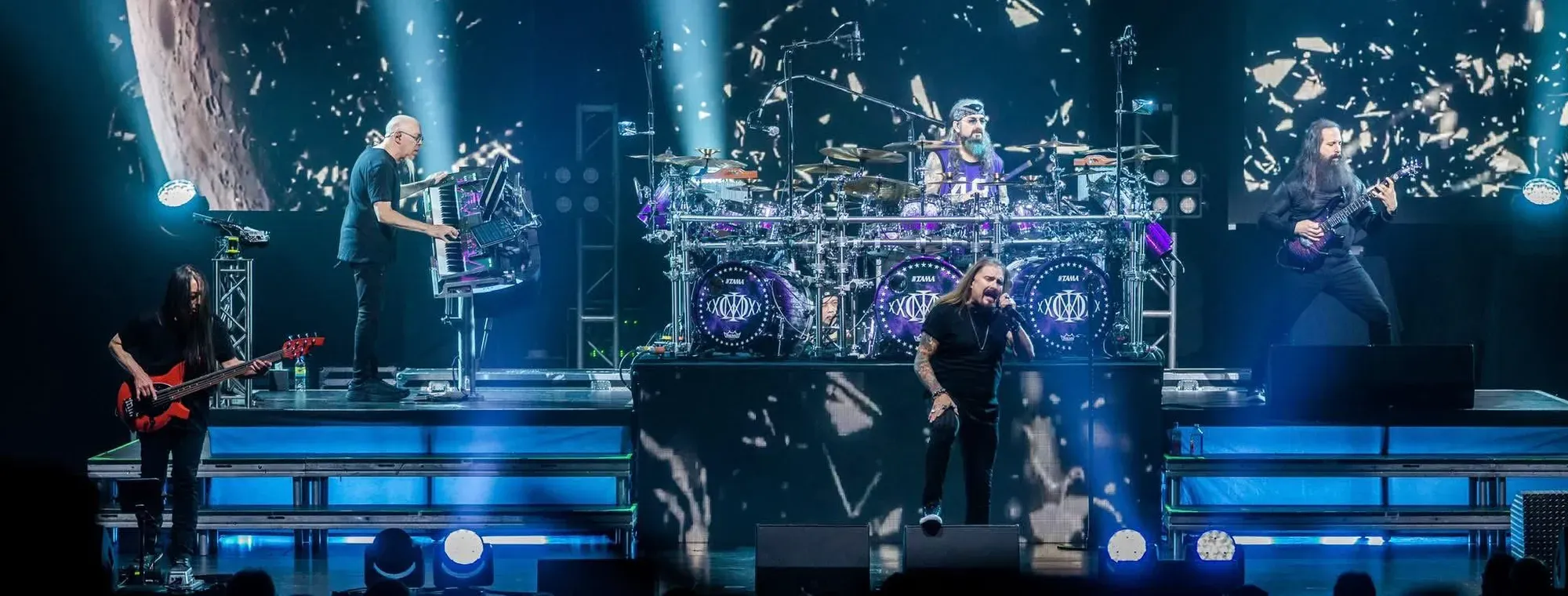
John Petrucci of Dream Theater
by Roger Lotring · September 30, 1997
InterviewJohn Petrucci18 min read
It’s been a long time in the making, but Dream Theater returned during the later part of 1997 with a new, full-length album called Falling Into Infinity. For a band usually categorized as a progressive metal band, Falling Into Infinity marked an exploration into different areas. Although the CD features plenty of epic Dream Theater music that their devoted audience continually demands, it also offers a new appreciation of concise, melodic songs. With tracks like “Hollow Years” and “Take Away My Pain,” the band has the potential to reach an even broader audience than ever before. Guitarist John Petrucci took time from the band’s busy preparations for their tour to talk about the creativity and relationships that sustain him as a song writer, as well as collaborating with Desmond Child and King’s X vocalist Doug Pinnick.
So, you guys have your new album out.
Yes, we do.
A long time in the making. What’s the next step? Are you getting ready to go out on tour?
Yeah. We’re setting everything up, trying to do as much promotion as we can before we hit the road. We’re going to start in America around October 25th, and I think we’ll actually start in Connecticut, coincidentally.
Oh, really? Somebody’s going to be upset with that. I’m getting married on the 25th.
Oh, is that right?
And my fiancee and her best friend-who’s coincidentally in the wedding party-are probably the two biggest Dream Theater fans I’ve ever met.
Oh, no!
In fact, we actually met at one of your shows.
Oh, cool.
At the El ‘N’ Gee in New London [Connecticut]. It was two years ago when you were doing those shows around Christmas time.
I remember.
Oh, she’s going to be bummed when she hears that!
Yeah. I mean, I’m not totally sure, but I think it’s going to be at Toad’s [Place] on the twenty-fifth; I think that’s the starting date. But I could be wrong. That’ll kick off the American leg, and then we’ll go, next year, to Europe and Asia and South America and stuff.
You just actually got back from Brazil.
Yeah. We went there for the first time. We’ve never played there and we went there before the record was out, so we concentrated mostly on the old material. And, it went real well.
My understanding is that when you were down there, you did smaller venues-two or three thousand seats.
Well, we did three shows, and the first two, I think, were like, seven thousand. It was actually our biggest headlining show, and then the last one was like, three or four thousand.
It just strikes me as rather odd, because most of the time when you hear of any English-speaking bands, shall we say, playing in South America, it’s usually big stadium productions.
Right. Oh, totally, totally, I think that we have the potential of growing to that level there. I mean, just seeing the enthusiasm, never going there at all. And going down there and doing real successful shows, I think we have the potential of being one of those bands. There’s certainly a lot of fans down there.
Did you find that the fans down there were very familiar with your material?
Oh, yeah, totally. Definitely. It was as if we’d been there many times. They knew all the words and everything. It was very cool.
Which just has to be especially cool, considering that most of the people down there probably don’t speak English. Y’know, just to hear ‘em singing your songs.
Yeah, exactly.
This new album, one of the things that I like about it is the fact that it seems more... ah, how do I put it? It seems more concise and song-oriented, rather than long and epic. I mean, there’s stuff on there that certainly falls into that sort of categorization, but there’s a lot of stuff on there that I find really accessible.
That’s definitely true. I mean, it’s definitely more song-oriented, and I think that we tried to have a balance because we’ve built our careers based on a style that we love to do, so we’re not about to change our identity or something-it’s real important to us. But I think that we all want to become better at writing songs. And, if you can kind of create a balance between your musical integrity and trying to write good songs, and, in our case, challenging ourselves musically and stuff like that, then that’s a good album. That’s what we tried to do.
It just seemed to me like maybe it was a step in the direction of... not necessarily freeing yourself from the typical Dream Theater material, but creating that option.
Yeah. I think-it’s almost like a simple matter, y’know? In a lot of our songs-’cause we’ve always focused in melody and grooves-the meaning of a song has always been important to us, but we’ve always kind of like, meandered a bit within that structure. It’s really funny... people would say to us, “You can take this song and make three songs out of it.” [Laughs] And, we kind of did that on this album, literally. We’d have some songs that were real long and had lots of changes in direction, and we used some of those sections-take ‘em out and use ‘em as whole other songs. So there’s sort of a consistent vibe throughout one song. It was kind of like, liberating to do that because you give yourself the freedom of just pursuing a real consistent thought and focusing in, and it was real cool.
One of the things that I think I really enjoyed about this album is the fact that you did all the songs song-by-song.
Yeah.
I’ve always found in the past with Dream Theater material that it just-it’s precise, but it just seems to lack a certain amount of emotion.
Yeah!
And this time around, it seems like you hit that right on the head.
I think so too. I appreciate you saying that. I think that the goal of Kevin Shirley as a producer was to bring that out-to get more of a live element, to not over-produce. And, to do one song at a time. It’s what we wanted to do and what he wanted to do, so each song would have a certain identity. You can do more experimentation that way, and all the band members can be involved-it’s more of a band effort doing it that way. So everybody’s constantly playing together and making improvements and changes together. I think if you do it that way, you loose some of the sterilization, y’know?
I’m sure there’s already a strong bond from all the years that you guys have played together, but did you find that doing it in a situation where you were all together, that that built up the comraderie even more?
Yeah, definitely. I mean, that’s going to happen as a result of that, y’know? It’s a cool process. Recording’s a lot of fun, and I think it’s more fun when there’s a real sort of positive vibe going on with everybody at the same time.
Did you find in this case that it may have been difficult as far as previous recording experiences [are concerned]? I always got the impression with previous Dream Theater albums that everything had to be so precise and on the money, and I gathered with this time, maybe that wasn’t quite so true. Was that a difficult thing to get over?
Well, it’s funny because with all our albums, we don’t get really perfectionist-minded when we record. I think we’re pretty tight because we’ve been playing together for a while, but things definitely aren’t perfect. They never have been in the past, and it really wasn’t any different this time around. Most of the songs we’d already been playing-we played a few of them live. We can play them through, so it really was the same thing. There is a way to balance getting a performance that’s the right thing that’s polished, but at the same time, that’s fresh enough to have the emotion. Like I said, I think from having the experience of playing live and stuff, there really wasn’t a change in that.
It’s interesting to look at the credits and the liner notes on this album and some of the names that are on there, particularly Desmond Child. From his background and what he’s known for, I would’ve never, ever, associated him with Dream Theater.
Right, right. There’s a funny story with Desmond. When I went down to work on this song [“You Not Me”] with him, he said that all the people on his staff, like his interns, were all big Dream Theater fans and they were all excited that I was coming down. It’s hilarious, y’know? He’s like, “Yeah, I just met with Madonna, and I told them that if she calls, let me know. And they were like, ‘Yeah, yeah yeah.’ And then I said that you were coming down, and they were like, ‘Oh, man!’“ [Laughs] It’s pretty funny, things that you don’t think of [like] the way you’re perceived or whatever, isn’t necessarily the case.
No, not at all. I mean, my first thought when I saw the name was thinking of the stuff that he’s done with Kiss and Aerosmith and so forth. Oh, God, what is this gonna be?! And, it was not what I expected.
Yeah. That’s cool.
Now Doug Pinnick, that was a fantastic surprise!
Yeah, I love Doug, he’s awesome.
Quite frankly, I think the vocals that he did on “Lines In The Sand” are probably the best thing he’s ever done. [Laughs] How did that come about?
Well, we wrote that song and the chorus to that song where he’s singing, we had his type of style in mind, y’know? And we were telling James, “Kinda sing it with a Doug vibe.” And then when it came to doing the record, we were like, “Why don’t we ask Doug to do it?” Y’know, we know him, and he was happy to do it. So we got the actual guy that inspired the part to do it. [Laughs] And it was so cool watching him do it. We gave him the words and he just improvised a whole bunch of takes and it was amazing. I mean, he’s so soulful.
Yeah! I mean, that’s what makes that tune so interesting to me, is that there’s just such a tension between James having the lush, high European voice, and Doug’s voice being so gritty and, as you said, soulful. It creates such a really cool tension.
Yeah, it does.
As far as working with Kevin [Shirley], I know in the past you guys were always compared to Yes and Rush and Kansas and so forth. That must have been kind of cool working with him, considering that he’s worked with... well, with Rush, particularly.
Yeah, it was great, especially the stories. [Laughs] He’s really good friends with Geddy and he’s really cool. He got us Rush tickets when they played in the area. [Laughs]
Oh, that’s cool. On the subject of influences and everything, it seems kind of neat, too, [that] the guy that you got to do the album covers-
Yeah, that was totally cool. I mean, I’m such a big Pink Floyd fan and it’s like, you look at that stuff and the Zeppelin covers, and you’re like, “Man, we’d love to work with someone like this.” And, we’ve thought that for a while, and this time it actually worked out. It was cool because he fit right into us, and we fit right into him. As soon as we told him the title of the album, he was kind of laughing. Like, “I think I can do something with that.” It fit right in.
Well, that must be kind of cool, considering growing up and listening to that kind of stuff, you probably never imagined, “God, whoever did this artwork...”
I know! There’s a lot of real weird things that happen as you move on and you’re able to do this professionally. And that’s one of ‘em, being able to work with people like that, like you said, you grew up admiring their work. It’s amazing.
And then, all of a sudden, they’re doing your album covers.
Yeah, and you’re talking to the guy and you’re like, “What?”
One of the things that I think is really interesting about the band is the level of fan devotion that you guys have. I went to a show last year at the Strand in Providence, Rhode Island. I’m a pretty big guy, pretty tall, and there was a guy standing behind me [who] tapped me on the shoulder and said, “Would you mind moving out of the way so I can see?” I’m like, “Yeah, no problem.” And he starts to tell me that he wasn’t trying to be rude pushing me aside, but he had come all the way up from, I don’t know, like South Carolina or Georgia, all the way to Providence to see you guys. I’m sure New England isn’t the only place that you guys play live. [Laughs] It just was so interesting to hear that somebody came that far to see you guys.
I think that’s great. That’s how we’re able to develop and continue to do this. I think that the fans being that dedicated to the band and interested in what we’re doing has helped us to continue to be able to do this. And, I think them being consistent allows us to be consistent, be ourselves. You know what I mean? It’s just like we feed off of it, and it’s really, really cool. Some of the things that you hear people say or things like you said-somebody driving real far, or seeing so many shows, or telling you a story on how such-and-such song or something was a positive influence or whatever, it’s just... it’s real, real cool.
It’s just really strange to hear people arguing over various performances. It almost sounds like the Grateful Dead, y’know? It’s just something I wouldn’t associate with a rock band.
I know, I know. It’s great. It’s so wild, it really is wild. Very cool.
Something that was pretty cool on this album is to see that John [Myung]’s playing the Chapman Stick. And yes, I actually know what it is! [Laughs]
[Laughs] There you go.
Was it experimental, or is it something he’s played for a while?
No, he actually got it pretty recently. That’s like, the instrument for him because he’s kind of an experimental kind of guy and he likes to have a wide range of sonic capability. He likes to play melodic chordal ideas. He plays piano-I mean, it’s just like, the perfect instrument for him.
Have you come across all the questions yet about that? Like, “Boy, what’s he playing there? A two-by-four with some string on it?”
Yeah, right. I don’t think most people really know what that is. He hasn’t played that live with us yet, but when you bring it up, people are like, “What’s that?”
As I mentioned before, how surprised I was with Desmond Child, it’s kind of interesting with your keyboard player now, considering where he comes from and with whom he’s played. It was quite surprising, like, “Wow! He’s playing with Dream Theater?!”
Yeah. It’s funny, it’s like, Derek pretty much has the same background as us-growing up listening to the same type of bands, going to Berklee and studying music. It’s just that he pursued a different course. Whereas we formed a band, he got gigs doing the sideman thing. It was only a matter of time until he got into a band where he was able to write and everything else.
From my perspective, it sounds like, as far as the keyboards are concerned, there’s a lot more jazzy soulfulness, which I think kind of lightens up the-for lack of a better word-sterility. It just kind of makes things a little bit more human, I think.
Yeah, exactly. That’s his whole vibe.
I’m curious about this whole Nightmare Cinema project.
Oh, don’t be too curious. [Laughs] It’s nothing.
Is that an ongoing thing, or is it just a one-time-
Well, actually, what we did one night is we decided to play a song, just switching our instruments. I played drums and Mike played guitar-no, bass. John played keyboards and Derek played guitar. Y’know, it sounds horrible. But we had to call it something, so we just like, did the reverse of our name.
So it’s actually not something that’s a serious, ongoing-
Oh, it’s totally not serious at all! Whether or not it’s ongoing is another story. [Laughs] But it’s the farthest from serious.
Actually, have you ever considered maybe doing something like opening for yourselves?
Well, y’know, it’s funny. Mike and I, we’re doing a side-project album right now with Tony Levin and Jordan Rudess. It’s all instrumental. It’s real cool. It’s pretty wacky, progressive stuff. And we talked about it. “Oh, we should open for ourselves.”
That would actually be kind of cool. Something that I never really realized before is how much of a lyricist you are. I mean, I always just go under the assumption [of] “Okay, singer... writes the lyrics.” And it was pretty wild to go through this album and [say], “Wow! This guy has written a lot of the lyrics on here.”
I’m real into it, y’know? I’ve always been into writing, and I’ve always gotten into the lyrics in bands. I mean, whether it was Marillion or Rush or Pink Floyd, they’ve always moved me, and I think it’s a real creative form of writing. It’s something that comes natural to me, so I love doing it.
Something that’s really interesting, I think, is the song “Take My Pain Away.” Considering the subject matter, it’s pretty wild that musically, it’s very upbeat.
Right. And the subject is very-it’s not necessarily dark, but it’s of a very serious nature. Yeah, there is a contrasting feel there. The song originally started out as an acoustic thing, still with a more positive musical outlook, but a little bit darker in the way it was presented. And this version, which is more rhythmical, more tribal, turned out to be more poppy and happy, so it’s kind of a strange marriage there.
Yeah, very much so because, again, I had one expectation and it didn’t turn out to be what I thought it was going to be. It’s really kind of neat with this record how it just bounces through so many things. I mean, there’s stuff on here that sounds very, very European and very... almost majestic. And then there’s other stuff that just sounds like classic Metallica. Is that a conscious effort to encompass so many styles, or is it just natural?
Nah, it’s just natural. We’re just spitting out our influences. I mean, yeah, Metallica and hard rock metal bands and stuff, are things that we grew up on, as well as progressive bands and fusion and jazz and classical. So it’s kind of like, we’re in a band where we give ourselves the freedom of letting all this out, we’re not just confined to doing one thing. And it’s a lot of fun. It’s a lot of fun to write that way, and like I said, our influences are pretty obvious when you hear stuff, y’know? Like, “Oh, man that sounds like Metallica,” or, “That sounds like Floyd,” but it’s still us, and we have fun doing it.
I just think it’s really a positive thing in the sense that I think there’s a lot of people [that I’ve seen at your shows and listening to your music] that are probably more into a hard rock, heavy metal kind of thing, and I think that’s kind of cool that maybe you guys are the beginning point of somebody being exposed to different styles. Unfortunately, it seems like there’s a lot of people who don’t follow where something came from. “It’s not Metallica, so it’s no good. It sucks.”
Yeah.
One of the things I’m curious about is the significance of the title. Where did that come from?
Well, the name of the band being Dream Theater, we’ve used a lot of imagery having to do with dreams and drama and stuff. “Falling Into Infinity” is sort of a metaphor for like, entering into a state of dreaming where anything’s possible. And that’s kind of how we view the band and our writing process, so that’s basically where that one came from.
I’d also like to ask you about the song “Peruvian Skies.” What is the incident that that’s based on?
It’s based on... sort of about, like, child abuse, potential child abuse topic. As you’re reading the lyrics or going through it, it’s sort of from the perspective of someone that’s on the outside that detects something might be happening, and how they’re sort of dealing with it.
That must have been a really strange subject to write about, considering that you have children.
Yeah! It’s weird. Y’know, some things you really get into, and some things, as a writer, you remove yourself from. Something like “Take Away My Pain” is very personal, and it really comes from deep within, and letting it out is like... it’s sort of a therapy. Then there’s like, a fictional side that’s just a fun thing of writing. And you can write about stuff that you don’t have any experience in, whether it be dark or whatever. That’s half the fun of being creative.
Having a family now, how has that changed... I guess, even just the way you look at things. When I think of a rock band, I don’t think of a guy with a family life. And apparently, all of you guys are pretty well settled down.
Yeah, totally. I mean, it’s always something that I’ve wanted to do. I’ve always wanted to have children and I think it’s wonderful. I mean, I can’t imagine life any other way. The relationship that I have with my wife, and now with my kids, has been inspiring beyond what I could imagine. So far as creatively, it’s like your life and your whole perspective and your enrichment changes drastically. Obviously, being someone who has to tour and stuff like that, that’s something that has to be worked out. It’s a balance that has to try to be kept so you’re there. That’s the hard part, but I can’t imagine-I don’t think I’d get as far if I was just by myself.
I know what you mean, because I think maybe that’s just a part of growing up. When you’re younger, you feel invincible and you think that you can take on the world on your own.
Yeah. Y’know, it’s wild-whether it’s in music or any other form of entertainment, or art, or business, most people have families and children, and it’s like their center of their life. It doesn’t matter what they do. But, it’s cool.
Well, I don’t think I have any other questions.
Let me ask you something. You’re saying that your fiancee and her friend were real big Dream Theater fans?
Absolutely.
What’s their reaction to this album? I’m curious from fans’ perspective.
Y’know what? To be honest with you, they haven’t had a chance to listen to it, because I’ve been listening to it, boning up on it.
Uh-oh!
I think they’re gonna like it. I think there’s enough of what people have come to expect from Dream Theater that they’re gonna like it, enough so that it’ll lead them into the stuff that’s a little bit different.
Yeah, right. Well, that’s cool. I mean, I think that’s part of doing a new album. Stay true to the identity of the band, but you also grow and move on to something that brings in new people, and that challenges what you want to do musically. So, that’s cool. If it strikes that balance, that’s real cool.
Well, it’s actually something where they’ve been the people who are really into Dream Theater, and in all honesty, I haven’t. This album came, and I’ve been listening to it. And it’s something that, in all honesty, I’m really starting to get into.
Great, man! That’s so cool.