

Originally published in InterMusic.com · 1999
Rhythm meets Dream Theater drummer Mike Portnoy, a man very much in control of his own destiny...
InterviewMike Portnoy7 min read
When American avant-rockers Dream Theater first touched down in the UK in April 1993, they were something of an unknown quantity to the media and public alike.
Of course, the band had more Brit followers than the press acknowledged at the time, but it was their two-date Marquee Club debut (the second of which was released as an EP, Live At The Marquee) that really broke them over here and established drummer Mike Portnoy as a worldclass player.
Mike first appeared in the pages of Rhythm in the same year, interviewed backstage just hours before that inaugural gig. Mike has a copy of every magazine article he and Dream Theater have ever done, all archived at his home along with concert videos and live tapes, in what he proudly refers to as ‘The Museum of Dream Theater’. Speaking to Rhythm on the phone from New York recently, Mike commented, “There aren’t many from the UK though.
We have a heavy metal and progressive rock reputation in the UK which we are trying to change. We would like more people to listen to our music and form their own opinions. Dream Theater is actually a giant melting pot of many different influences which the band members have brought into the main plot – like a film. Some of our instrumental music is along the lines of a film score, and we hope to do some work in that area soon.”
Mike started playing drums at the age of eleven and defines his style as “the technical approach of Neil Peart and Bill Bruford, mixed with the balls and energy of Lars Ulrich and Vinnie Paul. My aim is never to be too technical or too animalistic. My musical life and career is a set of different stages: first it was The Beatles and Ringo Starr; second, Keith Moon, John Bonham, Ginger Baker and Ian Paice.
Then I went through my Kiss era, which was followed by an interest in the more progressive styles of Neil Peart, Bill Bruford, Terry Bozzio, Simon Phillips and Rod Morgenstein. I call that my ‘art of drumming’ stage. Finally I got into thrash bands like Slayer, Anthrax, Metallica and Pantera for the double bass drum angle.”
Mike trained at the Berklee College of Music in Boston, Massachusetts, an institution renowned for its strong jazz-fusion curriculum. “I studied music theory, including harmony, sight-reading, arranging and ear-training, for a year,” he says. “Dream Theater was put together while we were all students there. I also play guitar, bass and keyboards, which helps with my songwriting.
If I started all over again, I wouldn’t play drums – I’d be in the front line. I used to get backache from having my drum stool set up too high so I could be seen by the audience, but now I take more care of myself. I also stopped smoking a couple of years ago.”
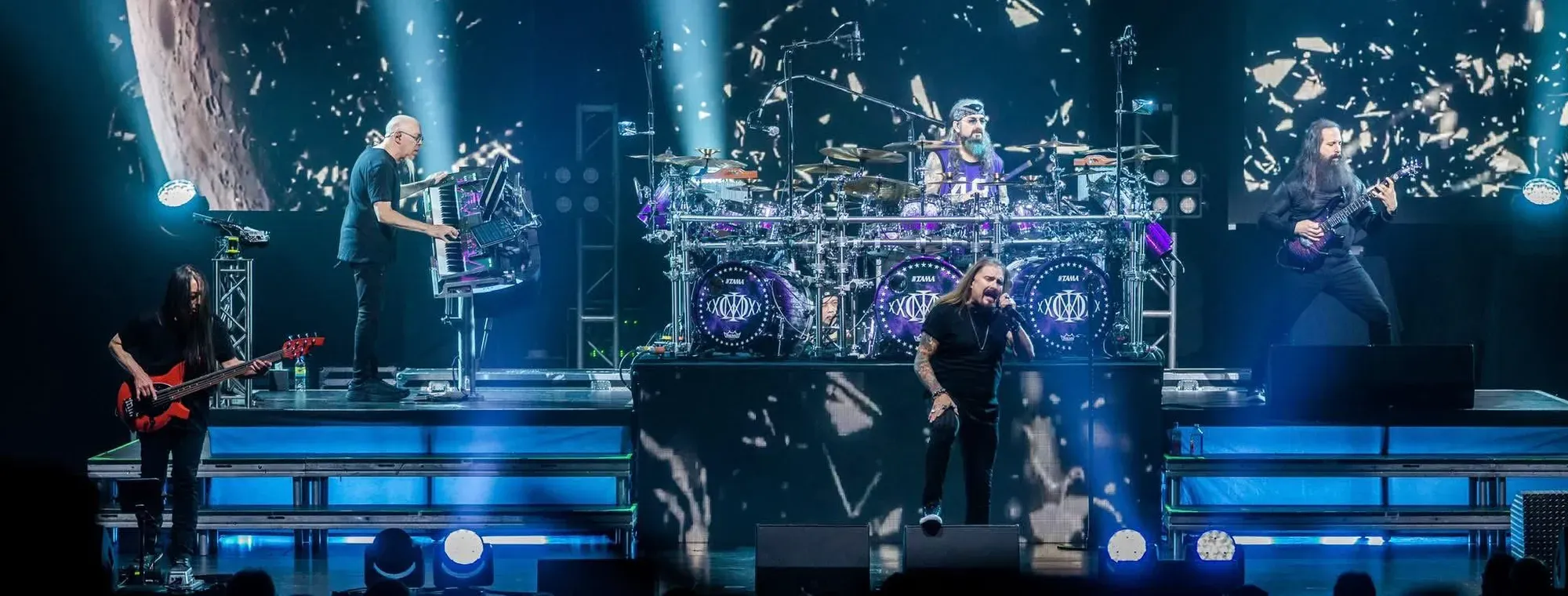
Dream Theater’s classic line-up – comprising Kevin Moore (keyboards), John Myung (bass), John Petrucci (guitar) and James LaBrie (vocals) – first shared their musical vision with the world in 1992, with the album Images And Words. However, the band’s literal debut album was When Dream & Day Unite, featuring vocalist Charlie Dominici and released in 1989. AtCo put out the Live At The Marquee EP and the video Images And Words Live In Tokyo in 1993, both of which Mike played a major part in besides his drumming contribution (“although I didn’t get any directing credits on the first video”). These were followed up by the much heavier Awake in 1994.
Immediately after the completion of Awake, keyboard player and founder member Kevin Moore announced that he was leaving Dream Theater and wouldn’t be doing the 1995 tour in support of the album. The rest of the band were shell-shocked to say the least, but undaunted, they turned their attentions to setting up the tour and drafted in fellow Berklee graduate Derek Sherinian, from Alice Cooper’s Trash and Hey Stoopid era. Apart from taking over keyboard duties, Derek also wrote parts of the music (although most of it was already finished) for the next album, A Change of Seasons. That album, released in 1995, was the first to feature lyrics written by Mike.
In 1996, Dream Theater took a break from recording and touring while Mike and John Petrucci concentrated on starting families and John Myung got married. However, Mike continued to host drum clinics to promote his instructional video, Progressive Drum Concepts, which he somehow found the time to make during 1995. So does he actually get any time to relax?
“Yeah, I drink a lot, play Nintendo and watch boxing videos,” he laughs.
During the 1996 hiatus, Mike got involved in an intriguing project centred around one of his heroes. “I’ve always been a great fan of Neil Peart’s playing with Rush, and I was asked to be Creative Consultant for a tribute album called Working Man, put together by Pete Morticelli and Mike Varney of Magna Carta Records. I played drums for half the songs on that album. John Petrucci contributed guitar on one song and James LaBrie sang on two others.
After that, in 1997, I was approached by Pete and Mike just before I started recording Falling into Infinity with Dream Theater. They asked me to compile a wish list of all the musicians I had ever wanted to work with, so I came up with Tony Levin and Billy Sheehan on bass, and Jordan Rudess and Jens Johansson on keyboards. Guitarists approached included everybody from Steve Morse to Dimebag Darrell to Trevor Rabin, but they were unavailable or just not interested. Then my wife pointed out that the guitarist answer was right under my nose: I’d not asked John Petrucci, wanting to keep this side project separate from Dream Theater. But we had played some pretty extensive improvisational jams during a clinic tour of Europe the previous year. So Liquid Tension Experiment finally got to the studio in September 1997, with Tony Levin, John Petrucci and Jordan Rudess.”
Falling Into Infinity was released at the end of 1997. Many fans regarded it as Dream Theater’s greatest work since Images and Words. During the recording of the album, Mike decided to give the band’s dedicated followers a bit of a bonus.
“I always have my two-track DAT and camcorder with me, because I like to record and video all our gigs, various backstage moments and recording sessions,” he explains. “I recorded, edited and compiled a CD called The Making of Falling Into Infinity. We had a great reaction to that and it’s since become a collector’s item, although I still have a few stashed away in my basement for posterity.” At the end of 1997, Dream Theater took to the road once again for another, no less exhaustive, tour. “We were doing the usual mammoth sessions, but this time we had frequent breaks so we could be with our families.”
Nonetheless, they still managed to pack in an inordinate amount of interviews, clinics and in-stores appearances. The tour finished at the end of June, 1998 with a special double set at Le Bataclan in Paris. The gig was recorded for a double live CD, Once In A Livetime.
“We took a mobile 48-track studio out with us. I use eighteen channels just for my drums when I record, and even then I have to consolidate some of them. I have six Octobans bounced down onto two tracks, for example.”
The Paris show and a further unplugged performance in Rotterdam the same week were also filmed for a simultaneous video release entitled Five Years In A Livetime.
“That was my project,” stresses Mike, “and it was a lot of fun. This time I have a director’s credit because I compiled, edited and directed the whole thing. We had five years of footage, different recording sources from all over the world – London, Paris, Tokyo, Germany, USA – some multi-tracked, some mixed, some on my portable DAT. It was kind of tricky in places, but I recorded everything.”
Straight after they finished that tour, Mike and John Petrucci got together with Tony Levin and Jordan Rudess again to record the second Liquid Tension Experiment opus. After a week the project was interrupted by the birth of John’s third child, but the four-piece went back into the studio at the beginning of this year and finished the album. Then came another significant change in Dream Theater’s personnel roster...
“We had such a good time writing and recording with Jordan that we asked him to join the band,” Mike grins. “He did one show with us in 1994 right after Kevin left and before Derek joined. We asked him then but we were touring heavily; we’d be out on the road for a good solid year without much break. Jordan and his wife had one child and another on the way, so he wasn’t prepared to go out and be the road warrior. Over the past five years, we’ve become more like him – we want to make the band more family conducive, spacing out the schedules to allow for our personal lives.
The two albums we did with Liquid Tension Experiment were an excuse for me to work with Jordan because I have tremendous respect for him. After the second album, we decided not to limit ourselves to side projects when we could have Jordan in Dream Theater full time. Derek is a great player and he made an excellent contribution to the writing and the Dream Theater image, but ultimately Jordan is more Dream Theater 2000. He’s taking us into the new millennium.”
By the time you read this, the first Dream Theater album with Jordan Rudess on keyboards will be almost ready to hit the record shops. And the band will be backing it up with a tour starting in Autumn/Winter of 1999. Keep a space in your diary for it, because any opportunity to see this truly incredible drummer and his equally stunning band should not be missed.