

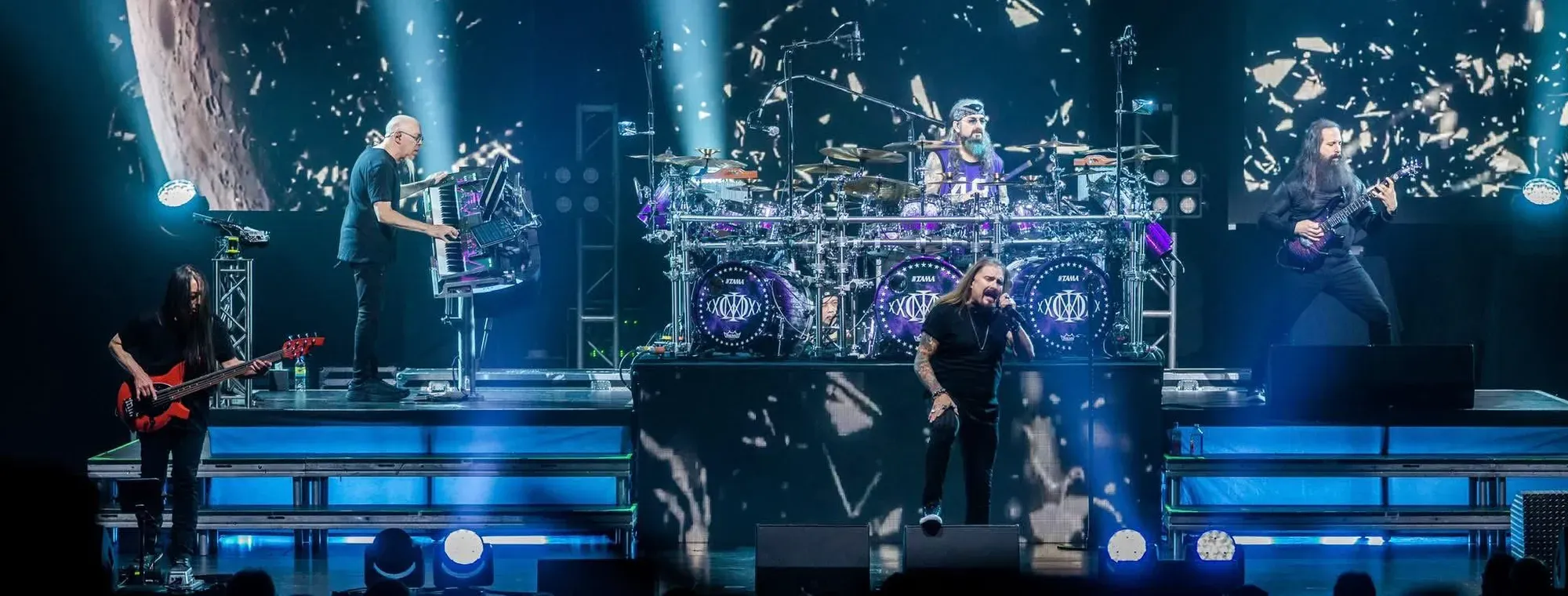
Originally published in Peavey.com · August 2003
Scenes from His Memory: A Conversation with Dream Theater's Accomplished Keyboardist
August 1, 2003
InterviewJordan Rudess8 min read
Jordan Rudess talks about entering Juilliard at age 9 with an almost casual manner, as if average third-graders spend afternoons practicing Bach concertos. They don't, rest assured, and neither do they grow up to become among the most prolific and respected keyboard players in modern music.
You can credit his talent – Rudess devoured classical piano as a precocious pre-teen while simultaneously honing his improvisational chops – or his curiosity and drive to create (programming synthesizer sounds for major companies by age 19 before pursuing a career as a recording musician), but his success has as much to do with his industrious work ethic and discipline as anything else. By his early 20s, Rudess had known more sides of the music industry than most pop musicians know chords.
Although Dream Theater has been a major part of Rudess's life since 1999 and the source of much of his celebrity, it accounts for only a fraction of his album credits – at last count totaling 31, including David Bowie, Liquid Tension Experiment and several solo albums stretching back to 1988. His extensive catalog will include at least one new entry in 2003, an as-yet-untitled Dream Theater record that should hit stores this fall, and he just completed a Dream Theater tour co-headlined by heroes-turned-contemporaries Queensrÿche. In the interim, Ytsejam Records (run by Mike Portnoy of DT) is releasing "official bootlegs" of Dream Theater music covering all sectors of the band's career, including live shows, demos, covers and miscellaneous studio projects.
Here, Peavey gets to the root of Rudess's multiple musical personalities. And she's an opinionated, austere music instructor from Eastern Europe with a wicked disdain for orchestral pop.
Peavey: You're a Juilliard graduate and have a long, well-rounded history in the music industry. What do you think you've brought to Dream Theater?
Jordan: My strong classical background is something they've never really had in a keyboardist before, so that's part one. The other part is my background in synthesizers. After I left Juilliard, I got heavily into synthesizers. I went from doing classical music to doing Tangerine Dream/synthesizer/electronic stuff. After that, I ended up doing a lot of programming for all the different sounds that come from the synthesizers, so I really had a deep familiarity of them. Those two elements together – the fact that I was a very seriously trained classical pianist and someone who was really into making sound and knew how to operate synthesizers and create my own sounds – those are the things that shaped who I am as a keyboardist.
Is there anything different in your approach to songwriting in Dream Theater as opposed to your solo work?
When I do solo work it primarily features the keyboards and synthesizers like on my last rock album, which was called Feeding the Wheel. Basically, the majority of the sounds were my keyboards, and I had Terry Bozzio playing drums. So even as far as playing all the bass parts and almost everything you heard, beyond that there were guest musicians playing. So when I work by myself, I'm really creating a whole world of orchestration on my own on my synthesizers; when I'm playing in Dream Theater, there's a whole band around me and a certain amount of space available for keyboards – sometimes more space than other times, but in general, it's a role within a unit.
Are Dream Theater's live shows regimented, as far as song structure goes?
Dream Theater is not a band that jams much. There are certainly sections, like lead sections, where we'll play differently every night, but the band as a whole pretty much sticks to the arrangement as we know it. It's not like there's a section within a song where we'll go into an all-out jam. At the most, there may be a section where we have just a set of chords and have a little more freedom. In general, we keep it very structured.
Is that any different from your solo shows?
Well, I only do solo shows occasionally, but it is an extremely different part of who I am as a musician, because some of my CDs – and especially ones like 4NYC and Secrets of the Muse – are very much based on improvisation. They're albums that feature piano or keyboard sounds, more on the gentler side, not rock 'n' roll at all. I like to sit down at the keyboard and just make up stuff spontaneously, so that's the totally other side of the coin from Dream Theater. It keeps me balanced. I've always been an improviser, though, since I started playing music. That's how I started.
Even with your classical background?
Yeah. What happened was there was a piano in my second grade classroom, and one day I just started to play it. My teacher called my mom and said (assumes voice), "Hey, your kid is playing the piano in the classroom." She said, "What do you mean? We don't have a piano (at home)." She goes, "Well, he's playing." So, I was just interested in playing the instrument, and when I started to take lessons, my very first teacher was one of these guys who used to come around the neighborhood and just teach the kids, and he was fascinated with what I was doing and decided to teach me all the chords and more of a pop approach. He didn't really teach me much about reading. But then when I started to pick it up very quickly, my parents said, "Well, this is fairly serious, so we need to take him to a very strict classical teacher."
So they took me to this wild Hungarian woman who actually had a funny story: her son was supposed to be a classical pianist, and emerged out of Juilliard only to play in (traditional/orchestral pop band leader) Guy Lombardo's band. So she was this wild, temperamental piano teacher who, added to that, had the frustration of having her own son, who was a genius, go off and play with Guy Lombardo! So when she met me and found out I was an improviser, she was even stricter in keeping me focused. At this point, I was nine years old and she wanted to see me go directly into Juilliard and totally, you know, stay very, very focused. She used to give me these gentle kicks into the piano when I was playing scales and not doing it right!
So then I actually got into Juilliard when I was nine and was, for a while, a closet improviser while I got my structure together. But I always played songs. Since day one, my mom would bring sheet music, just chords with a melody, and I would just play. So it was something I did in addition to this strict classical background.
How did you come across the KB5 keyboard amplifier?
I play in a pretty heavy rock band and they've got some serious volume to deal with, and I needed something that would be really strong and clear. I spend a lot of time programming my sounds and I care a lot about how they sound. In this case, I needed them to sound good and also be very loud! And I needed something that would survive from rehearsal studio to rehearsal studio and on the road. I needed something strong. That's how I came upon the KB5.
So when you're playing in amphitheaters or arenas, do you use it mic'd up or as a monitor?
So far, I've used it in rehearsals and the studio. We used them the whole time we were in the writing process for the new Dream Theater album. They were very handy, because I was able to crank out my own level. We do it kind of like the "garage" approach. On the last few albums, we were pretty much in studio mode and we'd do headphones and it was all very controlled. But with this one, we decided to just go in there and bust it out and play and go nuts, crank it up and see what the energy was like. Also, sometimes when we would want to turn down a little bit, some of the guys would just come over and plug into my system. So, at some points, we had John Petrucci and John Myung playing out of the KB5, because it has so many inputs! So that was pretty cool. I smiled and said, "If Peavey could see this, they'd be happy!" It was just very convenient. Getting all of their rigs together is very complicated, so we just plugged into my amp.
Will the new album be out soon?
It's going to be out in the fall. I don't have an exact release date, and there's no title to share yet.
Besides its numerous inputs, what do you think sets the KB5 apart from other keyboard amps?
What's really great about it is it's so solid. I just get the feeling that you can do anything with it and it'll survive. It's very road friendly. I had two of them out on a solo gig the other day – it was an outdoor gig, and the P.A. was fairly inadequate. So I put a KB5 on either side of the stage and just wailed. The engineer said he could see the cones really pumping. They were handling it! It was great! (laughs) If you have a speaker that'll survive hardcore usage like that, it's good.
How did the summer tour with Queensrÿche come about? Was it through mutual admiration?
This is something we've wanted to do for a while, something our management has been toying with for some time, and finally it all came together. We're excited, because Queensrÿche was a major influence and here we are, headlining half the gigs. It's kind of trippy for us. And I know that a lot of Dream Theater fans are also fans of Queensrÿche. Fates Warning is on the tour as well, and they're kind of in the same vein. A lot of fans are into all three bands.
Where do you see your music in five years? Or does that type of thinking contradict your philosophy?
Not at all. I'm very interested in technology, and I'm constantly thinking about how I can have more fun with my sound and see what else I can do to make it more interesting. I listen to music that's fairly cutting edge, a lot of electronica, and right now I'm getting into surround sound and composing for that. I just see myself going more and more in that kind of direction, using more of the tools that enable me to do more and more cool sonic things. One of the things I'm doing is arranging music for a show called "The Mancini Project," and my plan is to do part of it in surround. So that's one of the areas I like to stay somewhat involved in rather than just being a rock 'n' roll touring guy.