

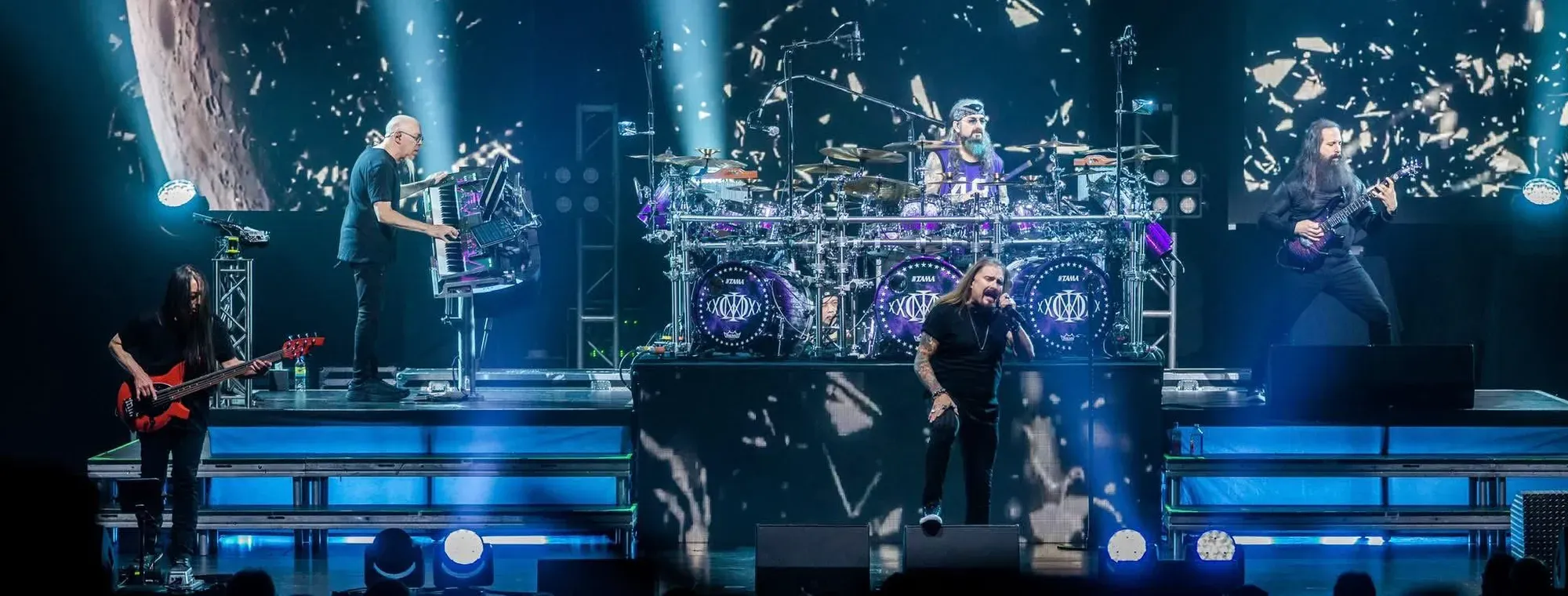
Originally published in Dream Theater · 2005
Dream Theater: The First Twenty Years...
Article9 min read
It’s mid-afternoon on Wednesday 16th February 2005 and, to coin a phrase, it’s raining on the streets of New York City. Tucked away in the Hit Factory Recording Studio on West 54th Street, Dream Theater are continuing to work on their album ‘Octavarium’ but today isn’t just another routine day. Studio One is accessed via a vast polished, antiquated elevator, and setting up behind the tinted glass on the expansive timber floor of the legendary studio – where everyone from John Lennon to Bruce Springsteen to Madonna has previously stood – is a sixteen-piece orchestra. The culmination of three months studio work, the classically trained musicians are providing their expert services for a single afternoon to add lilting string passages to a number of the album’s tracks. Ensuring that every aspect of the recording session is captured to perfection, drummer Mike Portnoy and guitarist John Petrucci sit at attention behind a sprawling control panel. Realising a lifelong band ambition, it’s one of many career zeniths that, back in the mid-eighties, would have seemed like an unattainable goal to the music college students who first hooked up together simply to perform a style of music they adored.
It was the fall of 1985 at the renowned Berklee College Of Music in Boston that school friends John Petrucci and bassist John Myung stumbled across a fellow inhabitant of Long Island, drummer Mike Portnoy. Portnoy had been practising in a rehearsal room and the three of them started jamming and bouncing musical ideas off each other.
“We never even officially said ‘Hey, let’s get together and form a band’,” smiles Mike. “We just started jamming one night and then it was like ‘OK we’ll see you tomorrow.’ It just somehow became understood that we would stay together. It is incredible. What are the chances of three kids, loving the exact type of music and coming from the same place, Long Island? It was almost like fate that the three of us connected.”
All three shared a devout passion for the likes of Rush, Iron Maiden, Queensrÿche, Metallica and Yes and the music that they began to create was a heady blend of all those diverse influences. Deciding that their future was destined to be together in a band, they left the college after an academic year to return home, joining up with similarly minded keyboard player Kevin Moore and shortly after, vocalist Chris Collins. Electing to call themselves Majesty, they soon began to put together a succession of demos and began playing gigs around Long Island in the summer of 1986. But within a few short months, Majesty had decided that Collins tenure had to come to an end after the band questioned both his vocal abilities and commitment to the band.
The band then spent an agonising year trying to replace him, finally settling on fellow Long Islander Charlie Dominici. A record deal with the Mechanic label was soon struck but before their debut album could be released, a name change was required after it emerged that a band in Las Vegas shared the Majesty moniker. After floating a number of suggestions that ranged from Glasser to Asparagus Piss, the name Dream Theater was chosen and ‘When Dream And Day Unite’ was finally released in March 1989. Although hampered by a low-budget production and deprived of any meaningful record label support, the album had an original, progressive metal edge and it rightly received numerous plaudits and rave reviews in the music press. But by that stage, the band began to have doubts about the suitability of Charlie’s voice, often likening it to Billy Joel trying to sing with Queensrÿche. Dominici played his last gig with the band in November 1989.
Finding themselves once again without a singer, the band took the best part of eighteen months struggling to recruit their ideal replacement, eventually coming across former Winter Rose vocalist, James LaBrie. LaBrie formally joined the band in January 1991, and within a few short months the new line-up had recorded a demo that attracted the attention of the Atco record label. Once the band escaped from their contract with the Mechanic label, they were promptly signed. The follow-up album, ‘Images And Words’ was released in July 1992 and contained the track ‘Pull Me Under’ which became an unlikely hit single. Far from the album’s most accessible song for the casual listener and edited down from around eight minutes to a mere five, it was heavily rotated on MTV and soon the band’s gigs were selling out. The album, which also contained the classic track ‘Metropolis – Part 1’, along with the other singles ‘Take The Time’ and ‘Another Day’, went on to sell over half a million copies in the US alone, and peaked at number 61 on the Billboard chart. Protracted and successful tours of North America, Europe and Japan followed which further enhanced their growing reputation. A live EP recorded at London’s Marquee club and a long-form video documenting the tour were also well received.
Their next album ‘Awake’ was completed in 1994, and two singles ‘Lie’ and ‘The Silent Man’ were released to help promote it. Although the singles didn’t manage to repeat the success of ‘Pull Me Under’, the album still contained some of their most memorable and durable moments and reached number 32 in the US chart. The band were however astounded to discover that keyboardist Kevin Moore intended to resign following the release of the album. Moore had become noticeably isolated during the writing and recording process, and an official statement released in August 1994 revealed that Moore had left the band due to “musical differences.” After Jordan Rudess turned down the chance to join the band, Derek Sherinian was subsequently drafted in to fill the keyboard slot, and the ‘Awake’ tour began in the late summer of 1994. Completing the tour, the band returned to the studio in May 1995 to record the twenty-three minute epic track ‘A Change Of Seasons’ which was released later in the year, along with live recordings of cover songs that were recorded at a special gig at the Ronnie Scott’s club in London.
By the beginning of 1996, the band were recording demos for their next studio album, ‘Falling Into Infinity’. Due to changes in personnel at their record label, pressure was exerted on the band to make the record more commercial with the intention of achieving another hit single. Consequently, the band spent a frustrating period that Mike describes as a “horrible way to write music”, with their demos repeatedly being rejected before finally getting the go-ahead to start recording.
The album itself possessed the type of compact, accessible tunes that radio should have lapped up. But times had changed, and the album’s single didn’t achieve any lasting exposure or airplay. Ironically, the commercial failure of the singles on ‘Falling Into Infinity’ would play a part in finally unshackling them from the restrictions imposed by their label. Dream Theater demanded that they be allowed creative autonomy for all future recordings, and with the label realising that there was likelihood the band wouldn’t survive if they were denied this independence, they relented. Indeed, the band had nearly fragmented during the tour to support the album when Mike, frustrated with their musical direction and the incessant pressures from their label and management came close to leaving the band: “I’d had enough and was giving up. It was no longer fun,” says the drummer.
But the 116 gigs from that tour weren’t without their highlights. A section of the tour included intriguing “unplugged” sets and during August 1998, the band toured with Deep Purple and legendary prog rockers Emerson Lake & Palmer. A reminder of the tour came in the form of the double live CD ‘Once In A LIVEtime’, which had been recorded on the 25th June that year at Le Bataclan in Paris, as well as a companion long-form video that documented the band’s activities from 1994 to 1998.
An outlet for Mike’s exasperation came in the form of a side-project, the Liquid Tension Experiment, where he joined forces with fellow Dream Theater member John Petrucci, the aforementioned Jordan Rudess and renowned bassist Tony Levin to produce two stunningly intense instrumental albums. A healthy working relationship developed between the band members and once again, Mike and John invited Rudess to join Dream Theater. This time he grasped the opportunity and he replaced Derek Sherinian in the keyboard position. With the new line-up and the record label finally allowing the band to produce the type of music they wanted, rehearsals were soon underway to create an album that could truly define the Dream Theater sound.
The result of this newly found freedom of expression was 1999’s concept album masterpiece ‘Scenes From A Memory’. Clocking in with a continuous seventy-seven minutes of solid progressive rock, it genuinely rivalled such albums as Pink Floyd’s ‘The Wall’ and Queensrÿche’s ‘Operation: Mindcrime’ which had inspired its direction. Receiving enthusiastic reviews, the success was even more pleasing given that they had self-produced the album.
“It was very satisfying on so many levels,” smiles John Petrucci. “We’d taken a lot of chances at the time and there were people who thought it was a bad idea not to have a producer. I mean, making a concept album always made me nervous. So having it become successful was like we’d proved something.”
The tour was equally ambitious and the band performed the album in the only way that was feasible – non-stop from start to finish. The last performance of the entire album was recorded for a formidable triple-CD album and accompanying DVD release in New York City on August 30th 2000.
Their next release, ‘Six Degrees Of Inner Turbulence’ (2002) was another expansive release that spread over two discs. The album included ‘The Glass Prison’ which began a succession of songs dealing with Mike Portnoy’s battle with alcoholism. Each subsequent album has had one song in the as yet uncompleted series, which by the time of its conclusion, will have covered Alcoholics Anonymous’ twelve steps of recovery from addiction. The second disc contained the album’s imposing title track with Classic Rock magazine claiming “You really have to hear the music to appreciate its full magnitude.”
Beginning with the 2002 tour, the band began a tradition of covering a classic album in its entirety, such as Metallica’s ‘Master Of Puppets’ and Iron Maiden’s ‘Number Of The Beast’ whenever they play two consecutive gigs in a city. The straightforward, heavy metal nature of these albums encouraged them to try to write an album in a similar vein. The result was 2003’s ‘Train Of Thought’.
“After doing those shows, John Petrucci and I decided we had to make our next album a classic metal record,” says Mike Portnoy. “But it still had a progressive element in the sense that the playing was incredibly technical and completely over the top.”
Another fulfilled ambition occurred on April 26th 2004 when the band played the legendary Budokan in Tokyo. Every self-respecting artist from Eric Clapton to The Beatles, Cheap Trick to Ozzy Osbourne had recorded gigs there, and with the ‘Live At Budokan’ DVD and CD release that followed, Dream Theater joined a very select bunch of musicians.
Returning in 2005 with ‘Octavarium’, the band had determined that, after creating a definitive concept album in ‘Scenes From A Memory’ and the classic metal of their previous release, ‘Octavarium’ was to become a classic Dream Theater album. The lengthy title track is particularly special and combines a multitude of progressive rock influences from the last thirty-five years.
“We were really trying to get the more classic prog rock feel to the track,” explains Jordan. “We were looking for that ultimate Yes and Genesis sound and I was digging back into my progressive roots and thinking about some of the things that got me going.”
Having accomplished so much during the first two decades of their existence, Dream Theater could have been forgiven for resting on their laurels. But back in the studio on that damp New York afternoon, Mike explains that there are still numerous goals left to achieve.
“There’s still so much room and places for us to go,” he says. “It would be nice to see how long we can sustain this and keep going for another ten or twenty years.”
With the orchestra completing their parts and starting to pack away their instruments, a clue comes from John Petrucci as to the nature of just one remaining goal in the plethora of objectives the band still hope to achieve in the next twenty years. Turning to Mike and Jordan with a glint in his eye, he says “Man that was cool. Imagine what it would be like with a 50 piece orchestra...”
Rich Wilson
Classic Rock Magazine