

Originally published in Dream Theater · 2007
Focus Here, Focus There...
Article10 min read
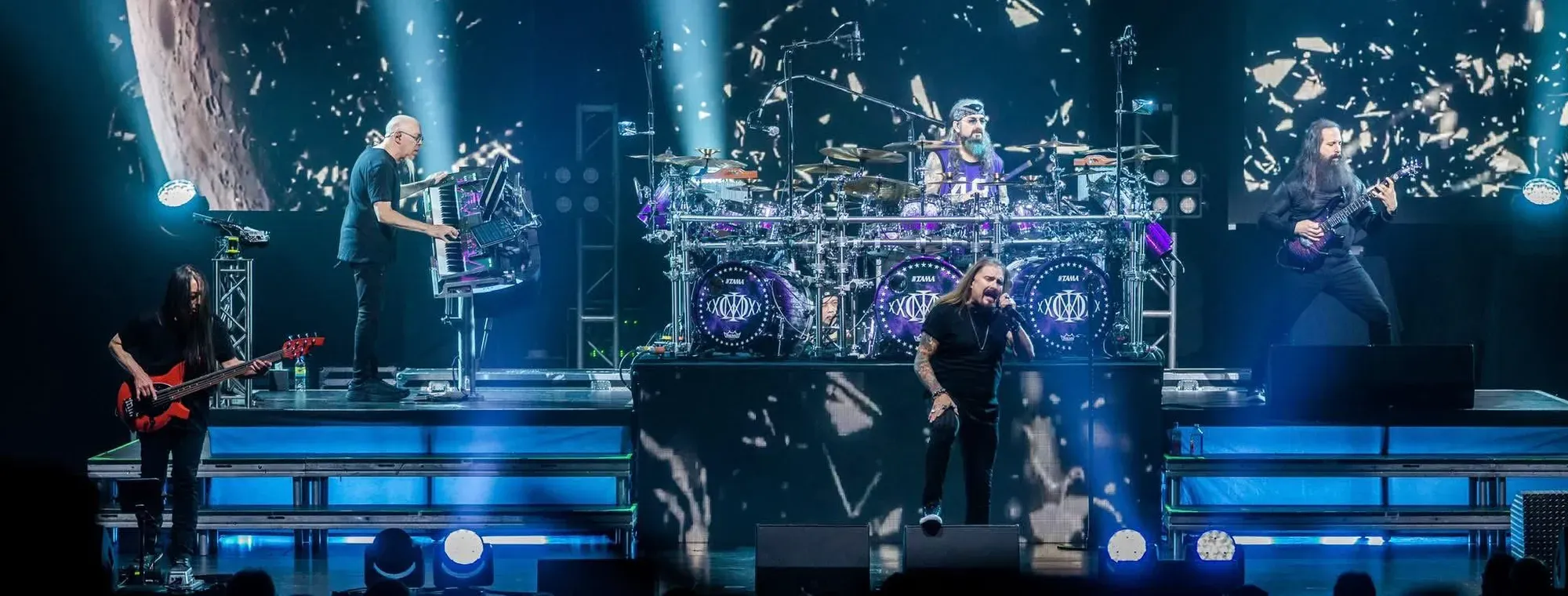
Glitzy, ritzy and glamorous, New York’s world-renowned Radio City Music Hall is an ostentatious venue that you feel would be more suited to hosting opera or an uptown cocktail party than a rock concert. But despite the two immense gleaming chandeliers, luxurious carpeting and exquisite art deco architecture, an endless list of legendary acts that have trodden the boards here. Everyone from Frank Sinatra through to Ella Fitzgerald, to such celebrated contemporary bands as The Who, Rush and Iron Maiden have passed through these doors, and on the night of April Fool’s Day 2006 it was Dream Theater’s turn to add their name to that prestigious roll of honor. The gig was the band’s debut here, and it had taken two decades of perseverance through a seemingly never ending writing-recording-touring cycle for them to reach this momentous career zenith. As a twentieth-anniversary homecoming gig on the final night of a protracted world tour, it was certainly one hell of a place to stage a party. And with the band seamlessly running through their highlights from their expansive back-catalogue before revealing a thirty-piece orchestra stacked on stage behind them, that night will live long in the memory of those fortunate enough to be in attendance.
So what happened next? Well, in the aftermath of that truly spectacular gig the band took their first true holiday in over a decade, spending the rest of the summer recuperating with their families from the toils of the best part of a year out on the road. But it was far from quiet in the Dream Theater camp, with drummer Mike Portnoy putting the finishing touches to ‘Score’ – a live DVD and triple-CD release that captured that New York, orchestra-backed performance. And as live DVD’s go, it’s hard to recall a release that matches the attention to detail and sheer visual perfection of ‘Score’. Hitting the stores on 29 August 2006, the DVD sold over 14,000 copies in the US during the first week of release – a feat that ensured it blasted straight into the Billboard Music DVD chart into the coveted number one slot.
With their seven-album recording contract with Atlantic finally expiring after the release of the ‘Octavarium’ album in 2005, Dream Theater were faced with the prospect of having to find a new suitor as well as write and record a new album. But rather than wait for a new contract to be agreed, they took the bold decision to finance the recording of the album themselves – and worry about reclaiming those costs and signing to a new label at a later date. Setting up at Avatar Studios in midtown New York in September 2006, the band followed their established routine of concurrently writing and recording material. Working and lodging in the city from Monday through Friday every week before heading home at weekends, the sessions lasted through the winter months before they finally concluded in February 2007. Mike and guitarist John Petrucci again took care of the production, although one notable change was the absence of long-time engineer Doug Oberkircher. Paul Northfield – whose past credits include work with Rush, Porcupine Tree and Queensrÿche – replaced him in that role.
“It was really just time for fresh ears,” explains Mike. “I guess it just felt like a new chapter for us, coming off the back of ‘Score’ and having the summer off, starting with a new label. So it was just time for a change. Paul’s obviously a very talented person and he can come up with different sounds and recording techniques.”
Northfield also thrived on the experience and found the lack of any nagging involvement by any record label “suits” particularly refreshing.
“I find it really rewarding working on records when you only have to please the people in the recording studio and you don’t have to worry about any criteria as to whether an album will sell,” says Northfield. “The style of recording, by going in without any songs and writing and recording in the studio, was something that we used to do in the seventies but has been done very rarely since because of the cost. Sometimes it’s totally prohibitive to do it that way but in this case it was a conscious band decision because they like the idea of being close to home, which is something I admire them for. I remember the first week they played around with ideas and grooves they liked, and the second week they started assembling a lot of interesting things they had put together that were somewhat random. The first song written and recorded was ‘In The Presence Of Enemies’, which had a lot of sections connected together and themes that re-occurred. That was quite a long project [laughs] and then at the end it was decided to cut in it half.”
Unusually though, the band had hit the studio without a master plan in place to dictate the album’s emphasis and direction. ‘Octavarium’ had been written specifically with an underlying conceptual thread throughout, ‘Train Of Thought’ was their attempt at creating a definitive metal album, and ‘Scenes From A Memory’ was of course a finely honed concept album. With Mike’s usual predisposition to determine the band’s next move, it must have been an unusual feeling for him to wander into the studio without any firm musical blueprint under his arm.
“I think it was almost harder for him not to think of something,” laughs Jordan. “That was part of the challenge for us, as both Mike and John Petrucci just love to think of these great concepts for each album. So there was less planning than on previous albums where I remember having more discussions about what we were going to do. This album was more a case of meeting in the studio and keeping it open. We just went in and shaped a plan there and then.”
As an impartial observer of the writing process, Paul Northfield is perhaps best placed to provide an accurate guide as to how the band members relate to each other during those months of musical creation.
“The vision of the band is obviously Mike and John Petrucci’s and they work closely together and bounce off each other,” confirms Northfield. “Often Mike plays the role of movie director and is quite vocal when he decides which way to go. His relationship with John Petrucci gives them both a degree of security as they know each other really well, and crucially, they know how to deal with each other’s strong sensibilities about what they want. John Myung is quite solitary, just spends his time practising and working a lot on his own, but I remember a few times during the writing they would use something that was inspired by one of his riffs. Jordan goes from being hugely influential with dramatic orchestrations, arrangements or the extraordinary riffs he does with John Petrucci to then take a back seat and just let it be a three-piece. Invariably when you get a lot of good musicians and people with strong ideas together, there tends to be a lot of conflict flying around. In this case there isn’t really, because the roles are clearly defined and because they know each other, know what they are doing and why. They are all managing to find what they need within the band.”
‘Systematic Chaos’ was released on June 4, 2007 and again marked another change of bearing for this continually evolving band. Nodding more in the intense direction taken by ‘Train Of Thought’, rather than the more overtly progressive ‘Octavarium’, it is however still a varied and noticeably contemporary recording that the band can be justifiably proud of. It was also shaped by a desire to ensure it had – as John Petrucci and Mike neatly put it – a certain degree of “balls”. Consequently, ‘Systematic Chaos’ is defined lyrically and musically by an overriding sense of heaviness.
“Yes, it really is,” says Jordan Rudess. “And again the vision came into reality when we all got together and started to work, the guys were saying let’s make this really heavy and dark and keep that theme throughout. So any happy riffs basically got tossed out of the window. But it kept it very focused. I think that is a major point in the success of this band in the ability to stay focused on a path. I have to credit John Petrucci and Mike at being really good at knowing what is within the Dream Theater window of parameters which is what people will accept.”
The album also represents a high point for James LaBrie, whose vocals are noticeable for their clarity and demonstrate his continued growth. They are also incredibly varied, with the contemporary track ‘The Dark Eternal Night’ neatly showcasing his burgeoning abilities – even if the growling vocals might have come as a bit of a shock for some of Dream Theater’s more conservative listeners.
“Well, on every album I’m trying to come out and use as much of my voice and all its different qualities as I can,” confirms James. “That’s what will keep the album dynamic and character driven. It’s really up to every vocalist not to become one-dimensional and to try and to give each song its own signature. Otherwise it can become monotonous. But I’m sure there will be fans who are perplexed when listening to ‘The Dark Eternal Night’. There’s a lot of that kind of music around where it’s very heavy and we’ve all appreciated bands like that – say a Pantera or more recently Lamb Of God. So it’s going to be something that we have our interpretation of it.”
Ultimately though, ‘Systematic Chaos’ is a formidable album that is crammed with tracks that are destined to become Dream Theater classics. ‘In The Presence Of Enemies’ and ‘The Ministry Of Lost Souls’ are overflowing with lush orchestral arrangements and include all the colour and passion that the band are capable of producing on their slower tracks. ‘Constant Motion’ is fresh and has the potential to take the band to a whole new audience, and in the beautifully crafted ‘Forsaken’, Dream Theater have a song that – if there’s any justice in the world – should give them their first bona-fide hit single since ‘Pull Me Under’ hit the airwaves back in 1992. These are thrilling times to be a Dream Theater fan and the band’s profile is continuing to rise.
The quality of their music aside, this new sense of optimism has been due in part to the support shown by their new label, Roadrunner. With no shortage of labels wanting to sign the band, Dream Theater were placed in the favourable position of simply matching their criteria to the offers that were on the table. Topping their list of demands was a label that would leave them alone to create the music they wanted but who were willing and able to put a substantial marketing muscle behind their releases. With Roadrunner, they seem to have found perfect partners.
“It’s going to be nice to have a label that, on the surface at least, will actually give a shit about us,” smiles Mike. “It looks like that they are going to let us do what we do but at the same time give us the promotion and marketing. We’ve always said that it’s amazing what we have done on our own. Just imagine what we could do with a little support from a label. We’re not looking for them to turn us into Metallica or Guns ‘n’ Roses, but just give us the attention that you would give any of your other bands and I’m sure that there will be that many more people who will discover us.”
With the band having already performed at the prestigious Download Festival in the UK in June and this tour taking them into larger venues and new cities, the future looks extremely rosy. The one thing you can guarantee is that Dream Theater will carry on creating their own idiosyncratic brand of music for their ever expanding fan base as long as they maintain the motivation to continue. These last two decades may simply have been the precursor to a period of prolonged growth. But for now, the last word goes to James LaBrie, who neatly summarises the band’s perspective of the story so far and what might lie ahead.
“Up until now, Dream Theater have had great success but what we have achieved has been self-propelled,” he surmises. “It has been coming from our hard work plus creative and artistic decisions on how to self-promote ourselves. Yet, as much success we have had, it still has that certain feeling of being underground and there’s a lot for us left to achieve. Each time we go out on tour, we play bigger venues and the album sales are consistent. I think with the new label we can make more people aware of us than was possible in the past. This really is a new chapter and the sky is the limit...”
Rich Wilson
Contributor
Classic Rock Magazine