

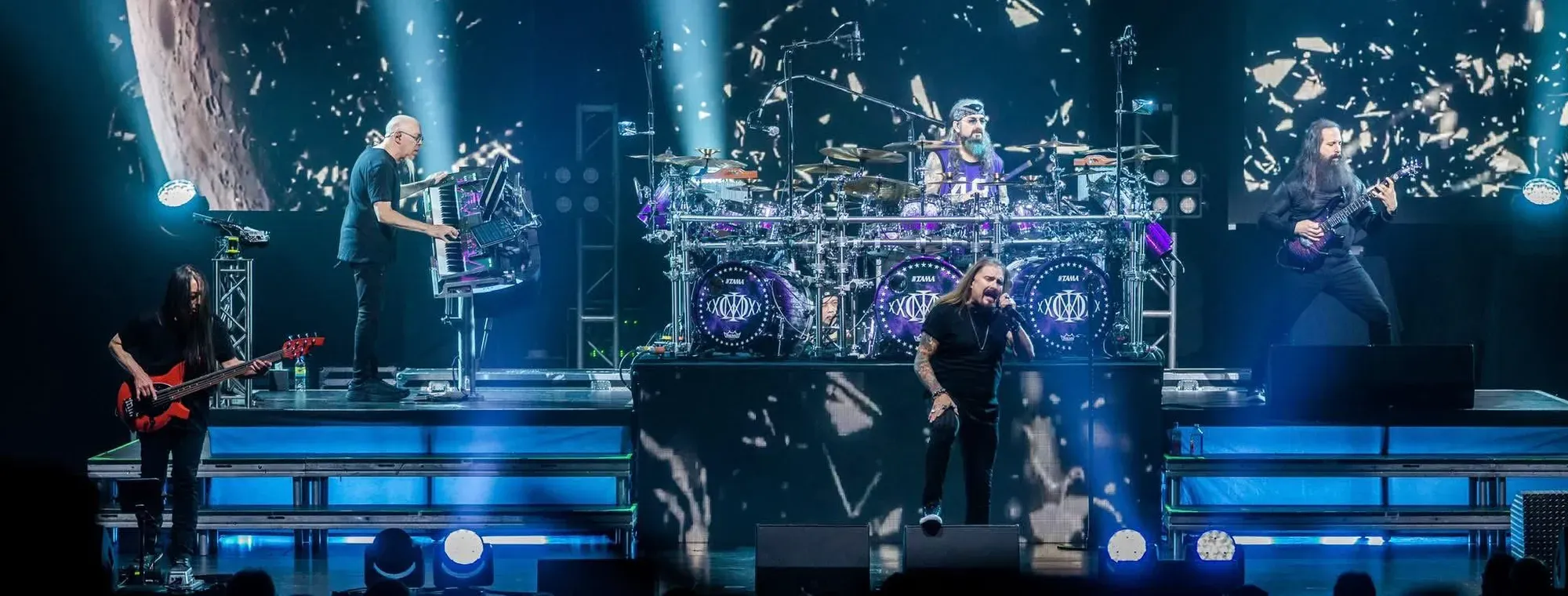
Originally published in Drum! magazine 209 · November 2013
Mike Mangini: Wired Science
InterviewMike Mangini17 min read
When the world’s most precise prog outfit needs to push the musical envelope, it takes a lot more than a little extra time in the practice room. Lucky for Dream Theater, drummer/educator/rhythmic mad scientist Mike Mangini knows exactly how to keep the synapses firing and the creativity flowing at maximum intensity.
By John Payne
In the now infamous YouTube videos of Dream Theater’s drummer auditions of 2010, a posse of percussion princes came to conquer, ready and able to prove that they and only they were the rightful heirs to departing drum leviathan Mike Portnoy’s throne. They were progressive metal’s best: Mike Mangini (Extreme, Annihilator, Steve Vai), Marco Minnemann (Necrophagist, Joe Satriani, Steven Wilson), Thomas Lang (Stork), Aquiles Priester (Hangar, Angra), Virgil Donati (Planet X), Derek Roddy (Nile, Hate Eternal, Today Is the Day), and Peter Wildoer (Darkane, Pestilence).
As legend has it, a furious battle ensued, and when the dust had settled, one man, sticks in hand, emerged to grab the crown. His name was Mike Mangini. Bloody but unbowed, this particular superdrummer knew this was truly the Big Time, and was more than up for the challenge. Indeed, he’d been preparing himself for it all his life.
“I felt the same pressure as always,” he says matter-of-factly. “I know how to prepare for an audition; I’ve done it for decades, preparing for the environment and prepping the material. And going up against friends made it that much more fun. I have tremendous respect for the drummers I auditioned with – it just made me dig in.”
Of course, the digging in required this veteran of countless eclectic sessions to assess how much he’d have to adapt his drumming to fit the sound and form of Dream Theater. It’s an issue that the former associate professor at Berklee College Of Music addresses in somewhat scholarly terms.
“There are two components to my perspective on fitting in: my pattern recognition, and the way that I have developed certain cognitive connections in my brain. We as music lovers have a choice to wire ourselves to be able to comprehend what we’re listening to. I wired myself by listening to music that my brothers and sisters played; my brain got accustomed to listening to different key signatures and different modes and different emotions, with progressive music of all kinds.”
The hard science of musicianship is a source of endless fascination for Mangini. And he suggests that most anyone can wire themselves to play the complex polyrhythms of progressive rock bands like Dream Theater – anyone motivated to do so, that is. These are ideas he’s published in two books about his drumming techniques titled Rhythm Knowledge.
“If musicians don’t start to study the brain,” he says, “then they’re just going to be artists that think certain things with no proof at all as to what they’re talking about – as opposed to human beings who want to learn more about being human beings.”
Warming to the subject, Mangini cites an MIT paper which proved that no human beings are born with an inherent understanding of polyrhythms, and that the comprehension of compound rhythms requires wiring into the brain via study and practice, practice, practice.
“Before playing with Dream Theater,” he says, “I had previously wired not only those areas of the brain necessary to comprehend what I’m listening to, but because I comprehend what I’m listening to, I can then make a musical choice: I like it or I don’t like it. No one’s going to be able to make an objective choice if their brains don’t allow them to comprehend it and if the feeling inside them is one of discord and discomfort, simply because they really don’t know what they’re listening to.”
Applying The Dream
Mike Mangini is famed for his formidable array of chops, notably for the almost perfect symmetry of his arms and legs in complex polyrhythmic patterns. He’s also reknowned for setting five World’s Fastest Drummer (WFD) records, evidence of which was shown on the Discovery Channel’s Time Warp program in which he displayed his awesome skills for high-speed cameras.
Mangini is also at great pains to portray his role in music as something above and beyond that of a mere technician. Yet he acknowledges that an ability to apply substantial technique is crucial to his musicianship. “I’m not a technical guy,” he says. “I’m a kid who loves The Beatles, who loves Buddy Rich and Zeppelin and Sabbath. I like Christina Aguilera! But I also love progressive music, and I love the idea of playing it knowing what I’m doing.”
Wiring himself for the job of recording Dream Theater’s eponymous new album wasn’t difficult for Mangini, because their music was not just something that he comprehended. He liked it, too. “With pattern recognition, I could understand Dream Theater’s music pretty easily, but that I liked it on a musical level made me feel not only that I liked it when I heard it but that I could fit in,” he says.
Dream Theater’s melodic landscapes are usually created within the time signatures created by guitarist John Petrucci and keyboardist Jordan Rudess, and, according to Mangini, “You can’t help but sing a melody over it. And I would not have trained myself to play it at all if at some point I didn’t enjoy it. When you put together the two worlds of comprehension and enjoyment, it’s gotta work.”
You can hear Mangini’s sheer joy on the album’s ‘Surrender To Reason,’ whose introduction explodes with odd-timed percussive bursts played in what must have been difficult side-vs.-side coordination moves. “Check out the first three drum fills that open ‘Surrender,’” he says. “The first is a 15 tuplet on the snare drum, before I do a triplet for the second fill. Note that I did this not by being a scientist and calculating, ‘Gee, I think I’ll play a fifteenth-note tuplet just because I can.’ I played an odd amount of notes because it gave me a certain feeling.”
He did the same thing with the third fill, a devilish 29-against-5 polyrhythm that he swears came bubbling out of pure feeling and musicality. “In fact, the first fill I played instead of the 29-against-5 polyrhythm was a more even set of triplets. Now, to me, sometimes sixteenth-note triplets are too square and studied, and it’s because most of us don’t practice to go beyond that to experience this other world. But [Dream Theater singer] James LaBrie got out of his seat like a banshee, pointing at me, and said, ‘No, Mike, the other one you played, that was gold!’ I’m like, ‘Really?’ So I looked at my drums and I calculated and said, ‘Oh, wow, it was two notes on every drum on the kit, plus five on the kick drums. So it was 12 times 2, plus 5 = 29.”
Despite Mangini’s hardwired facility for executing the most hair-raisingly intricate rhythmic patterns, there were tracks on the album that raised his personal bar even higher. On the epic ‘Illumination Theory’ there are a couple of spots where Mangini uses limb pairs against one another, such as his left foot playing a china-stack sound that his hands would normally hit, and throughout one section the left side of his body is playing in 3/16 while the right side is playing multiple time signatures, following Jordan Rudess.
“In ‘Enemy Inside,’ I had to reach so far from one side of my kit to the other, hitting the effects cymbals as I’m following the guys melodically, that the entire trunk of my body had to turn from left to right in less than so many thousands of a second, and while I was doing that I had to whack the bass drums. I’m sorry, but I’m not a robot!”
Even the band’s simpler, more overtly pop songs such as ‘The Bigger Picture’ required Mangini to create as much air and space as possible while still strutting his technical stuff. You hear him play parts that closely resemble the melodies and riffs from the other musicians – and note that his bandmates asked Mangini to play more, in order to create a unique drum part for each song. Throughout the album, the production is a minefield of sonic surprises, such as the stereo nature of the kit actually changing with the sharps and flats in the charts.
“I’m following the key signatures of the music, I’m changing cymbals based on key signatures, my tom toms are following the unison runs exactly,” he explains. “If Jordan Rudess goes up the keyboard then I go up the drums; if John Petrucci goes down his guitar in sets of triplets or threes, I go down my drums in triplets or threes.”
He would also like to point out the substantial time he took playing simple parts for perhaps just two minutes without missing any hits off the grid. That’s a tough job for any drummer, a difficulty aggravated by the microscopic exactitudes of modern recording technology.
“My challenge was keeping the velocities extremely high – if I hit one hit light in the middle of a run, it got lost. And to me it wasn’t light, because I could hear it perfectly fine. But with the recording software we use today, if it’s just a couple of dBs shy, it’s no good.”
He laughs.
“I often question why I do what I do, because it is so pressure-filled, but there’s something about stepping it up in front of everyone and seeing smiles after I nail a part. It feels like scoring a hockey goal did when I was young!”
Back To The Roots – And Back Out Again
Mangini grew up in a big Italian family in the Boston suburb of Waltham, Massachusetts. His was a musical clan whose paternal grandfather was a sax player who also worked in a watch factory. His mother played piano and sight-read, and most of his aunts, uncles, and cousins played a musical instrument.
“My family on both sides really knows how to party,” he says with a chuckle, “and we had a lot of weddings, with 300 to 500 people. By the time I was five I was performing once or twice a year – and I had already been performing since the age of four, when my brothers and sisters would make me play for the neighbors.”
Mangini learned early on that the realities of the music business required him to grasp as much as possible about not just drumming technique but aspects of music theory and composition. His tough-love fifth-grade drum teacher made real sure of that.
“He forced me to play mallets, and I would’ve rather bad a ball-peen hammer whack my elbows twice a day than to study mallets,” Mangini howls. “He got in my face and said, ‘Listen to me, kid; if you don’t learn how to write melodies, you won’t get publishing. You’ll just be back there on the drums, humming out stuff, looking like a fool, and you’re gonna wonder why everyone else is making money and you don’t get any writing credit. You may think you wrote a song because you wrote a drum part, but a drum part is not copyrightable info.’”
Mangini got the message, embarking on a study of various mallet instruments, including glockenspiel. “I learned my key signatures and how to navigate on a keyboard instrument. Even though I’m not a pianist, alone with an iPad or keyboard or bass or other melodic instrument I can record my ideas so that I can communicate the ideas I have. And if I have to do it on the spot – come up with a riff – I can and I do.”
Mangini’s career as a professional drummer commenced the day he quit Waltham’s Bentley University after a semester and a half, spending the next year playing in a cover band. He didn’t go back to music full-time until he quit his job as a software engineer on the Patriot missile system for Raytheon, a position he held for five years. Establishing his own drum teaching business in 1989 while playing in an original band and doing cover-band gigs, he’d begun to develop the spectacular multilimb-coordination skills he’d go on to showcase in bands like Annihilator and Extreme and with Steve Vai.
Mangini’s wide-ranging set of playing chops reflected the stylistically varied drummers he’d grown up admiring. “The drummers that influenced me up until I was an adult – What am I saying? I’m still not an adult, and I’m 50! – till I was about 20: Ringo, Bobby Colomby, Danny Seraphine, Buddy Rich, John Bonham, Neil Peart, and Terry Bozzio. Those drummers’ musical expressions struck me so hard that I learned every song from their catalogs.”
Still influencing him today is most any drummer who, as he puts it, does anything remotely personal. “It could be a conga player, a jazz player, a player with a large drum set, a speed drummer with even velocities and no dynamics, a drummer with all dynamics. When I hear somebody that really plays with quality, meaning that the things that they choose to play are unique to the song, that’s my kind of drummer.”
Peaks And Valleys And In-Betweens
“My playing technique goes in cycles,” says Mangini, “and when it plateaus, it doesn’t really plateau. It’s only the perception of a plateau, meaning that it’s increasing in such small increments that you can’t tell. And practicing is so boring, so tedious, so awful to dredge through, because you want to see a result and you don’t see it.”
But practice you must, he says, or else... “Proton decay is real. If you’re not getting better, then you’re getting worse. You’re not staying the same. You’re either progressing or you’re regressing, and there’s no in-between.” Mangini has modified his own practice routine over the years, in part because decades of meniscus tears and frays from playing sports led to a double meniscoptomy in 2009. The surgery forced him to go back to basics during practice, and that included slowing the hell down – but not too much.
“I’ve been practicing extra slowly since I auditioned for Dream Theater, and so my velocities are stronger and my hits are cleaner,” he says. “It’s a balance, though. To play at a faster rate uses different muscle groups and techniques, so essentially it’s not the same as practicing slowly. You have to do both.”
Mangini believes that the practicing he did before he hit 21 formed the foundation for the chops he has today, so that when he digs in to practice, he can achieve his goals fairly quickly. “I incorporate the spirit, mind, and body,” he says. “The first thing I address is one of feeling – my spirit and my purpose. I ask myself, Do I want to get better today or do I want to just have fun? Once I decide that, Yes, I want to improve today, then I isolate what it is I want to improve on, choose a series of exercises, and repeat them throughout a phase of specifically worked-out environments, stickings, and rhythmic landscapes.”
He also finds it beneficial to practice the music at half-speed or lower tempos; interestingly, his use of a metronome for practice comes after he is sure that he can physically do what he wants to do. “You can’t iron the wrinkles out of a shirt if you don’t have the shirt,” he says. “So I want to make the shirt first: I want my limbs and my brain to work such that I can physically do what it is that I need to do. Once I have wired it in, a metronome comes in when I want to perfect it, when I want to experience what it’s like to play it at an even velocity or even timing.”
Mike’s Mechanics
Onstage and in the studio, Mangini’s massive custom Pearl drum kit is one and the same (“for muscle memory purposes,” he says), though he does most of his practicing on a small Pearl ePro kit, primarily working on the connections between his voice, mind, hands, and feet. “That’s my primary function when I’m trying to improve my hitting velocity, my accuracy, and my musicality as well.”
Mangini’s equipment is currently undergoing a reconfiguration for both live and recording work. His 26” and 18” bass drums will eventually be replaced with Pearl ePro two-track pads, for the wide variety of sounds they offer, and because they take up less room.
And for the first time since his Speed King pedal days in 1975, Mangini has switched to hard felt beaters on his two 22” kicks, twisting his Pearl quad beater to the hard felt side because, be claims, he’s hitting the drum harder these days and pushing more air through the drum. As for that crucial “slap” effect, he’s going with recording software DSPs to get that sound for him.
A potential downside with felt beaters is that there’s less of a dynamic change once you hit a certain decibel level, and when Mangini kicks his 22” bass drums, there are no dynamics. He has a system in place to address that situation in a typical recording session or live performance.
“I’m not allowed dynamics, because my hits will not go through the gates,” he says. “Now, I am a classically trained musician, and I’m sorry but the music isn’t fulfilling unless it has dynamics in it. So the way I kept the dynamics was by having multiple kick drum sounds; having the 18” allows me to play very softly, but it also allows me to get a lot of boom; with the 26” I’m getting a lot more air blasting through.”
To further expand his kick drum arsenal’s sonic variety, Mangini has supplemented his two outer kick drums with ePro kick drum pads, where with just the turn of a dial he can get any bass drum sound he wants; he also uses these for foot percussion effects, further freeing up space by eliminating extra pedals.
We Are Family
To hear him tell it, Mangini has had approximately one million thrillingly heart-warming – and brain-fulfilling – experiences in his musical life, and, better yet, he’s just getting started. He wants you all to know that he’s very, very thankful.
“I can’t help but smile with gratitude to all those people who have allowed me to have the opportunity to learn more and work more. I have had support from family and friends, just enough to keep me fighting. And that includes the Dream Theater camp. I’m looking around me thinking, ‘These guys want me to be as good as I can.’
“And I think about the moment that I meet my maker. You know, ‘I have given you talent. What have you done with it?’ I want to show up having done something.”
Inset
Funny Games – Jordan Rudess
If you noticed that the drumming approach on the new Dream Theater album is different than 2011’s A Dramatic Turn Of Events, that’s because the “new” drummer didn’t put his stamp on the previous album – at least not the full Mangini treatment. “The first album we did with Mike, he wasn’t there when we wrote the music, so he came in and he interpreted the drum parts that we wrote,” explains DT keyboardist Jordan Rudess on the phone from his home in New York.
On Dream Theater, however, the inertia-defying athleticism, Swiss watch-precision and the OCD-like preoccupation with symmetry that MM is known for are in full gale force. “I was a little concerned at first because he’s such an ‘on’ personality and I know that John [Petrucci, guitarist] and I need a lot of space when we are writing the music to think and reflect and explore. I was concerned Mike would not be able to chill while we did that. What he ended up doing, which impressed me, is he was so patient and respectful and aware of the things we needed to do. When there was an opportunity for him to offer something constructive, he would.”
In a band where everyone is a virtuoso the competing voices are difficult to parse. That’s where Mangini’s orchestral sensibilities and educational rigor come into play corralling disparate creative outpourings into a coherent musical idea. “He has a really mathematic head and applies it to the drumming,” Rudess says of the former software engineer turned drum jock. “During this album we actually applied things he suggested with his concepts. We could not have written it without a conceptual rhythmic brain in the room. That was a highlight. Other than that it was about his strength and his energy.”
Mangini’s only drawback according to Rudess, is that the drummer might be too energetic. When he auditioned for us he played it so intensely – I think it was ‘Dance Of Eternity’ – and I thought he would die playing at that intensity song after song. And I was totally wrong. I sometimes want to check and see If he is human or not.
“I’ve played with a lot of good drummers [including Rod Morgenstein with whom Rudess has a duo, Rudess/Morgenstein Project], and I have a lot of respect for our last drummer. But of all the drummers I played with in my life there is something about Mangini – he is not the norm.”
Despite the drummer being literally caged in by his two-tier rack system, the setup doesn’t prevent the on stage energy from going back and forth between him and the rest of the band. “He and I are very in touch visually when we play. We have all sorts of facial expressions we enjoy. Little fun things we do to make a game out of it, like, ‘Okay we’re going to put 23 consecutive notes in this measure. I have a way of going on the keyboard from middle C to the middle G three octaves above it and the notes don’t matter, I just time it so I know when to get from here to here. And Mike will be like, ‘Okay, how many notes do you play?’ And I’m like, ‘I don’t know,’ and then I’ll count: ‘Oh, it’s 37.’ So then he’ll play 37 notes in 4/4.”
For Rudess having the drummer puzzle through each measure is almost as enjoyable as watching him execute them. It’s fun to watch. He reaches high [to the upper rack’s horizontally mounted cannon toms] and comes back down then goes back up. It’s almost as if he is doing it for extra exercise.”
As for in-ear mix Rudess’ is very close to what a listener playing a DT album might experience with headphones. And he is as anal about the drums as he is the keyboard parts. “I am looking to get the full drum experience, like the whole kit, as much as possible, really,” he says. “Not just the bass drum and the snare – I want to near everything.”