

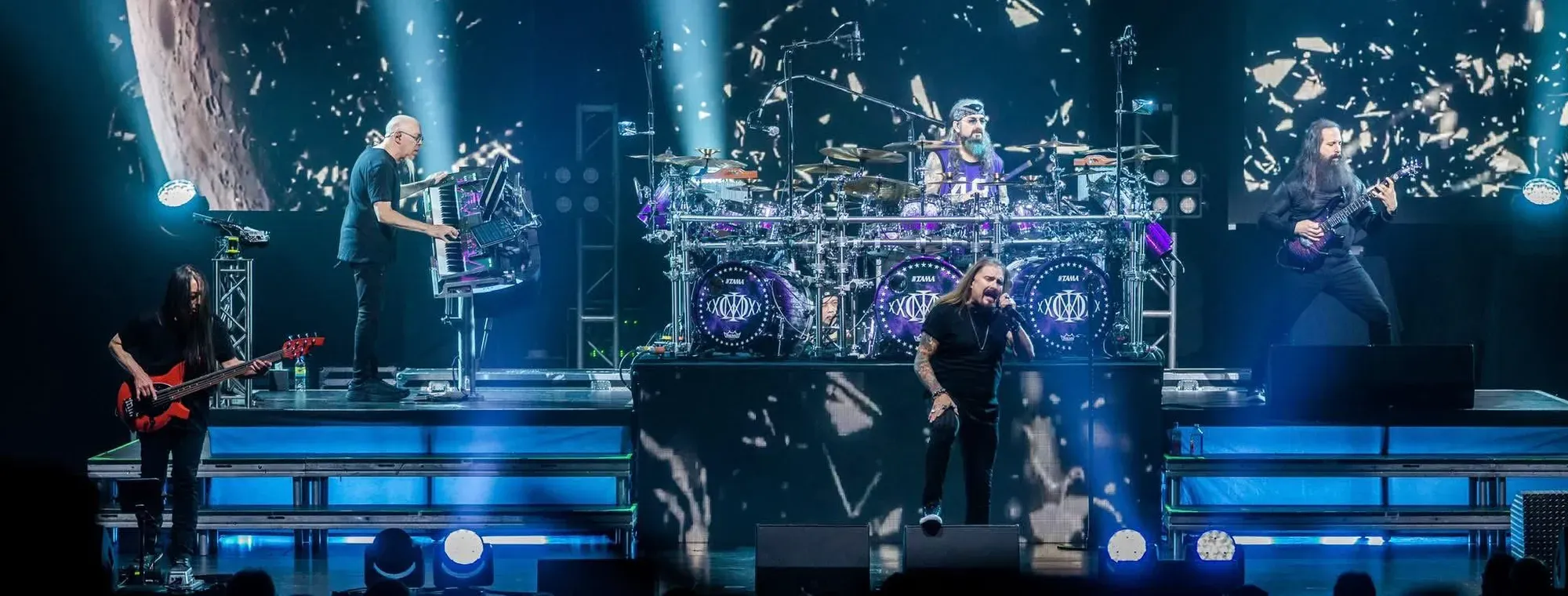
Originally published in Stormbringer.at · September 2013
Interview: Dream Theater – John Petrucci
By Text: symX · Published on 09/14/2013
InterviewTranslatedJohn Petrucci16 min read
Translated from the original language with DeepL, so the wording may differ from what was actually said.
The extremely likeable supersonic guitarist John Petrucci talks about line-up changes, 20-minute prog epics as well as his life as a guitar god in this great interview and concludes with a short course on “The musician as a businessman”. (Not only interesting for prospective music students!)
With their twelfth album the US prog gods already present their second work after the departure of bandleader Mike Portnoy (drums). After this change a good three years ago caused some turmoil, the band seems to be one heart and soul again since the new addition of Mike Mangini, as the likeable guitar god John Petrucci confirms in the interview:
“It’s really an absolute stroke of luck that this fits together so incredibly ideal with Mike Mangini. He understands our background, the music and complements us perfectly. It’s really brilliant that we found him! It’s true that our way of working hasn’t changed much after the departure of Mike Portnoy. Even since ‘Scenes From A Memory’ the whole band meets in the studio to start songwriting and recording. The biggest difference really is that there is a different person in the band with Mike Mangini. They are both exceptional drummers, but they are different characters. The great thing is that not only did we have this great band chemistry with Mike Portnoy for 25 years, but now with Mike Mangini that continues seamlessly!”
Asked about the new album and the fact that they decided against a separate album title this time, John goes on: “The new album is a statement for us. To emphasize this, we have dispensed with an additional album title and simply called the work “Dream Theater”. This is also to express our conviction that we simply love what we do and stand behind it with all our heart. Our career has lasted 27 years, but we are still as enthusiastic about it as we were when we first started the band. I also think that the new album could also be a good opportunity for people to get excited about Dream Theater anew or again, as it will definitely be an exclamation point in our discography!”
“In terms of content, I think the work is structured similarly to a Dream Theater concert,” John continues. “It’s structured according to a clear musical production: it has a great intro (‘False Awakening’) that is meant to build anticipation in the listener for what is to come. The second song (‘Enemy Inside’) has this high-energy vibe that is supposed to sweep the listener away and really pull them into the album. In the next tracks, there is truly a rollercoaster ride of emotions – there will be short breathers, only to promptly take the listener back to the next mountaintop. The whole thing ends with the undisputed highlight ‘Illumination Theory’, which once again demands everything from us and the fans and hopefully gives everything they hope for! I’m convinced that the album is extremely exciting from beginning to end.”
The mammoth 22-minute track ‘Illumination Theory’ is a particular favorite of John’s, as he enthusiastically elaborates: “Yeah, that’s already the most special song on the album for me. It’s just always highly interesting to do such a big, 20+ minute epic where you really have room to let the ideas grow and develop. Plus, the orchestral middle section, where the whole band drops away, is quite different from anything we’ve done before. It’s a truly cinematic moment that I absolutely love. And James’ vocals on this track and on ‘The Bigger Picture’ are some of the best I’ve heard from him.”
“Of course, the creation of such a mammoth work as ‘Illumination Theory’ is a long process,” as John continues. “But we also consciously take the time that is necessary to really let a song of this size mature. We don’t just go at it haphazardly. We discuss at length what kind of song we want to create. So we knew from the beginning that we wanted to make a track that was at least 20 minutes long. That’s where it’s especially important to make sure that every idea is fully fleshed out and given the space it needs so that the piece remains tangible as a whole. And finally, we made something like a script for the song, where we determined what journey we would take with the piece. By now we’re really experienced with these kind of overlong tracks. And the cool thing is that our fans also appreciate these songs and expect such epic works from us.”
In my opinion, the new disc offers almost all the musical trademarks of the band’s more than 25-year history. John sees this similarly: “I agree – you can definitely see the album as a simultaneous look into the past and into the future. But actually our own style has always been a combination of past and future – on the one hand with influences from Yes, Rush & Co. and more modern metal bands like Metallica. We have remained true to these two worlds on our latest work. On the one hand it should sound familiar and on the other hand we wanted to explore new worlds. This time we consciously tried to develop these elements in different directions. In addition, we worked on making it more melodic than before, to make the songs more accessible, but also easier to sing, because we are aware that with all the complex music we make, catchy vocals are still the best tool to tie it all together and make it more relatable. The vocals are often the listener’s entry point when they hear a song for the first time. As another point, it was also important for us to be more adventurous and bold again with this album. The sounds are more or less all directly ‘in your face’. Everything is loud, direct and has that live energy. That’s our statement!”
After a band history spanning several decades, it can be assumed that the band’s internal workflows have long since settled down. Nevertheless, in Dream Theater the division of labor is not as obvious as it might seem to the listener from the outside, as John Petrucci explains: “When it comes to songwriting, we don’t necessarily have a fixed distribution of roles. It’s a little different for each piece. Of course, it generally makes sense that the guitar riffs come from me and the orchestral parts from Jordan. But listen to the orchestral beginning of ‘Illumination Theory’ for example – that was a guitar melody that I wrote in the beginning. Then we just split it up so that the guitar does the rhythm and the melody is played by the strings. Likewise, it’s possible for Jordan to come up with chords that I then turn into guitar riffs.”
And if you assume that the lyrics are mostly written by the singer himself, you will also be proven wrong in this respect with Dream Theater: “I wrote practically all the lyrics on the album – except for the lyrics of ‘Surrender To Reason’, which were written by John Myung. I aimed to make the lyrics more emotionally accessible and organic, as well as less esoteric. Many of my lyrics deal with human reactions, feelings, and situations where people are struggling with difficulties in life. On the one hand, the lyrics are about people doing bad things, why they do it, and what’s going on in their heads. And on the other hand, they are also about courageous deeds and the motives behind them. This contrast between darkness and light is typical for the lyrics on this album.”
For more than 25 years, Dream Theater have enjoyed a god-like status among their fans, and the expectations of their followers grow immeasurably before each new album. This creates an immense pressure that John and his bandmates can handle quite well: “We actually put ourselves under pressure every time. We know that our fans are very demanding and would not accept anything mediocre from us. They rightly expect quality and that’s what we want to deliver – because that’s what we expect from ourselves! Ultimately, we set the highest value on getting the best out of the lyrics, arrangements and songwriting, as well as in production with every album. This requires a lot of work and energy, but in the end we have something we can be really proud of! Fortunately, even after twelve albums, we never really run out of song ideas. I think the fact that we’re all in a band together with great musicians already provides so much potential for inspiration that the ideas often just bubble out of us.”
Despite the undisputed qualities and abilities of Dream Theater, John does not take it for granted that his band has been successful in the music business for almost three decades: “We can consider ourselves really lucky that even after almost 30 years, in which we have essentially remained true to our style, we still have success and gain new fans. At the beginning of our career, we were criticized, for example, for the excessive length or over indulgence of the songs. But over time it turned out that these exact elements have contributed to the fact that we could establish ourselves as a band with an independent style until today. And we think it’s just great that we have so many fans who have remained loyal to us for almost 30 years. That’s really extraordinary!”
“Of course, it’s not easy to deal with the pressures of the music business while maintaining your enthusiasm for the music,” John continues thoughtfully. “But that’s part of having a career. I describe it this way: if you have a talent that people want to be a part of, in whatever field, then you have the basic potential to have a career. But then to really follow through with that career, you have to have a business sense and you have to be smart. But in all of this, you must never forget the reason why you started. This quality must never be lost! You must always try to preserve that original root. You just have to be aware that business is just as much a part of having a career in the first place. That can’t be separated.”
And how do you go on when you’re in a band like Dream Theater that has pretty much accomplished everything? For John, the pursuit of new goals seems far from over in any case: “We still have a lot of dreams for the future, even if they have naturally changed over time. We want to continue to try to set a new peak with each new album. In addition, there are always countries where we have never played, which is always a great experience. And finally, to this day, we’re lucky enough to keep having new experiences – like two years ago when we received our first Grammy nomination. Whenever we reach a milestone like that, we look at each other and smile widely. It shows us that what we’re doing is right.”
Original text
Interview: Dream Theater – John Petrucci
Text: symX
Veröffentlicht am 14.09.2013
Der äußerst sympathische Überschallgitarrist John Petrucci erzählt im großen Interview über Besetzungswechsel, 20-minütige Prog-Epen sowie über sein Leben als Gitarren-Gott und schließt mit einem Kurzlehrgang zum Thema "Der Musiker als Geschäftsmann". (Nicht nur für angehende Musikstudenten interessant!)
Mit ihrem zwölften Langeisen legen die US-Prog-Götter bereits ihr zweites Werk nach dem Abgang von Bandleader Mike Portnoy (Drums) vor. Nachdem dieser Wechsel vor gut drei Jahren doch für einigen Wirbel gesorgt hat, scheint die Truppe seit dem Neuzugang von Mike Mangini wieder ein Herz und eine Seele zu sein, wie der sympathische Gitarrengott John Petrucci im Interview bestätigt:
„Es ist wirklich ein absoluter Glücksfall, dass das mit Mike Mangini so unglaublich ideal zusammenpasst. Er versteht unseren Background, die Musik und ergänzt uns perfekt. Es ist wirklich genial, dass wir ihn gefunden haben! Zwar hat sich unsere Arbeitsweise nach dem Abgang von Mike Portnoy gar nicht groß verändert. Schon seit „Scenes From A Memory“ treffen wir uns mit der gesamten Band im Studio und beginnen mit dem Songwriting und der Aufnahme. Der größte Unterschied ist wirklich, dass mit Mike Mangini eine andere Person in der Band ist. Beide sind außergewöhnliche Drummer, aber es sind unterschiedliche Charaktere. Das tolle daran ist, dass wir nicht nur mit Mike Portnoy für 25 Jahre diese großartige Band-Chemie hatten, sondern, dass sich dies mit Mike Mangini jetzt nahtlos fortsetzt!“
Auf das neue Album und den Umstand angesprochen, dass man sich dieses Mal gegen einen separaten Albumtitel entschieden hat, holt John weit aus: „Das neue Album ist für uns ein Statement. Um das zu unterstreichen, haben wir auf einen zusätzlichen Albumtitel verzichtet und das Werk schlicht „Dream Theater“ genannt. Damit soll auch unsere Überzeugung zum Ausdruck gebracht werden, dass wir das was wir machen einfach lieben und mit vollem Herzen dahinter stehen. Unsere Karriere dauert zwar bereits 27 Jahre, aber wir gehen immer noch gleich enthusiastisch an die Sache, wie zu Beginn, als wir die Band frisch gegründet hatten. Ich denke zudem, dass das neue Album auch eine gute Gelegenheit für die Leute bieten könnte, sich neu oder erneut für Dream Theater zu begeistern, da es in unserer Diskographie bestimmt ein Ausrufezeichen darstellen wird!“
„Inhaltlich ist das Werk meiner Meinung nach ähnlich aufgebaut, wie ein DREAM-THEATER-Konzert“, erzählt John weiter. „Es ist nach einer klaren musikalischen Dramaturgie strukturiert: Es hat ein großartiges Intro („False Awakening“), dass beim Hörer die Vorfreude auf das Kommende steigern soll. Der zweite Song („Enemy Inside“) hat diesen hochenergetischen Vibe, der die Hörer mitreißen und richtiggehend ins Album hineinziehen soll. In den nächsten Tracks gibt es wahrlich eine Berg- und Talfahrt der Emotionen – es wird kurze Verschnaufpausen geben, nur um dann den Hörer umgehend wieder auf die nächste Bergspitze mitzunehmen. Das Ganze endet mit dem unbestrittenen Höhepunkt „Illumination Theory“, der uns und den Fans noch einmal alles abverlangt und hoffentlich auch alles gibt, was sie sich erhoffen! Ich bin überzeugt, dass das Album von Anfang bis zum Ende hochspannend geworden ist.“
Der 22-minütige Mammut-Track „Illumination Theory“ hat es John besonders angetan, wie er begeistert ausführt: „Ja, das ist für mich schon der speziellste Song auf dem Album. Es ist einfach immer hochinteressant, ein so großes, über 20 Minuten dauerndes Epos zu machen, bei dem man wirklich Platz hat, die Ideen wachsen zu lassen und zu entwickeln. Zudem ist der orchestrale Mittelteil, wo die ganze Band wegfällt, ziemlich anders, als alles, was wir bislang gemacht haben. Es ist ein wahrhaft cineastischer Moment, den ich absolut mag. Und auch die Vocals von James in diesem Track und beim Stück „The Bigger Picture“, gehören für mich zum Besten, was ich je von ihm gehört habe.“
„Die Entstehung eines solchen Mammut-Werks wie „Illumination Theory“ ist natürlich ein langer Prozess“, wie John weiter erzählt. „Wir nehmen uns aber auch ganz bewusst die Zeit, die notwendig ist, um einem Song dieser Größe auch wirklich ausreifen zu lassen. Wir gehen da nicht einfach planlos drauflos. Wir besprechen ausgiebig, welche Art von Song wir daraus erschaffen wollen. Wir wussten also hier von Anfang an, dass wir einen Track machen wollten, der mindestens 20 Minuten lang ist. Da ist es jeweils besonders wichtig darauf zu achten, dass jede Idee voll ausgearbeitet wird und den notwendigen Platz erhält, damit das Stück als Ganzes fassbar bleibt. Und schließlich haben wir für den Song fast so etwas wie ein Drehbuch gemacht, wo wir festgelegt haben, welche Reise wir mit dem Stück machen werden. Mittlerweile haben wir ja schon richtig Erfahrung mit solchen überlangen Tracks. Und das coole daran ist, dass unsere Fans diese Songs auch wertschätzen und von uns solche großen Werke erwarten.“
Die neue Scheibe bietet meiner Meinung nach fast alle musikalischen Trademarks der über 25-jährigen Bandgeschichte. John sieht dies ähnlich: „Man kann das Album durchaus als gleichzeitigen Blick in die Vergangenheit und in die Zukunft sehen, da gebe ich dir Recht. Aber eigentlich ist schon unser eigener Stil seit jeher eine Verbindung aus Vergangenheit und Zukunft – einerseits mit Einflüssen von Yes, Rush & Co. und moderneren Metal-Bands wie Metallica. Diesen zwei Welten sind wir auch auf unserem neusten Werk treu geblieben. Es soll auf der einen Seite bekannt klingen und auf der anderen Seite wollten wir neue Welten erforschen. Dieses Mal haben wir bewusst versucht, diese Elemente in verschiedene Richtungen zu entwickeln. Zudem haben wir daran gearbeitet, das Ganze noch melodischer zu gestalten als bisher, um die Songs zugänglicher, aber auch besser singbar zu machen. Denn wir sind uns darüber im Klaren, dass bei all der komplexen Musik die wir machen, eingängige Vocals immer noch das beste Werkzeug sind, um das Ganze zusammenzuhalten und fassbarer zu gestalten. So sind die Vocals häufig der Einstieg für den Hörer, wenn er einen Song zum ersten Mal hört. Als weiterer Punkt war es uns zudem wichtig, mit diesem Album wieder abenteuerlustiger und mutiger zu sein. Die Sounds sind mehr oder weniger alle direkt „in your face“. Alles ist laut, direkt und hat diese live-Energie. Das ist unser Statement!“
Nach einer Bandhistorie über mehrere Dekaden kann davon ausgegangen werden, dass sich die bandinternen Arbeitsabläufe längst eingependelt haben. Trotzdem ist bei Dream Theater die Arbeitsaufteilung nicht so offensichtlich, wie es für den Hörer von außen vielleicht erscheinen mag, wie John Petrucci erzählt: „Beim Songwriting haben wir nicht unbedingt eine feste Rollenverteilung. Das ist bei jedem Stück etwas anders. Natürlich macht es generell Sinn, dass die Gitarrenriffs von mir stammen und die Orchesterparts von Jordan. Aber hör dir zum Beispiel mal den orchestralen Anfang von „Illumination Theory“ an – das war zu Beginn eine Gitarrenmelodie, die ich geschrieben habe. Wir haben’s dann einfach so aufgeteilt, dass die Gitarre den Rhythmus übernimmt und die Melodie von den Streichern gespielt wird. Genauso ist es möglich, dass Jordan mit Akkorden daherkommt, die ich dann zu Gitarrenriffs mache.“
Und wer davon ausgeht, dass die Lyrics meistens vom Sänger selbst geschrieben, sieht sich diesbezüglich bei Dream Theater ebenfalls eines besseren belehrt: „Ich habe praktisch alle Lyrics auf dem Album geschrieben – bis auf den Text von „Surrender To Reason“, der von John Myung verfasst wurde. Ich hatte zum Ziel, die Texte emotional zugänglicher und organischer zu machen sowie weniger esoterisch. Viele meiner Lyrics beschäftigen sich mit menschlichen Reaktionen, Gefühlen und Situationen, in denen Menschen mit Schwierigkeiten im Leben zu kämpfen haben. Zudem handeln die Texte einerseits von Leuten, die schlechte Dinge tun, warum sie dies tun und was in ihren Köpfen vorgeht. Und andererseits geht es auch um mutige Taten und die Beweggründe dazu. Dieser Kontrast zwischen Dunkelheit und Licht ist typisch für die Lyrics auf diesem Album.
Seit mehr als 25 Jahren besitzen Dream Theater bei ihren Fans einen Gott-gleichen Status und die Erwartungen der Anhängerschaft wachsen vor jedem neuen Album wieder ins unermessliche. Dadurch entsteht ein denkbar immenser Druck mit dem John und seine Bandkumpels aber mittlerweile ganz gut umgehen können: „Wir setzen uns eigentlich jedes Mal von neuem selbst unter Druck. Wir wissen, dass unsere Fans sehr anspruchsvoll sind und nichts Mittelmäßiges von uns akzeptieren würden. Sie erwarten zu Recht Qualität und die wollen wir auch liefern – denn das erwarten wir auch von uns! Schlussendlich legen wir bei jedem Album höchsten Wert darauf, sowohl bei Lyrics, Arrangements und Songwriting, als auch bei der Produktion das Beste herauszuholen. Das erfordert jeweils viel Arbeit und Energie, aber am Schluss haben auch wir selbst etwas, auf das wir wirklich stolz sein können! Glücklicherweise gehen uns auch nach zwölf Alben eigentlich nie die Songideen aus. Ich denke, der Umstand, dass wir alle zusammen in einer Band mit großartigen Musikern sind, bietet schon so viel Inspirationspotential, dass die Ideen häufig einfach so aus uns raussprudeln.“
Trotz der unbestrittenen Qualitäten und Fähigkeiten von Dream Theater, sieht es John aber gar nicht etwa als selbstverständlich an, dass sich seine Band seit fast drei Dekaden erfolgreich im Musikbusiness halten kann: „Wir können uns wirklich glücklich schätzen, dass wir auch nach fast 30 Jahren, in denen wir unserem Stil im Wesentlichen treu geblieben sind, immer noch Erfolg haben und neue Fans dazu gewinnen. Am Anfang unserer Karriere wurden wir beispielsweise für die Überlänge oder die Überfrachtung der Songs kritisiert. Aber mit der Zeit hat es sich herausgestellt, dass genau diese Elemente mit dazu beigetragen haben, dass wir uns bis heute als eine Band mit einem eigenständigen Stil etablieren konnten. Und wir finden es einfach großartig, dass wir so viele Fans haben, die uns seit fast 30 Jahren treu geblieben sind. Das ist wirklich außergewöhnlich!“
„Natürlich ist es nicht einfach, mit dem Druck des Musikbusiness umzugehen und sich gleichzeitig die Begeisterung für die Musik zu bewahren“, gibt John weiter nachdenklich zu Protokoll. „Aber das gehört dazu, wenn man eine Karriere hat. Ich beschreibe das so: Wenn man ein Talent hat, an welchem die Leute teilhaben wollen, in welchem Bereich auch immer, dann hat man das grundsätzliche Potential eine Karriere zu machen. Um diese Karriere dann aber auch wirklich durchziehen zu können, muss man einen Geschäftssinn haben und klug sein. Aber bei dem Ganzen darf man nie den Grund vergessen, weshalb man damit begonnen hat. Diese Qualität darf niemals verloren gehen! Diese ursprüngliche Wurzel muss man immer zu erhalten versuchen. Man muss sich einfach bewusst sein, dass das Geschäftliche halt genauso dazu gehört um überhaupt eine Karriere zu haben. Das lässt sich nicht trennen.“
Und wie geht’s weiter, wenn man in einer Truppe wie Dream Theater spielt, die so ziemlich alles erreicht hat? Für John scheint das Streben nach neuen Zielen auf alle Fälle noch lange nicht abgeschlossen: „Wir haben immer noch viele Träume für die Zukunft, auch wenn sich diese mit der Zeit natürlich gewandelt haben. Wir wollen weiterhin mit jedem neuen Album versuchen, einen neuen Höhepunkt zu setzen. Zudem gibt es immer wieder Länder, in denen wir noch nie gespielt haben, was jedes Mal eine großartige Erfahrung ist. Und schließlich haben wir bis heute das Glück, immer wieder neue Erfahrungen zu machen – wie beispielsweise vor zwei Jahren, als wir zum ersten Mal eine Grammy-Nominierung erhielten. Immer wenn wir einen solchen Meilenstein erreicht haben, schauen wir uns an und grinsen uns breit an. Das zeigt uns, dass das, was wir machen, richtig ist.“