

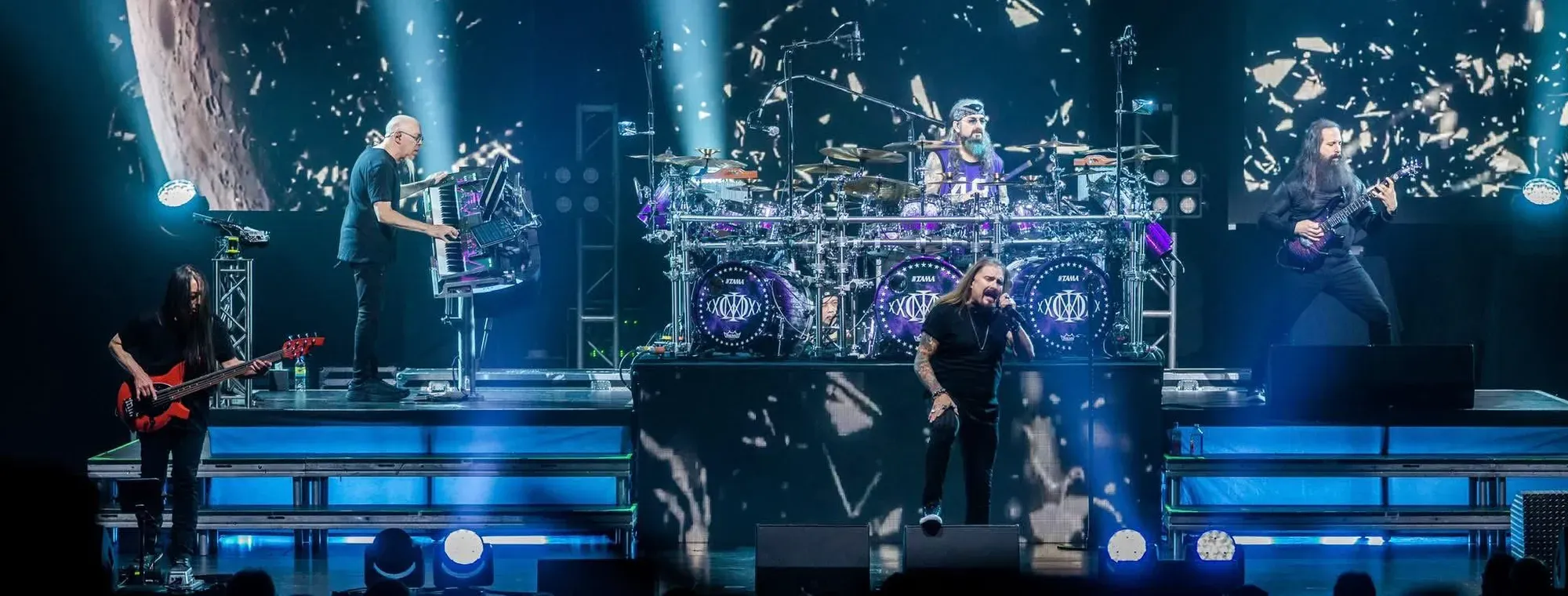
Originally published in Consequence.net, Heavy Consequence YT channel · March 2019
John Petrucci interview
InterviewJohn Petrucci7 min read
Spencer Kaufman: We’ve got a new Dream Theater album, Distance Over Time. [For] this one, you all lived together in the studio for four months in Monticello. What effect did that have overall on the album?
John Petrucci: It was great, actually. We were really only together as a full band for around a month or so. Our intent was to go away somewhere where we had no distractions, we can hang out, just enjoy the days, not have to go anywhere, drive anywhere. Barbecue, drink bourbon, have some wine at night, wake up in the morning, make some eggs and start all over again. But then we ended up actually staying there and recording the record. But the first month or so was the whole band there writing. I think what it did was it made a really relaxed environment. It got everybody all on the same page, all totally invested into what we were doing, all a part of things. And just sort of rebonded us, even though we spend so much time on the road and everything, you’d be surprised at how little time you actually hang out as friends. So it was really great for that as well.
SK: The last album, The Astonishing, was a double album, a pretty grand effort. I don’t think you can ever say anything was streamlined with Dream Theater given the complexities of the music, but was there more of an approach to go into this album and kind of streamline it?
JP: Yeah. We talked about it – everything from the initial conversations about the album length. We didn’t want to have another double CD. We just came off a two-hours-plus record with The Astonishing, so we did talk about, “Let’s try to keep this to an hour. Let’s see if we can do it.” But I love albums where you can have workout sessions to the record, or a train ride or a car ride or something like that. So within that format, as we were writing the songs, we were very conscious of making sure they didn’t really go on too long, because with an hour play time we wanted to get a bunch of songs in there, so we didn’t want to have [just] two songs on the album. So yeah, we were conscious of that.
SK: Let’s get into some of those songs. The first song we all heard was ‘Untethered Angel,’ It’s also the lead off track on the album. What about that song did you think made it a good introduction to the album for fans?
JP: If I remember correctly, that was a fourth song that we wrote, and as we were writing music, we were sharing with our label head, Thomas Waber who signed us to our brand new label Inside Out/Sony Music. When Thomas heard that he was like, “That’s an album opener,” like he just kind of planted the seed, and I was like, “Yeah, well let’s see how the rest of the songs turn out.” All along it was the obvious contender that would be a great, dramatic way to pull people into the record, and ended up being the album opener and the first single as well. It has a lot of elements I think of what make up our sound. I am very comfortable with the prog metal label, if you had to label us, because to me that just means we were influenced by Yes and Metallica. So that song has that, where there’s a lot of instrumental sections as heavy riffs, but at the same time it’s very melodic and there’s some unconventional things that happen and some things that showcase the playing as well. So it kind of has all the elements musically.
SK: ‘Paralyzed’ is the first official single. ‘Untethered Angel’ was the first song we heard, but as far as going to radio... I’d like to hear more about that song musically and what made it a good fit as a radio single as well.
JP: Again, you don’t know how these songs are gonna come out as you’re doing them. It’s not necessarily like as we’re writing, we’re like, “We gotta write a single!” We try not to think that way because that’s not the way we thought in the beginning, and I think the music always has to come from a place where it’s really genuine – you can’t force direction. But as soon as we wrote it, it again sort of screamed, ‘Wow, this song – there’s something about it. It has a really strong hook to it, the song structure is more concise, etc.’ But what’s cool about that song is it initiated from a riff that Mike Mangini brought in as a drummer. You don’t think of a guitar riff coming from a drummer, but he had amassed a whole bunch of ideas that he had programmed on his laptop with guitar sounds. [He] presented this idea and I started playing it on guitar, morphed it a bit, made it a little more modal, just something that sounded more Dream Theater-y, whatever that is, and it turned out to be the main riff of the song. So that was a great example of what we talked about in the beginning – the full band inclusion being up there, everybody feeling comfortable to participate and share ideas.
-----
On the 20th anniversary of Metropolis Pt. 2: Scenes From a Memory
That was a big record for us. We’re celebrating the 20th anniversary, which is crazy. That was the first record [keyboardist] Jordan Rudess recorded with us when he joined the band, so it was monumental that way, and it was the first record where we self-produced – every record before that, we had an outside producer. And it was our first concept album, which was a big undertaking for us.
As a progressive band, you’d think it’s a very natural thing to fall into, but some of our favorite bands made some of the most incredible concept albums of all time – like [Pink Floyd’s] The Wall, and [The Who’s] Tommy, and [Queensrÿche’s] Operation: Mindcrime. So, we were like, “Are we ready to do this? We don’t want it to be some hack concept. We want to do it right.” So, it ended up being something our fans really loved, and felt really close to – and 20 years later, it turned out to be one of our band’s favorites. So we’re happy to celebrate the [anniversary of] its release.
On what the band has rediscovered about Metropolis Pt. 2 while rehearsing for their spring 2019 tour
Right now, we’re preparing for rehearsals for the tour, and this is something that nobody really thinks about, but as musicians, you don’t just automatically remember the music you wrote. You have to go back and learn it – “What the hell was I playing there?” – and try to figure out and remember the fingerings, and the sounds, and then try to practice that stuff and make sure you can perform it. Yeah, there’s some crazy stuff [on that album]. Like in the songs ‘Beyond this Life’ or ‘The Dance of Eternity’, there’s some insane playing, so it takes some work to get that back into play.
On how the band plans to present the new Distance Over Time songs alongside the Metropolis Pt. 2 tracks on tour
So, we’re doing “An Evening With” – it’ll be two sets with an intermission. The first set is focused on songs from the new record, of course, and some older songs, and then the second set is Scenes From a Memory in its entirety. So, that’s the way we’re breaking it up. Yeah, it should be a fun night.
-----
SK: You mentioned Rush before, and there have been recent reports that sadly, that it looks like this is it for the band. Neil can’t play anymore and Geddy came out and said, “Rush as we know it no longer exists.” So I wanted to ask – you being someone in the prog world and them being an influence – first, what their music meant to you, and second, if you have a favorite Rush memory yourself, even meeting them or going to a show or just hearing it for the first time.
JP: To me, that was the band that changed everything. When music just hits you in such a way, especially when you’re young, you’re [easily influenced] and you’re sort of developing your tastes, and that band – there was something about it – I just loved it. And so I got completely sucked into all things Rush. One of my greatest musical memories has to do with them cause Rush was the first concert I ever went to. Back in 1982, they were on the Signals tour, they were playing the Nassau Coliseum on Long Island. I went there and had the worst seats ever. They were so far away, but I just couldn’t believe that this was the band that I was listening to all this time, and here I am in the same building as them – how was that possible? I was just blown away by the show and the production, and you can imagine what impact that had on me, eventually making that my career.