

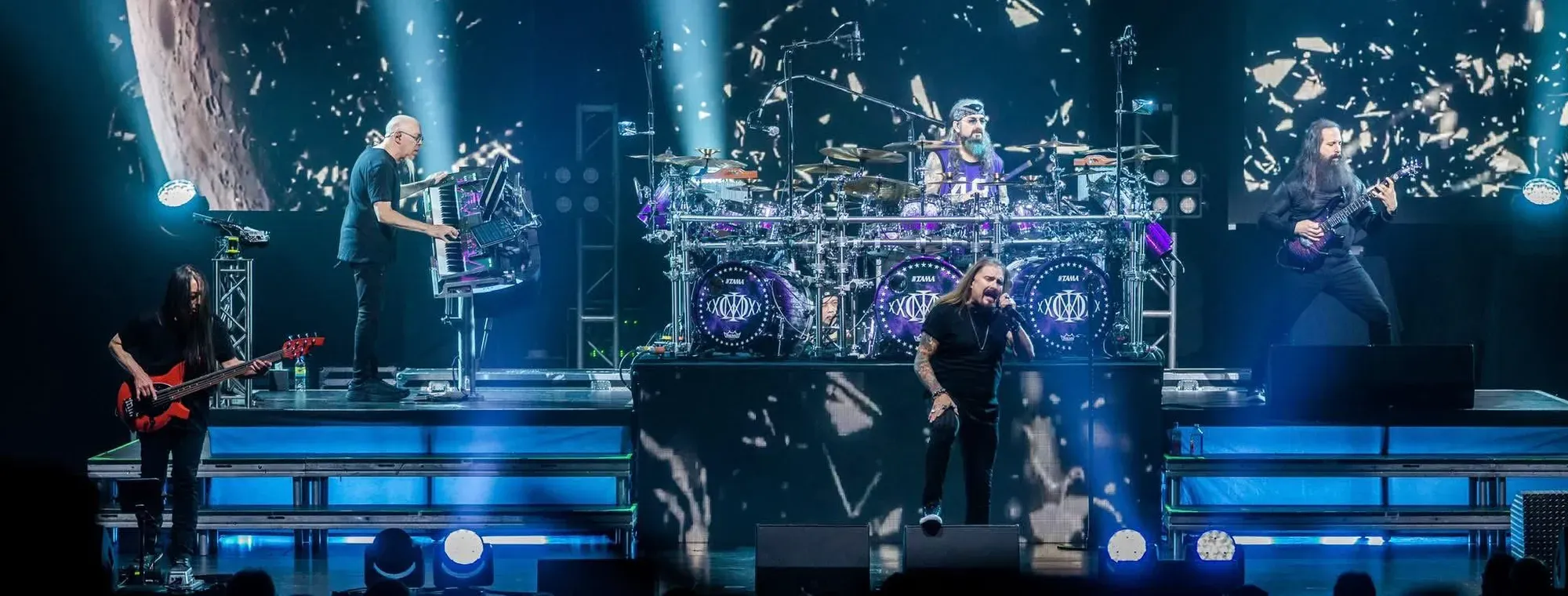
Originally published in Everyman Podcast · March 2019
John Petrucci interview
InterviewJohn Petrucci15 min read
Justin Vigile: Distance Over Time is out February 22nd. Obviously, a new Dream Theater record is always like counting down to Christmas for me, and it’s been a bit since we’ve had some new stuff out. The singles that I’ve heard so far, I love them, and from what I see online, people are pretty happy about it as well. So what are you most excited about, to get the new album out in front of people?
John Petrucci: Well, first of all, we always have so much fun when we make new music. Like you said it’s like Christmas for you; it’s like Christmas for us. Getting together, especially the way that we did this one, we decided to do a guys’ retreat.
JV: Let’s talk about that. So you were up in New York, I saw you were doing some serious grilling up there. What made you feel like that was the right time to go on location?
JP: Well, a couple of things. After we did The Astonishing and the way that we did that, where Jordan and I wrote the record based off of a story that I wrote – it was something that was very different for us because normally, we do things in a very collective way. So it was like, next record, let’s do something where we’re all together, immersed in almost an opposite of that environment, where it’s more of just a live rehearsal kind of thing, which is the way that we wrote Train Of Thought, the way that we wrote Awake and records like that. And I was talking to my wife, Rena, and she’s like, “You guys should go away instead of just going to a studio.” She’s like, “Go to some cool place.” Our wives always have the greatest ideas, so I was like, “That sounds like a great idea.” So we found literally the perfect place to do it in, which was upstate in New York, in this renovated barn that was gorgeous – no distractions...
JV: ...other than the grill...
JP: ...other than the grill. And every time we wanted to eat, we were distracted. But other than the grill and wildlife coming up to the barn, we were good.
JV: Yeah, I heard there was quite a few bear sightings up there.
JP: Well, now it’s turning into a tall tale, because there was like one bear sighting. [laughs]
JV: Right, yeah, next thing you know, John wrestles a 14-foot black bear.
JP: I always thought it was funny that the barn was originally owned by and built by Ryūichi Sakamoto, who scored The Revenant. You got that famous bear scene.
JV: That’s all you’re thinking about.
JP: That’s all I was thinking about. We don’t want to recreate...
JV: Yeah, oh man, certainly wouldn’t want that either. The sound of the new record is much bigger, and the drum sound – as a drummer, I love it. I’d love to know what you guys did differently this time, because there’s definitely something different going on there.
JP: Part of it is where we recorded. The barn that I’m talking about just had this amazing main room that had really, really high ceilings. It was all wood, all the original barnwood was refinished and used to decorate the inside, so the room itself sounded amazing. Originally, we weren’t going to record there; we were just writing the record there. But after being there for about a month, we were like, “Let’s just stay here, bring in some microphones.” Because it was kind of like an emptied-out studio – picture a studio that was built but then the guy sold it and took everything out. So, all right, let’s bring in a desk, bring in speakers, bring in mics and pre’s, and record here. So part of that drum sound is the beautiful room. The other thing is sort of the approach, as far as the way that it was engineered and the way I wanted to produce it, was to make this sort of more organic-sounding record. I’ve said this a couple times, but it’s like: what does Dream Theater sound like when we’re all playing together full tilt? Just put some mics up. What does the band sound like? I wanted this record to sound the most like that. So part of this drum sound is that approach – being conscious of keeping everything really natural and organic. And then the third part is our amazing mixing engineer, Ben Gross, and how he treated the drums to make sure he retained that organic quality but also made the record really powerful and driving. So it’s a combination of all those great professionals that just know what they’re doing. And as a producer, letting people know the type of record I want to do, the type of sound that we’re going for. In other words, if we went for, “Yeah, we want this to sound completely retro 70s,” it would’ve gone into a whole direction. If I said, “We want this to sound super hyped, modern, all samples,” it would’ve went another direction. But the idea of doing this more primal, organic, natural, “capture the sound of the room” sounding record – that got everybody on the same page. So I think that’s what you’re hearing.
JV: Yeah, and I understand you used a room mic too, which is not something you normally do, right?
JP: Well, on the guitar, yes, I’m very anti-room mic. I like a very closed mic. I want it to sound like you stuck your head inside of my guitar cabinet.
JV: One of the things I wanted to touch on is it takes a team and having great engineers, great gear, great equipment, great guitars – all that comes together to put this all into one great package.
JP: You’re 100% right about the team. There’s no way that we could have done this record if not for the hard work of Maddie and Jimmy T and our mix engineer and everybody involved in doing this. It’s an amazing thing to be a part of something where everybody has a real passion for what they do and an invested interest in the band and the music that we all want to create. So it’s great. It really is like nothing else.
JV: Yeah, and I attest to getting to spend some time around your team. You guys have a great crew, and everybody is passionate and believes, so that makes it all – it shows through in the music. Being a student of Dream Theater, [having] a 40,000-foot view of how the band has progressed in the last 10 years or so, I feel like this is the new Dream Theater, in a sense. I feel like it was coming out in some pieces in the last couple albums, but what I’ve heard so far, that’s just my take on that. So I wanted to talk about Scenes From A Memory. Historically, the legend about this record has grown over the years. When you went into the studio to make Scenes From A Memory, you guys were following up an album that, at a time, wasn’t really a fan favorite; you guys were trying some new things. I’m talking about Falling Into Infinity. Looking at the album that came after Scenes From A Memory, it’s clear how much of an impact that process had on the future of the band. When you were doing Scenes From A Memory, did it feel like you were shifting as you were writing the album or were you guys not even thinking about that?
JP: There were definitely some changes that we made that were very purposeful, that were as a reaction to a few different things. Just prior to Scenes, Mike and I had done two records with Jordan with Liquid Tension Experiment and we really had these amazing writing sessions and this great chemistry with him, and we were writing some of the best music that we’ve written, but yet he wasn’t in our band. So the pivot to ask Jordan to join was a big step. We kind of knew that we were completing this sort of circle of what we felt was the ultimate writing collaboration, and so that was one of them. That was a hard thing to do because we had to ask Derek to leave – that’s not easy stuff. It’s not easy for him, it’s not easy for us. It’s a big change to do a band member change like that. That was purposeful and a decision that we made. Another one was that this was the first record we decided to self-produce; up until then, all the records had outside producers. Falling Into Infinity had Kevin Shirley. This idea [that] we just want to do our own thing, close ourselves in a room and not really have anybody else influencing what we do or telling us we can't do this or that was an important step. I remember having conversations with Mike at the time, like “Hey, let’s do this – we can do it. We can handle this. We don’t need somebody telling us this and that, we just need an engineer”. So that was another big step. And then the third part was – and this took the band gaining confidence in ourselves – because we’re all such big fans of music and bands and records like The Wall and Tommy and Operation: Mindcrime. These are iconic in our minds. So to make a decision as a band to create our own concept record was like, can we do this? Can we do it on the level that we really want to? And that was a big undertaking. That’s why we didn’t do it sooner than that, because we wanted to make sure that we did it right, we were able to do it, and the timing was right. So all these things sort of added up, and they were all purposeful decisions. So it wasn’t just like we walked in one day, “Hey, what do you guys want to do?” These were discussions – some of them came out of years of leaning in that direction. So major changes were made for that record.
JV: I kind of see some parallels with that in preparing to put out Distance Over Time. How do you think that your experience with Scenes From A Memory – whether it was truly or not, I mean the fan perspective is that it was a make-or-break moment for you guys in a career sense – do you think that there’s a parallel there? Not that I mean with your career, but as far as musical direction and the similarities between bringing Mike Mangini in, and I noticed he’s got some credits for some lyrics now, so he’s more a part of – I assume – the writing process. I know on some of the other albums, like you said, The Astonishing, it was you and Jordan. And so this seemed like the combination of, like I said, the band getting all the guys together, a new direction. Do you feel like that at all for this?
JP: Yeah, there can be some parallels. I guess the difference is with all the stuff that I just told you about Scenes, the other thing at that time, there was sort-of behind the scenes business stuff that was going on that wasn’t really great. There were some legal things and some weird stuff. We were in a different place, it was about 10 years into our career, and so we had to make some decisions that were sort of make-or-break. The place the band is in now in going into this record, when I look back if I were to compare, it’s a much healthier place. There’s a very established system and we have all the right people in place that are behind the scenes, everything is very stable. I can’t explain it; it’s just a really good place. So going into the record, it was more of a joy, not make-or-break.
JV: I watched all the behind the scenes stuff and you guys really seem to be enjoying it, like truly happy.
JP: It’s more like that. People might make the comparison because The Astonishing wasn’t received by everybody the same way, a lot of people didn’t like it. Some people liked it, some people didn’t, which I knew would happen. I’m that way too with my favorite bands. You like certain things, you don’t like other things, but as an artist, you have to follow your creative path, wherever that leads you. You can say the idea of rebonding as guys and doing this retreat thing is a reaction to that. I mean, yes and no, but if you want to be real, probably you can say that. But it’s almost like the Scenes sort of reaction is almost like a damage control type of thing, like, “Oh, we got to get this together, there’s too many weird things going on.” But with Distance Over Time is like, “I miss you guys, let’s hang out.” It’s from a healthier, more stable place, if that makes any sense.
JV: No, I’m definitely picking that up. My business, the production company that puts these podcasts and the music we do for the NFL together, we’re also sponsored by Ernie Ball, and we’ve got some custom Petruccis. They’re incredible instruments. So talk to us a little bit about what’s new for the 2019 model that you just put out at NAMM.
JP: For 2019, basically, we took the Majesty to another level as far as just the aesthetics of the guitar. Some of the new colors are just ridiculous, they’re unbelievable. We did two different Basswood versions, four different Mahogany versions, and then for the first time, an Alder version, which we call Tiger Eye, which has, instead of the maple top being only on the shield, it’s a full maple top with the maple strip down the neck, maple in the headstock. Each guitar is a work of art. We also tweaked the DiMarzio pickups a bit just to even bring out more of the amazing tone woods and what they have to offer as far as resonance and sustain and volume and stuff like that. And it really all makes sense and ties into this whole new record because, again, going into that amazing room in that barn... we started this conversation about – the drum sounds and room mics and stuff like that – just trying to capture the living, breathing qualities of wood and how those interact, it goes right along with what we did with the guitars and the pickups. Because they’re just beautiful instruments created out of wood and amplified and magnified with electronics, and that’s exactly what we’re doing with the record, what we’re doing with the guitars.
JV: I really feel like the guitar is really turning into my generation’s Les Paul, in a way, where it’s become iconic and, like I said, universal, and it’s become a shape and a silhouette that everybody recognizes. I just find that really interesting.
JP: That’s really cool. You know, it’s something that Sterling Ball has said about these guitars. There’s an interesting article in Forbes not too long ago that said that my signature guitar is the second top-selling signature model, only behind the Les Paul. So there’s something there where there’s a universal appeal, and again, you talking about a team – if it weren’t for Sterling and if it weren’t for Drew Montel, who designed that guitar, it wouldn’t exist. So working together and giving people their credit, their due, I think is really important.
JV: There’s something for everyone too. If you want a Floyd Rose, you can get one of those. If you want a floating bridge, you can. There’s something for everybody, for the discerning fan. Speaking of the fans, I’ve got a few questions here that are from the fans directly. I went out to the Dream Theater Reddit in incognito and I said, “What do you guys want to know?” First off, Samantha wanted to know: being on the road can be lonely at times, as I can imagine. How much of an impact has technology had on making tour life happier, more fulfilling, and staying in the loop with your family at home – not feeling like you’re just off in the wilderness?
JP: Huge impact. To give you an idea, when we first started touring and stuff, I’d go to Europe and there’d be no way to contact me unless I called home on the phone in the production office. And I remember you had to rent a cell phone in Europe and have this prepaid card, and it cost like a million dollars. It was so, so difficult. And now, yeah, I mean, technology between Skype and texting and international phone service, data plans, all being so cheap – yeah, it’s completely changed everything. It’s very, very helpful. Samantha.
JV: That's great. Life’s On Rule 65 wants to know when will we get another John Petrucci solo album?
JP: It’s something that I’m just almost embarrassed about. My first one was released in 2005, and I do, as people may know from watching the G3 tours, I do have plenty of material for that. So the next time I can sit down and get into a studio, when I’m not making a Dream Theater record or touring with Dream Theater, I will record music for I guess a follow-up if you want to call it, solo album.
JV: Pork Thruster wants to know what do you think about doing a Liquid Tension Experiment reunion with the original members?
JP: That’s something that people are curious about and would definitely enjoy. I’m definitely open to it. It’s not something that we really have been talking about too much only because we’re so busy and we have a tour coming up. But we’re all friends, we’re all in touch and open for that, so I’m sure that’s something that everybody would love to do at some point. Those records were a lot of fun to do.
JV: You guys did two shows at BB King’s up in New York. I was at both of those. It was crazy.
JP: The funny thing about both those records is that they were done really quickly – just like, get in there, write it, record, okay, bye.
JV: That’s great. Huhu wants to know, and this is actually something I was curious about too, so deep into the John Petrucci lore regarding the music you wrote for Digital Pinball: Necronomicon for Sega Saturn – how did you get that opportunity? Do you have the game, and did you ever play it?
JP: I have a copy of the game somewhere. I never played it. I forget how it came to me – somehow through management or the opportunity came in. And yeah, I remember doing it. It was very specific writing. They wanted a one-minute-and-30-second song for an intro and a two-and-a-half-minute song for this, and it was a lot of fun to do.
JV: The tracks, they’re really good. I was just listening to them. I really enjoy them. I’d love to hear you redo those with real drums. That’d be great.
JP: Oh, that’d be fun, yeah.
JV: The other most popular question: when are we getting an 8-string Petrucci?
JP: I have been talking to Ernie Ball about that and we actually started to design one together – it was a Majesty version. We talked about doing it for the new record, having one for me to play on the new record; it’s not something that we ended up doing. So hopefully, it’s something that we’ll do. Ernie Ball Music Man doesn’t make an 8-string, they don’t have an 8-string in their lineup at all, so I think it would be great. So we’re continuing to talk about it. I don’t have a definite answer for that.