

Originally published in Livewire · June 1993
Progressive Mosh Power
By Jennifer Rose
InterviewMike Portnoy4 min read
The name Dream Theater was brought to my attention at a Pantera party last year, when I was handed an advance cassette of the band. I first met drummer Mike Portnoy that same night. Not only are Pantera and Dream Theater labelmates, but Phil Anseimo and Mike Portnoy share an affinity for boxing. Both are diehard boxing fans. I’ll admit, I wasn’t instantly swept off my feet by DT’s music, but their “Pull Me Under” video on MTV grabbed my attention. I heard the infamous music biz buzz on the band, but that’s typical, it goes along with the territory. I’m not one to jump on a band wagon, just ‘cause everyone else is. I’m my own judge and jury- but to each his own. Music is a personal interpretation.
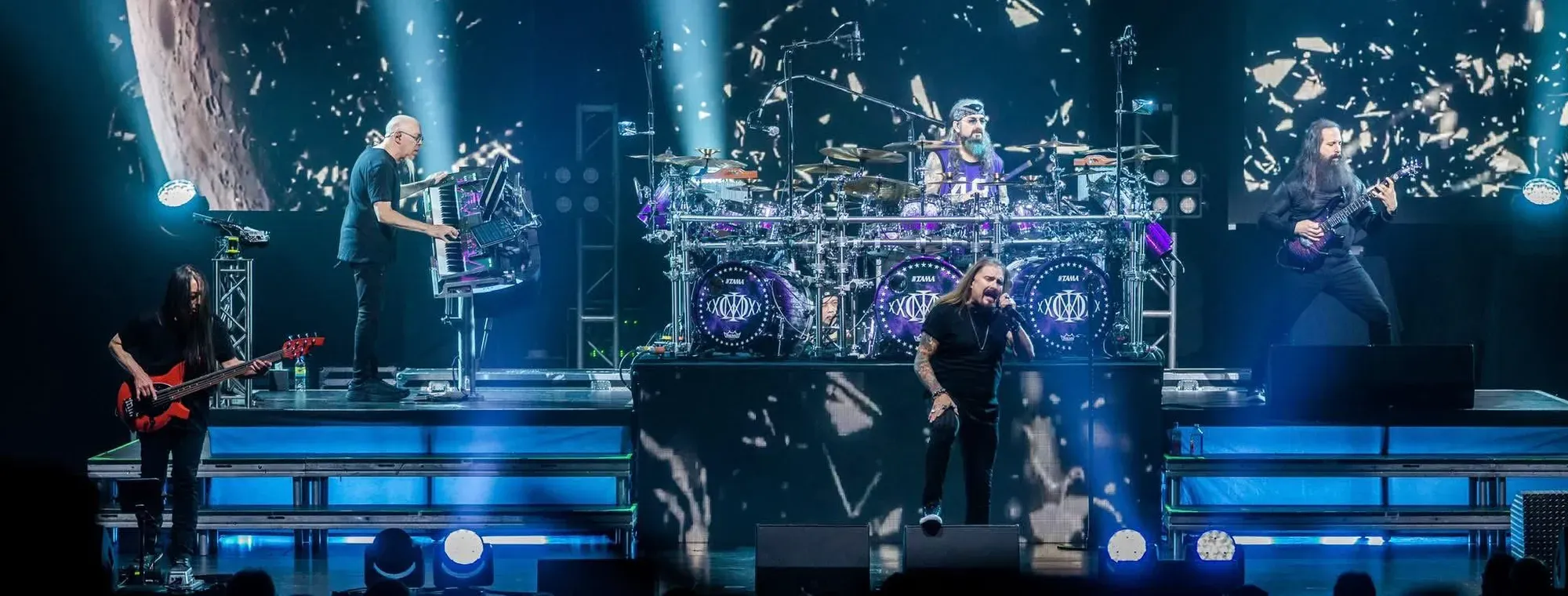
But like I said, the video lured me in, and then I found myself bodies deep in a crowd at NYC’s Limelight, dodging the occasional Doc Marten flying overhead. My initial reaction upon hearing the music was, I wondered if The Doc had knocked me out, or what. I was some what stunned, because this band sounded different than their tape. This is one of those moments where the live show outweighs the studio product. The reactions from the crowd ranged from “The sound like Rush,” to “They sound like Queensryche!” The outlying similarities are palpable, but only to a certain degree.
Formed in 1985, drummer Mike Portnoy, guitarist John Petrucci and bassist John Myung crossed paths at Berkelee College of Music in Boston. That fateful meeting of the minds turned out to be a match made in heaven for the threesome, who, on top of that were all from Long Island. Mike recalls, “It was kind of a strange coincidence because there’s people from all around the world up a Berkelee. And to find two people that love the same music that I did, and they were musically on the same level when it came to their playing, and what they were into, and what kind of music they wanted to write, it was incredible.”
Returning home after two semesters, they recruited another school buddy, keyboardist Kevin Moore, along with a singer, and recorded a demo under the name Majesty. More changes followed with another singer, a record deal and the release of their first album. Having reached a stalemate, the band re-evaluated their situation, “cleaned house,” and rebuilt the unit. That included replacing their singer with Canadian born James LaBrie, which took a year and a half, and 200 tapes. “He got along with us great,” Mike says of James. “We went out drinking to see if he was cool. We hung out and saw how he reacted to other people, which was important. Actually, he was quite silly the first night we took him out drinking. We’re like, ‘Oh my God, this guy is a Canadian lush.’ He was strolling around all drunk and everything but he was fun and we had a great time, and it just worded out.” Within two days, James was recruited and the ball started rolling again and another deal was inked, resulting in their second record, Images and Words.
The common bond that drew them together in the beginning was Rush. “That was the band that we all totally loved,” says Mike. I grew up in high school learning all of Neil Peart’s drum parts, and the same with the other guys. Back then, the common interest was Rush, and Iron Maiden, and Black Sabbath, and Yes. It was a combination of old progressive bands and the pioneers of heavy metal at that point.” All of those combinations are elements within their music, but not entirely. Mike attributes part of this as “being the basis of our music. Throughout the years it’s developed into different areas.”
Comparatively linked to the aforementioned bands, Dream Theater have been dubbed a progressive rock band. Aware of the band’s labeling, Mike negated, “People say that because we have long instrumental sections, and there’s a lot of time changes. I think the focus for us is on the musicianship. We’re not living in the past. We have a lot of sounds or elements like Yes or Rush but I don’t think any of those bands were really as heavy as what we’re doing. We’re coming from the ‘90s point of view, they were coming from the ‘70s point of view.”
It was Mike’s father who coined the name Dream Theater, after the band learned that their previous name Majesty was already trademarked. “We couldn’t come up with a name,” explained Mike. “but my dad happens to love the band. He’s a huge fan of the music. He suggested Dream Theater from a movie theater out in California, where he lives. I’ve been to this theater many times, and it’s artsy, and an old fashioned theater, but they play cult movies like Rocky Horror and (Pink Floyd’s) The Wall. He suggested it, and it perfectly fit the music. Dream Theater was wide open to a lot of different styles, and you can sit there and come up with a lot of different images.”
Not only was Mike’s father responsible in naming the band, but he was also influential to his son in another aspect. “My father, he’s the reason I love music,” Mike says proudly. “The minute I came flying out of my mom’s womb, he snapped a set of headphones on me and put Sgt. Pepper on. So I grew up listening to The Who, The Beatles, Led Zeppelin, literally from when I was one or two years old, He used to be a DJ on the radio, and I used to work with him when I was four or five, actually taking the mike and spinning records. He introduced me to music.”