

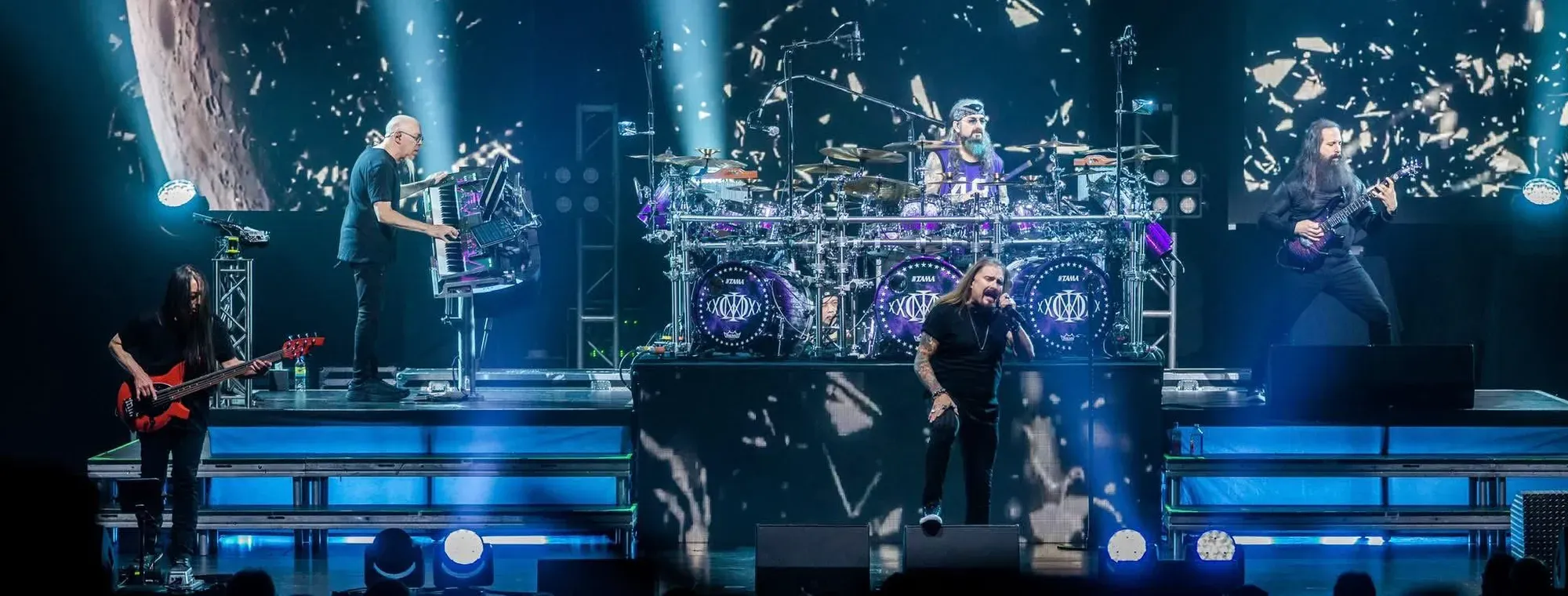
Originally published in Ghostland · March 1999
The Newest Member of Dream Theater Chats About the ELP Tribute album, Dream Theater, Liquid Tension 2 and the Rudess Morgenstein Project
Thursday, March 25, 1999 - 5:00 p.m.
InterviewJordan Rudess15 min read
Chad Hutchinson: How did you become involved with Encores, Legends & Paradox?
Jordan Rudess: I got a phone call from Pete Morticelli. I’ve been doing a lot of projects over the years with Pete and Magna Carta and with our relationship he was fairly aware with what I do and asked me if I would do it. He asked me if I would play those particular pieces as well. At first, it was just going to be “Karn Evil” and then expanded to “Hoedown.” I was interested, especially in doing something with Jerry [Goodman] because of course Jerry and I played together in the Dregs and Mark Wood and I are friends, actually very old friends from high school days. I met him when I was 17.
CH: It’s amazing how small these circles are.
JR: Yeah, it is amazing.
CH: You were also on the Steinway to Heaven CD. Did you get to meet Keith Emerson during that?
JR: I did not meet him during that process. As a matter of fact, I tried to meet Keith Emerson for years. It was the funniest thing. I was turning into a joke actually because I would be invited to come backstage to meet Keith and I’d come back and say, “Where is he?” “Oh, he’s already gone.” I got to know Will Alexander, his tech, very well over the years. “Oh, yeah of course Keith is already gone and back to the hotel.” So finally, about a year ago I met Keith and now when we see each other we’re actually, “Hey, how ya doin’?!” It’s kinda funny.
CH: What does his work over the years mean to you as a keyboard player?
JR: A lot, actually. I remember sitting in my room when I was living with my parents many years ago and listening to Tarkus and having it totally cranked up and having it really change my whole life. It was such a powerful piece of music. It really solidified my desire and interest to get totally involved in being a rock keyboardist. What Tarkus really did for me was that it let me know that it is possible to make really powerful music in the rock vein using complex harmonies and rhythms. It’s not that I was just either going to be a classical pianist or that I was just going to play trashy rock. I could take my classical background and really give it some rock energy.
CH: I read in the bio on your web site that Tarkus was your first exposure to them and it was a very eye-opening experience.
JR: Yeah, it was totally.
CH: Who else did you look up to growing up? You mention Jan Hammer on your site as well.
JR: Well, as far as rock goes, I would say that my biggest influences were the progressive bands. I would say Gentle Giant, probably one of the biggest, and Yes, definitely...very strong and older Genesis stuff...ELP, no doubt. Perhaps the keyboardist that had the biggest effect on me, at least as far as playing leads, was Patrick Moraz. He played this particular solo on the Refugee album, in the song called “Someday,” and it was soaring. It was absolutely amazing and I would listen to it over and over and over again. I started to post pictures of up on my wall, this was before I had a Mini-Moog, and I’d say “What is that instrument?” And then someone told me, “That’s a Mini-Moog.” So I would cut pictures out of magazines and post them up all over my bedroom wall and say to myself, “I’m gonna get one of those. I gotta have one of those!” Now, I know Patrick very well and we laugh about all these things, but that solo really did it for me.
CH: How about Larry Fast?
JR: I know Larry. I just did a concert with him a couple of years ago. We did Wendy Carlos’ “Switched on Bach.” It was the first live performance of it ever and Larry Fast was one of the keyboardists with me. I thought the Synergy albums were great. I really enjoyed them when they came out. The timing of that was great. He knew the technology, he was involved with the right thing and had the interest to make it happen. It was really interesting to listen to Larry and Wendy Carlos about the old days.
CH: You work with Robert Berry on Encores, Legends & Paradox. Since he worked with Emerson and Palmer in 3, did he bring a different perspective to the project?
JR: Basically what happened with the project was that Robert laid out a chart which Simon Phillips was then able to play to; he laid out all of the meters. In ELP’s music, in a lot of the progressive stuff, sometimes it’s a little bit difficult to discern the exact meter. I think it was done somewhat on feel and so Robert had to go in there with respect and also with knowledge of their music and decide “Okay, this is going to be in 7/8 because that’s what it’s the closest to.” He made the decisions about the cuts and the tempo changes and basically sent me a track of his bass and the drums done and a scratch piano track with just some of the chords. I then took it and did whatever I wanted to with it. So after Robert gave me this kind of structure, I took it and then added, from the harmonic point of view I added a lot of different kinds of chords and bridges. You can hear that some of the things are just not at all in the original piece. I tried to bring a little bit of originality to that aspect of it. I also worked very hard on the timbres. I figured if I’m going to do this ELP thing, it’s got to have a top-of-the-hat to Keith because the music is so great and had such a big influence on me and it’s important music if you look at the whole time line of rock and progressive rock. I wanted it to have a lot of respect towards the original, but also wanted to add my own flavor and I wanted to take the piece a little bit more into the current technology. I did a lot of programming and thought I came up with some interesting timbres and tried a little bit to stay away from the organ vibe. I’m not so much of an organist, I’m more of a synthesist, so I wanted to bring it into that realm. It actually took a few days just really thinking and making sounds and putting that whole thing together.
CH: You really did, in the true sense of the word, a tribute to what Emerson played in the original, but added your own flare.
JR: For one thing, Keith hardly ever bends any notes as far as a lead thing goes and I do, so I put in some of that.
CH: So this whole thing was done by mail?
JR: Yeah, it is. I’ve met Simon Phillips, but it was a few prior to this tape and we never even discussed it. It’s funny the way things are done nowadays. “Hey Simon, great jamming on ‘Karn Evil.’“ I don’t think I’ve ever met Robert Berry, but I’ve spoken to him on the phone and I like him. He’s a very nice guy.
CH: What are some of your favorite ELP tracks? Any other ones that you would have liked to have covered?
JR: Well, it’s funny. I did the whole other section to “Karn Evil,” the one that starts with the piano [“Second Impression”]. I did an arrangement of that which I played with the Rudess Morgenstein Project here and there. So, I had just finished that, which is such a cool piece, and then I got this call to do this other one. I thought, “So how about I do this one too! I just did an arrangement.” And that was a live arrangement where I can play the whole thing in real time which is a lot of programming. I changed that up a bit. Instead of piano, I went with more of a synthesized approach. So, I love that piece. A lot of the ELP stuff is just really wonderful. Other ones? Let me think...I would have done “Tarkus.” That’s certainly one that I would have been interested to do. Then probably “Karn Evil, Second Impression” and then the one I did.
CH: Any other tributes in which you would be interested in being involved?
JR: Well, if they ever did Gentle Giant that would probably be fun to do. King Crimson would be cool. It’s amazing to me that they’ve made a whole thing out of doing these progressive bands considering the fact that progressive bands were never that popular in the first place. Of course they are in certain circles. Now we have these tribute albums and I wonder how they compare to the original sales.
CH: What are the main pieces to your keyboard arsenal?
JR: Well, these days I use all Kurzweil equipment. I use particularly the 2500 keyboard and in my studio I have a bunch of them. I have a 2500 rack and a keyboard and a K2VX keyboard. I’ve also got some other stuff from other companies, but I don’t use it because I’m very involved with Kurzweil. I do a lot of programming for the company and I’m so deeply into the technology. It’s an amazing instrument. What they do is they’ve found a way to combine this whole sampling world and synthesis into one instrument putting the two concepts together to create this powerful synthesizer. So I end up doing all my work on those and I’ve got a tremendous CD-ROM collection of their synthesizers and all kinds of samples of orchestras and amazing sound effects. Whatever I need that’s not within the Kurzweil instrument I just load up the CD and can have access to the whole world. It’s amazing.
CH: So what’s it like being the newest member of Dream Theater? I know you played with them a couple of years ago.
JR: It was about four years ago that I auditioned for them. I had a decision to make between the Dregs and Dream Theater. Of course, I decided with the Dregs. At that point, it just was not good timing for me to join Dream Theater. They were planning a year-long tour, I’d just started working with Kurzweil and my wife and I just had a baby. I was not ready to completely uproot my life, especially when the Dregs were knocking at my door going, “Hey, you wanna play?” I was like, “Wow, that’s a cool gig.” They were only going out for three weeks at a time and I thought I could do that. But now, since that time, I maintained my relationship with the Dream Theater guys because we definitely got along personally and totally got along musically as well. There was always a little bit of a feeling like it would have been cool if I had joined that group. It’s funny how my connection just maintained, it had such strength with them. And of course the Liquid Tension project with John Petrucci and Mike Portnoy, we now have two albums. The second one is coming out in May. That was just a great way to make music with Dream Theater, but not necessarily be in Dream Theater. It was sort of a logical progression in a sense that by the second album, we were so in tune just as far as just working together. I mean the riffs between John Petrucci and I just fly back and forth very fast. I trigger his ideas, he triggers mine and Mike is there with just such a strong conceptual mind putting pieces together and shaping things. We all enjoy working together so much. So one day, it was almost obvious that it was a change that was going to come up.
CH: What drew you to those guys in the first place?
JR: Well, actually they found me. I got a call four years ago and I think it was Kevin Moore, the original keyboard player, knew of me and he told them about during the course of their relationship. They remembered that Kevin had mentioned this other keyboard player. They also looked in Keyboard magazine. They figured since they all won the best in their category in all the guitar magazines and bass magazines, they’d open up Keyboard magazine and see who was happening in that area. That year I had won “Best New Talent” in Keyboard magazine and they said, “Oh, well, Kevin mentioned him. He’s the ‘best new talent.’ Let’s give him a call.” So they called me up and we did it. I went down for an audition. I think Jens Johansson was there that day as well. We played, jammed and I played some of my stuff for them. Then I agreed to play a concert with them and then in talking with them, we decided not to do the whole thing at that point [join the band]. When they asked me this time, I said, “You know what, guys? I want to do it. I want to do it this time.”
CH: How is the new Dream Theater album coming along?
JR: It’s coming along great. It’s really fun. I’m actually doing some of my keyboard tracks at home and I was just working on them before I called you. I’m just having a really good time. Great stuff. It’s happening quickly.
CH: Have you guys done any rewriting of “Metropolis II”? Is that going to make the album?
JR: We’re in a code of silence about this record as far as the details go. We want what’s happening to be a total surprise. I will say that the chemistry between us is amazing and we’re all really excited about it. We just feel this is going to be fun for everybody, for us for the fans. We’re going back into the studio in a few days actually to have all of April in the studio and some of May and then probably finish up sometime at the end of May.
CH: I was pleasantly surprised to hear how well you guys played off each other on the first Liquid Tension album. It was almost like you had known each other for 20 years.
JR: We have very similar musical minds. John is very much into the idea of having his technique developed so much that he play what comes into his head. He doesn’t want to be limited by his fingers. Some musician play very well, but certain things they just can’t pull off and John can pretty much play whatever he wants. The whole idea of being a musician to me is: “I hear something in my head. How am I going to actually make this happen on a keyboard?” There’s got to be a certain level of technical skill to make that happen. Both of us think along those lines. That’s part of what makes it fun.
CH: Is John Myung going to break out the Stick again for this one?
JR: That’s a good question. I’m wondering if he is as well. I’ll let you know. He hasn’t used it yet, but I’m sure he’ll break it out. That’s a new thing for me, working with John Myung. I know James, but we haven’t been in the studio together working on the vocals. But working with John Myung is a pleasure. He’s a great guy. He’s very focused, very into his instrument and is ready for anything.
CH: How does the new Liquid Tension compare to the first one?
JR: I’m so excited about this Liquid Tension album. I think it turned out great. It’s different from the first one in the sense that there are a lot of different stylistic things we through in there that are new for us. You’ll hear some Latin progressive-type sections. There are some interesting sound effects things that happen. One example is attributed to the fact that John Petrucci’s baby came right in the middle of our sessions. All of a sudden John got a phone call: “Hey, come home. We’re having a baby.” He went home, the sessions stopped and we had to resume sometime later, about a month later. There’s a song on the record called “When the Water Breaks” and that song starts with the sound of the baby being born and goes into a musical box sound and then turns into this whole long progressive rock thing, a 20-minute long piece or something. It’s about the same balance as far as jamming and also composed material. The people that liked the last album as far as hearing some jams, will get some jams on this one and the people who liked the song element, the composed progressive stuff, will get some of that as well. I think it’s the next level of Liquid Tension. There’s a lot of piano on this one.
CH: Is this going to be a continuing thing? Will there be an “LTE3”?
JR: It’s really unknown. It’s really hard to say. Now it’s so similar to Dream Theater, three out of four of the members. So does it make sense to really do another Liquid Tension album? I’m not sure.
CH: You might not be able to with Tony Levin going on the road with Peter Gabriel.
JR: Yeah, I think Tony was going with Seal for a while. I don’t know what’s happening with that, but he was going off forever with Seal on the road. We’ll see.
CH: Is there going to be another Rudess Morgenstein Project disc?
JR: We would both like there to be. Rod and I would love there to be another Rudess Morgenstein Project. It’s been a little bit hard for us to determine exactly when we could do that. If difficult for me to think about scheduling a lot of other stuff right now on anything else because it’s a big deal for me to join this group. It’s a large change in my life and it takes a lot of work. I’m going to have to learn a lot of the repertoire to go out and play. Not only that, but I’m busy composing music for this record. I definitely know that I want to record with Rod again, but I can’t say when it’s going to happen.
CH: I heard something about a Dregs reunion. Would he be doing that?
JR: I heard something about that, too, that the idea was floating about. He would definitely do that. Actually, Rod is doing “Jazz is Dead” right now and actually T. Lavitz is the keyboard player. It’s a jazz group that plays Grateful Dead tunes and they get a cool audience, so Rod is doing a bunch of gigs with them.
CH: When do you think DT will hit the road for the first time with you?
JR: We have a gig in Korea in June, so that will be the first time. I’m sure that after the record comes out we’ll do the U.S.
CH: Definitely looking forward to that. Is the direction of this new Dream Theater about going to go back to being real heavy like Awake? I know that some of the criticism of Falling Into Infinity was that parts of it were a bit on the poppy side.
JR: Well, with Falling Into Infinity, the band definitely had a slant towards making it a little more commercial. With this album, the slant is trying to make it as musical and cool as possible. And by “cool” I don’t mean heavy necessarily or anything other than we just want to give the fans and ourselves the most musical, cool experience we can think of. There’s going to be some mellow things, some really gentle things and there’s going to be some amazingly heavy and progressive things. We’re not limited by thinking that we have to produce this particular kind of commercialism for the record company. I think the record company realizes there are a lot of Dream Theater fans out there who want to hear Dream Theater.
CH: I would like to congratulate you on being the newest member of Dream Theater and on the new LTE album.
JR: Thanks, man. I appreciate your time today as well.