

Originally published in Hard Force magazine · January 2000
John Petrucci interview
InterviewTranslatedJohn Petrucci13 min read
Translated from the original language with DeepL, so the wording may differ from what was actually said.
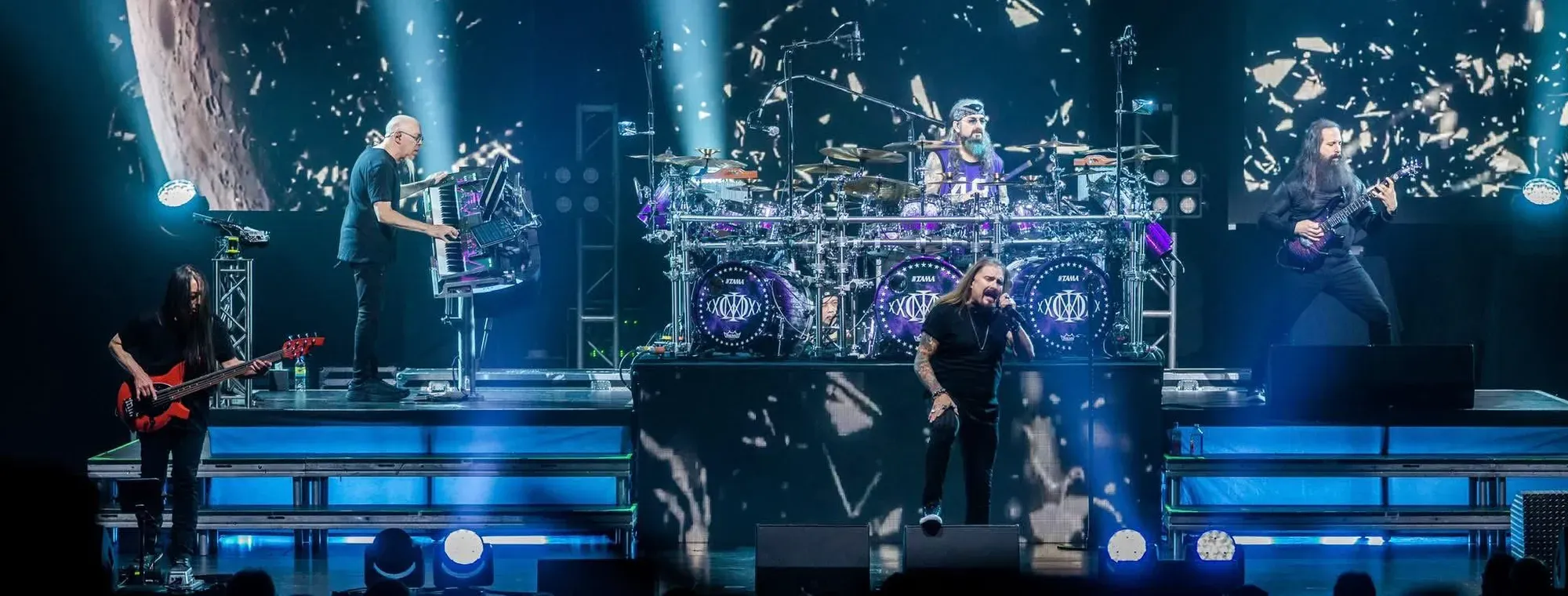
A critically acclaimed latest album, a live show we’ve never heard of before, the arrival of Jordan Rudess, a new sold-out tour... There’s no shortage of things to talk about with Dream Theater. These musicians, long recognized as luminaries, prove that they haven’t let fame put them to sleep.
One might have thought you’d reached your peak, and you’ve managed to outdo yourselves on Metropolis Part II: Scenes From A Memory.
Music is strange; you can’t plan it. We’d just decided to make a concept album and give it our all. After that, it’s a kind of magic that makes or breaks a good album, but fortunately, you can’t predict anything.
When you say “concept album,” you say... concept. How did it come about, and how would you sum it up?
I had the basic idea, but developed it with Mike and James. It’s a story of pure fiction. The general theme is reincarnation, past life. Specifically, it’s about a man who realizes that he was a woman in a previous life. He wishes to learn more about this woman in order to better understand himself. He discovers that she has been murdered, and that the crime has never been solved. So this is the strange story of someone who wants to find out who murdered him... in a previous life.
Each of you wrote part of the lyrics. How did you organize yourselves?
First we wrote the twelve pieces, then we looked at which part would best fit the story in question. Then we each chose what we wanted to describe and tell. Finally, we got together to compare and contrast what we had, so that the whole would be coherent.
Do you believe in reincarnation?
No. I was brought up in a Catholic family, and you can imagine that this kind of belief is not an accepted notion... That said, life after death is a theme that runs through many religions. I think the idea of reincarnation in Buddhism is really interesting and intriguing.
Do you think you’ve ever had a past life?
No, it’s a subject that really interests me, but I don’t feel the way that some people do. Take, for example, the guy who feels uncomfortable in a car because he thinks he died in an accident in a previous life. It’s certainly a strange and powerful feeling.
The album’s concept is an undeniable plus. Do you feel you’ve reached a higher level from a purely musical point of view?
Yes, having Jordan [Rudess] in the band has helped improve the musical value. Everyone wants to prove something to themselves, to propel the whole thing forward. For example, sometimes I want to play a particularly difficult passage, and everyone will try to follow me. But sometimes it’s Jordan who comes up with a crazy idea, and I have a hard time catching up with him! It’s all this emulation that advances our progress. For a musician, the feeling of learning and surpassing oneself is essential.
It seems to me that very little time elapsed between the announcement of Jordan’s arrival and the release of the album.
It’s true, Jordan joined us at the beginning of January, and by February we were already in the studio. That said, it wasn’t the first time we’d written together. We’d been through two albums with him [with Liquid Tension Experiment] and we’d already established ourselves.
The question is how and on what terms Derek [Sherinian, former keyboard player] left. We’re used to saying “on good terms.” Is this the case?
In any case, we’re trying. In concrete terms, we simply asked him to leave so that we could bring Jordan into the group, and we were sorry about that. I don’t know how he feels now, but at the time he didn’t really understand; he was shocked because nothing was really wrong with the band. It’s just that we wanted to play with Jordan, who is an outstanding musician with whom we had an excellent feeling, which wasn’t the case with Derek. I see it as a bit of a business decision, but it’s not an easy one. Derek must have been hurt. In fact, I’ve had no contact with him since that day.
Is this a situation that everyone is happy with, or is every member now afraid of being replaced by a better musician?
No, the keyboard was a special case.
The idea of bringing Jordan into the band was up in the air. Did the general pressure, especially from the years, convince you to ask him to play with you?
No, not at all. It’s the kind of thing that happens without you really knowing why. When there’s such a rapport between musicians, whether on a musical or intellectual level, and if, on top of that, you respect them a lot, you have to do everything you can to play with them.
Changing the subject, once again, Dream Theater didn’t go for simplicity. Was the recording a headache?
Yes, all the more so as we did everything simultaneously, from composing to recording. We hadn’t really “broken in” the tracks. We recorded the tracks as usual, breaking them down into blocks. We kept the drum tracks and then everyone added on to them, in turn.
Synchronizing the keyboard and guitar tracks must be no mean feat.
No, but I like it. It fits in with an aspect of my playing and Jordan’s; we try to be very “sharp” and precise.
Going back, why did you choose France, and Paris in particular, for this extraordinary concert? Dream Theater had recorded Once In A LIVEtime at Le Bataclan during a concert lasting over three hours.
First, we knew there would be a fantastic audience... Second, we weren’t doing a big tour, but mainly festivals, and there weren’t many headline gigs. We had also played in Hungary, for example, but that was the first time and we weren’t going to record there without knowing what it would be like.
How is Dream Theater’s career going in the United States?
We haven’t played there for a long time. We’re going to check it out at the end of January, as we have a tour planned. In some states, it’s going well. For example, in the New York area, New Jersey, our whole home region, but also Chicago, parts of the Midwest, Los Angeles, Texas... In others, we play in much smaller clubs.
How do you perceive the nu-metal wave that’s so popular at the moment, like Korn or Limp Bizkit for example?
What’s popular right now is the opposite of us. We’re not fashionable, we don’t get radio airplay and we don’t sell millions of albums, but our fans are the kind who love to see us play. That’s an essential point. As a result, they show up and our concerts are successful, which is good enough.
You’ve been compared a lot to Queensrÿche in your early days. What do you think of their evolution over the last decade?
We’re a long way from that now. They’ve changed a lot. Even though our albums are different from each other, our philosophy is pretty much the same. We’re a progressive rock band mixed with heavy metal. We’ve always had that sound. As for Queensrÿche, I prefer the Operation: Mindcrime period; now I don’t like what they’re doing at all.
Which brings us back to Metropolis Part II, and the concept album!
Yes, I actually listened to Operation: Mindcrime several times while we were making the album. I was thinking about how the songs related to each other, that sort of thing... The main difference is that Queensrÿche songs are more commercial than what we do.
Do you think your emergence on the progressive scene since the early ‘90s may have had an influence on Queensrÿche’s evolution?
Did we influence it? I don’t think so. To be honest with you, I never thought of them as a progressive band. If you listen carefully, I’d say they’re more of a heavy metal band in the vein of Judas Priest, with a darker side like Pink Floyd. They’ve never really been progressive.
I seem to have caught a glimpse of, among other things, a female orgasm on ‘Home’... How are you going to reproduce all this on stage?
Our next record won’t be a concept album, but with Jordan in the band, the writing will certainly evolve. We’ll continue to play something technically challenging and difficult, and simply good songs, with emotion. To achieve this, having experience is essential.
Finally, can you give me some news about two bands, Nightmare Cinema [Dream Theater’s “encore” line-up with band members changing instruments] and Meanstreak [his wife’s band, who plays guitar]?
Nightmare Cinema split up... and Meanstreak split up two years ago. It’s a shame, because it gave me a chance to see my wife play, and I love it!
Henry Dumatray
Original text
Un dernier album encensé à juste titre par la critique, un live dont ils ne nous avaient pas encore parlé, l'arrivée de Jordan Rudess, une nouvelle tournée qui fait salle comble... Les sujets de conversation avec DREAM THEATER ne manquent pas. Ces musiciens, depuis longtemps reconnus comme des sommités, prouvent qu'ils ne se sont pas laissés endormir par la renommée.
On aurait pu penser que vous aviez atteint votre plus haut niveau, et vous avez réussi à vous surpasser sur "Metropolis Part II: Scenes From A Memory".
La musique est étrange : on ne peut pas la planifier. Nous avions juste décidé de réaliser un album conceptuel et de nous investir à fond. Ensuite, c'est une sorte de magie qui fait ou non un bon album, mais heureusement, on ne peut rien prédire.
Qui dit "album concept" dit... concept. Comment est-il né et comment le résumerais-tu ?
J'avais l'idée de base, mais nous l'avons développée avec Mike et James. C'est une histoire de pure fiction. Le thème général, c'est la réincarnation, la vie antérieure. Concrètement, c'est l'histoire d'un homme qui réalise qu'il était une femme dans une vie précédente. Il souhaite en apprendre plus sur cette femme afin de mieux se connaître lui-même. Il découvre qu'elle a été assassinée et que le meurtre n'a jamais été élucidé. C'est donc l'histoire, un peu étrange, de quelqu'un qui cherche à savoir qui l'a assassiné... dans une vie antérieure.
Chacun d'entre vous a signé une partie des paroles. Comment vous êtes-vous organisés ?
Nous avons d'abord écrit les douze morceaux, puis nous avons cherché quelle partie collerait le mieux avec l'histoire en question. Chacun a ensuite choisi ce qu'il souhaitait décrire et raconter. Pour finir, nous nous sommes réunis pour confronter ce que nous avions, afin que l'ensemble soit cohérent.
Tu crois en la réincarnation ?
Non. J'ai été élevé dans une famille catholique, et tu te doutes bien que ce genre de croyance n'est pas une notion acceptée ... Cela dit, la vie après la mort est un thème qui se retrouve dans beaucoup de religions. Je pense que l'idée de la réincarnation dans le bouddhisme est quelque chose de réellement intéressant et intrigant.
Penses-tu avoir déjà eu une vie antérieure ?
Non, c'est un sujet qui m'intéresse vraiment, mais je ne ressens pas cette impression que certaines personnes peuvent avoir. L'exemple du type qui es mal à l'aise dans une voiture car il lui semble qu'il est mort dans un accident, dans une vie antérieure. C'est un sentiment certainement étrange et fort.
Le concept de l'album est un plus un indéniable. Avezvous le sentiment d'être parvenus à un niveau supérieur d'un point de vue purement musical ?
Oui, le fait d'avoir Jordan [Rudess] dans le groupe a contribué à améliorer la valeur musicale. Tout le monde veut se prouver quelque chose, propulser l'ensemble. Il m'arrive, par exemple, d'avoir envie de jouer un passage particulièrement difficile et chacun essaiera de me suivre. Mais parfois aussi, c'est Jordan qui lance une idée un peu folle et j'ai du mal à le rattraper ! C'est toute cette émulation qui fait progresser notre niveau. Pour un musicien, la sensation d'apprendre et de se surpasser est primordiale.
Il me semble que très peu de temps s'est écoulé entre l'annonce de l'arrivée de Jordan et la sortie de l'album.
C'est vrai, Jordan nous a rejoints début janvier, et en février nous étions déjà en studio. Cela dit, ce n'était pas la première fois que nous écrivions ensemble. Nous en étions à deux albums avec lui [avec Liquid Tension Experiment] et nous avions nos marques.
La question est de savoir comment et en quels termes Derek [Sherinian, ancien clavier] est parti. On a coutume de dire "en bons termes". Est-ce le cas ?
En tout cas, on essaie. Concrètement, nous lui avons simplement demandé de partir pour pouvoir faire entrer Jordan dans le groupe et nous en étions désolés. Je ne sais pas comment il se sent maintenant, mais sur le moment, il ne comprenait pas trop: il était choqué parce, que rien n'allait vraiment mal au sein du groupe. C'est juste que nous souhaitions jouer avec Jordan qui est un musicien hors pair, avec lequel nous avions un excellent feeling, ce qui n'était pas le cas avec Derek. Je considère un peu cela comme une décision professionnelle mais ce n'est pas facile pour autant. Derek a dû être blessé. Je n'ai d'ailleurs plus de contact avec lui depuis ce jour.
C'est une situation qui satisfait tout le monde ou, à présent, chaque membre a-t-il peur d'être remplace par un meilleur musicien ?
Non, le clavier, c'était à part.
L'idée de faire entrer Jordan dans le groupe était dans l'air. La pression générale, des lans notamment, vous a-t-elle confortés dans l'idée de lui demander de joue avec vous ?
Non, pas du tout. C'est le genre de choses qui doit arriver sans que tu saches vraiment pourquoi. Guand il existe une telle connivence entre des musiciens, que ce soit au niveau musical ou intellectuel, et si, en plus, tu les respectes beaucoup, il faut tout faire pour jouer avec eux.
Changement de sujet : encore une fois, Dream Theater n'a pas fait dans la simplicité. L'enregistrement a-t-il été un casse-tête ?
Oui, d'autant plus que nous avons tout accompli dans la foulée, la composition puis l'enregistrement. Nous n'avions pas vraiment "rodé" les titres. Nous avons enregistré les morceaux, comme d'habitude, en les décomposant par blocs Nous avons conservé les pistes de batterie et chacun s'est ensuite greffé dessus, tour à tour.
Synchroniser les pistes de clavier, et de guitare ne doit pas être une mince affaire.
Non, mais j'aime ça. Cela correspond à un aspect de mon jeu et de celui de Jordan : nous essayons d'être très "pointus" et précis.
Retour en arrière: pourquoi avoir choisi la France et plus particulièrement Paris pour faire ce concert hors normes ? Dream Theater avait enregistré Once In A Livetime au Bataclan pendant un concert de plus de trois heures.
Tout d'abord, nous savions qu'il y aurait un public fantastique ... Ensuite, nous ne faisions pas une grande tournée, mais essentiellement des festivals, et il n'y avait pas beaucoup de concerts en tête d'affiche. Nous avions aussi joué en Hongrie par exemple, mais c'était la première fois et nous n'allions pas enregistrer là-bas sans savoir à quoi ça ressemblerait.
Comment se porte la carrière de Dream Theater aux États-Unis ?
Ça fait longtemps que nous n'y avons pas joué. Nous allons voir à la fin du mois de janvier, car nous avons une tournée prévue. Dans certains Etats, ça se passe bien. Par exemple dans la région de New York, le New Jersey, toute notre région d'origine, mais aussi Chicago, le Mid-West en partie, Los Angeles, le Texas... Dans d'autres, nous nous produisons dans des clubs beaucoup plus petits.
Comment perçoit-tu alors la vague metal qui cartonne en ce moment, version Korn ou Limp Bizkit par exemple ?
Ce qui est populaire actuellement est à notre opposé. Nous ne sommes pas à la mode, pas diffusés à la radio et nous ne vendons pas des millions d'albums, mais nos fans sont du style à aimer avent tout nous voir jouer. C'est un point essentiel. Résultat, ils sont présents et nos concerts ont du succès, ce qui est déjà bien.
On vous a beaucoup comparé à Queensryche à vos débuts. Que penses-tu de son évolution durant cette décennie ?
Nous en sommes loin à présent. Ils ont beaucoup changé. Même si nos albums sont différents les uns des autres, notre philosophie est à peu près la même. Nous sommes un groupe de rock porgressif mélangé à du heavy metal. Nous avons toujours eu ce son. Pour Queensryche, je préfère la période Operation Mindcrime; à présent, je n'aime plus du tout ce qu'ls font.
Ce qui nous ramène à Metropolis Part II, et au concept album !
Oui, j'ai d'ailleurs écouté plusieurs fois Operation Mindcrime pendant qe nous faisions cet album. Je me suis penché sur la façon dont les chansons étaient reliées entre elles, ce genre de choses... La différence essentielle, c'est que les titres de Queensryche sont plus commerciaux que ce que nous faisons.
Penses-tu que votre émergence sur la scène progressive depuis le début des années 90 a pu avoir une influence sur l'évolution de Queensryche ?
Nous, l'avoir influencé ? Je ne crois pas. Pour être honnête avec toi, je n'ai jamais pensé qu'il était un groupe progressif. Si tu écoutes attentivement, je le place davantage dans un style heavy metal dans la lignée de Judas Priest, avec un coté sombre comme Pink Floyd. Il n'a jamais vraiment été dans le progressif.
Il me semble avoir aperçu, entre autres, un orgasme féminin sur "Home"... Comment allez-vous reproduire tout cela sur scène ?
Notre prochain disque ne sera pas un concpept album, mais avec Jordan dans le groupe, l'écriture va certainement évoluer. Nous continuerons à jouer quelque chose de techniquement motivant et difficile, et tout simplement de bonnes chansons, avec de l'émotion. Pour y parvenir, avoir de l'expérience est essentiel.
Pour finir, peux-tu me donner des nouvelles de deux groupes, Nightmare Cinema (la formation "bis" de Dream Theater avec les instruments changeant de main) et Ministream (le groupe de sa femme, qui joue de la guitare) ?
Nightmare Cinema a splitté... et Ministream s'est séparé il y a deux ans. C'est dommage, ça me donnait l'occasion de voir ma femme jouer et j'adore ça !
Henry Dumatray