

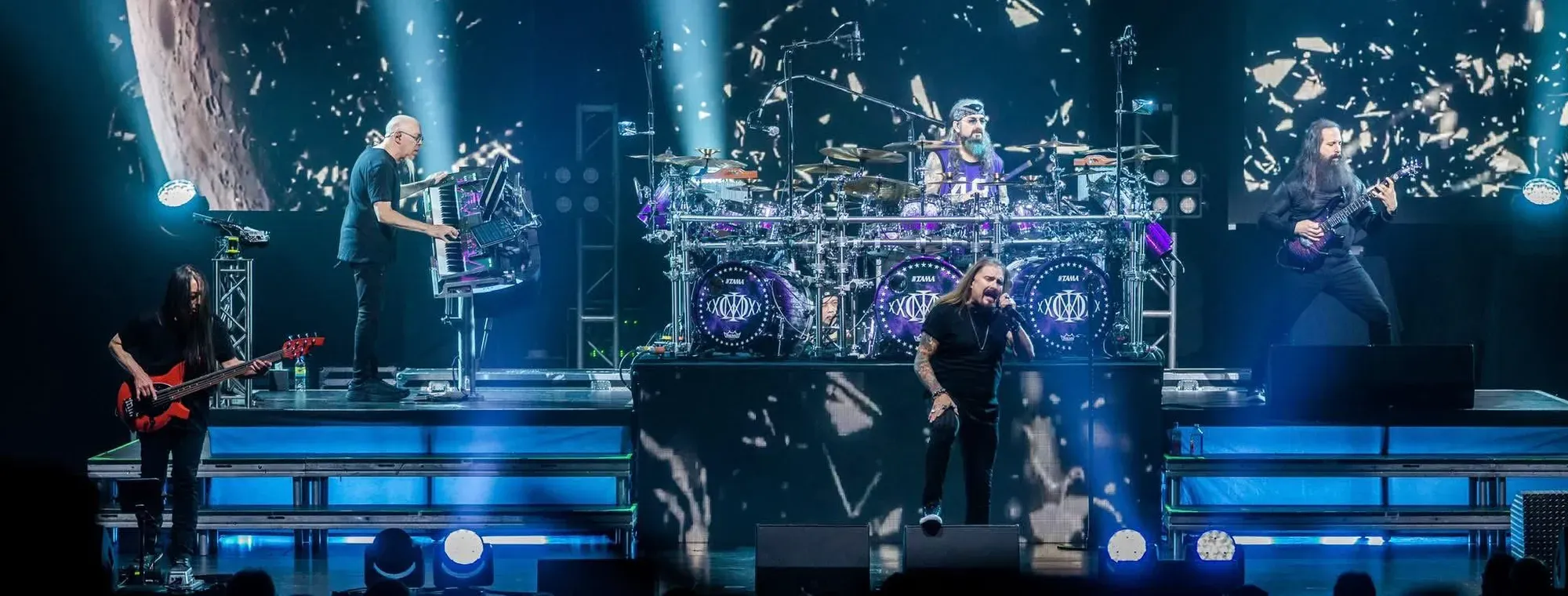
Originally published in Amarok Mag.com · December 2018
Interview – Dream Theater
InterviewJames LaBrie24 min read
Stephane Mayere
April 29, 2019
Friday December 7, a large hotel near the Champs-Elysées. It is in a strange atmosphere of barricades that we have an appointment with James LaBrie, lead vocalist of Dream Theater, who has come to defend their first opus at Inside Out.
Hello James, welcome to Paris, despite this strange atmosphere...
JAMES LABRIE: Thank you, we’ve just arrived from Berlin, we’re just here for the afternoon (editor’s note with John Petrucci who is doing other interviews at the same time in another hotel lounge), we didn’t have time to realize a lot to tell the truth, and we start to be very burnt by the promotional days.
How do you feel ?
JL: Great otherwise, we’re all excited about the release of this new album.
Congratulations by the way, it’s a good vintage from Dream Theater to my taste!
JL: It’s nice, thank you!
The album is very different from the previous one, how did you work for this record?
JL: In a way, it’s a natural progression from the previous one. The Astonishing was an oversized business next door. 3 years of work, 2 hours of music… In comparison, Distance Over Time goes back to the fundamentals of what a rock band is (note: funny, the same speech as Mike Portnoy about Sons of Apollo). When you start a band, the first thing you feel is the energy when everyone is in the same room and starts playing… and the songs start to take shape. That’s what happened for us here, we got together, in a place far from our home, and we kind of went back to our roots, to our roots.heavy. And we tried to feel the vibrations, to let the pieces breathe take shape on their own, in a rather simple and natural way. This is also probably why there is no long epic on this record. This is what we focused on this time, and I find the result both very powerful and very melodic: 9 songs, rather collected, but powerful and melodic. Not too many very technical and very progressive flights this time, which is more our nature and ultimately quite easy for Dream Theater. There were times when some would try to go into complex developments and eventually the rest of the band pulled back in a simpler direction, focused on the song.
Did you jammed a lot to get the ideas?
JL: Not really, actually there are some themes that we just found during soundchecks. The theme of “ Viper King ” comes from a soundcheck like that of “ Pale Blue Dot ”. Each time, these are simple ideas that we developed into a song. John ( Petrucci ) came up one day with a single riff that became “ Fall Into The Light ”, something he found backstage on a G3 tour.
It’s my favorite track.
JL: Cool, and so a lot of the album was written like that, mixing little ideas from each other, Mike ( Mangini ) was very involved in the creative process. It’s the first album where he’s so involved from start to finish… and it’s great because it brought a new side, almost refreshing compared to what we usually did, it was really a collaborative effort.
I found that with this record, the band sounded like Dream Theater sounded in the 90s...
JL: Really? It’s cool, I like the sound we had in the 90s. The record has a very natural sound ( note: it says ‘organic’ ). Maybe it’s from where we wrote, a refurbished barn, the Yonderbarn next to New York… it was like a summer camp. Usually, we are in the studio during the day, we sleep at the hotel… completely different this time. A very vintage atmosphere and the sound of this studio was very natural, like what you can find live during a concert. It gave us an energy and vibes that we wouldn’t have found in a more classic studio. Obviously there was an impact on the way the album developed and the way it sounds. In addition, we left a lot of freedom to our sound engineer on the mix of instruments. As he put the tracks together, it felt like watching or listening to each other play, rather than directing the outcome. We let him build the songs according to his ideas. He has been doing this for over 30 years and he has a lot of experience to give a natural side to the songs.
What is your personal contribution to the album?
JL: On the music I rather brought ideas, suggestions or, on the contrary, said when I didn’t like something while the guys were playing. Otherwise, I contributed on the vocals, the vocal melodies, which we wrote with John. Then Jordan added ideas and I finished writing the texts.
About the tracks now, The Astonishing was very conceptual, with a real story. Is there a hidden concept here as well or is it more of a record in opposition to the previous one?
JL: (chuckles) No no no, no concept here. We pushed the concept to its maximum with the previous album. There it’s just a rock band having a good time. A fucking heavy metal progressive rock band! No concept, each title is independent and is sufficient on its own. Of course you will be able to find some identical themes in the lyrics from one song to another, but it’s just because we are influenced by what is happening around us in today’s society. There is no will to tie the pieces together here.
You said you were co-responsible for the voice lines.
JL: With John and Jordan, yes.
How do you manage to keep a song with the same power for so many years. You’ve been the singer of Dream Theater for 27 years, how do you preserve your voice? Including for the live, do you have any particular techniques?
JL: I already don’t smoke, then when we’re on tour, I don’t drink either. Not very rock’n’roll way of life, eh (he laughs) … And it’s not easy, because I like good wine, I like Bourbon, Scotch, beer… but I try to have a healthy lifestyle and to consume in moderation… and nothing on tour. On tour, I drink a lot, but rather tea or coffee with honey, fruit juices, vitamin stuff. I try to run 5 km a day… I try to eat a healthy diet, vegetables, fruit… not too much junk food or shady stuff… and it keeps me healthy.
I’m not saying it’s not difficult on tour. You know I sing 3 hours per show, 5 to 6 concerts per week… I’m not 20 anymore either. It’s very demanding as a rhythm of life. Sometimes I could also be criticized when my voice got weak during the tour, but you know what? (he mimics a middle finger) “ Let them fuck themselves ” if I can put it that way… Because those who criticize are not in my place and probably could not endure this rhythm.
There was no criticism hidden in my question...
JL: No, no, but what I’m saying is I’m OK with this situation. The voice is a biological instrument, human, therefore fallible... sometimes... But to answer your question, because my voice is still there and powerful in most cases, and I am able to sing as the group asks, I take care of it and I am also very disciplined. Everyone will tell you in the group, I take my voice very, very seriously. You know I’ve been singing since I was 5 years old, my father also had a great voice… he introduced me to jazzmen, great singers… I have a deep affinity with melodic music. Ever since I was a kid I knew I wanted to be a singer, to do this job.
The band has been in the business for many years now, you said you’ve been in it for 27 years.
JL: And I’ve been in other bands before (laughs).
What is the longevity of Dream Theater?
JL: I think we just love what we do, at least I do. We never took anything for granted, and we question ourselves. We always put our work in perspective, we are normal, simple people, we do not have a big head thinking that we have already given everything. The point is that we do what we dream of doing, but above all, we are not jaded. We felt it again during the recording of Distance Over Time, it was like a bunch of friends having a good time together, while keeping the quality in mind, and being responsible for our work. We could be around the BBQ having a drink, we stayed focused on the music and in the end it all came back to the album.
Let’s talk about the tour, on the previous tour you celebrated 25 years of Images And Words, I heard rumors about another anniversary in 2019, that of Metropolis Part 2.
JL: Absolutely! The tour will be in the form of ‘ An Evening With ’… no first part and three hours of show, the second set will be the whole of Metropolis Part 2. (he laughs: ‘here we go again!’), the first set will consist of songs from Distance Over Time and other titles from our back-catalog, some of which we haven’t played for a very long time and the second set will be Scenes From a Memory from start to finish… and usually a reminder. We don’t know exactly what we’re going to put in the setlist yet, but that’s the idea. We will probably do a variable setlist on the first part but Scenes will be played every night.
So do you plan to do several evenings per city, because part of the audience will want to attend all the concerts if the setlist changes?
JL: That’s another story. Our agents are starting to book the tour, the venues, so at the moment we don’t know. It is possible that we will come back to the same place after several months… In France, for example, there are plenty of places where we would like to play, we have a lot of fans all over France. For example I love Lyon, Bordeaux, Marseille, Paris of course, I hope we can do several dates. We’re going to try two evenings in Paris.
By having 14 albums on the clock and deciding to play an entire one, in addition to the album to promote, is it hard to build a setlist?
JL: You know, our fans are hoping to hear songs that we haven’t played for a long time. There are plenty of criteria to consider. In fact we have an excel sheet with the titles of the songs, then everyone chooses their favorites, and we do a first sorting like that. Then we vote, we seek a consensus around a common list. And we come back to the option I gave you earlier: a first set with a setlist that varies every night, apart from the titles of Distance Over Time. It makes it more… interesting. We haven’t ruled 100% yet, but we are in the process of arriving at set-lists that we hope will be cool for the public.
And do you already have an idea of the tour agenda?
JL: Well this time we start in March in the US in San Diego, then we will scour the USA, Canada and Mexico for 3 months. From June we will be doing a festival-oriented tour in Europe, moreover we will be at Hellfest this year. Then we go home at the end of the summer to rest, and we come back to Europe in the fall with the same show as in the US. And we will also play in South America, in the Pacific... in March (he is laughing)
What does it change for you to play in the US, Asia, Europe…
JL: In Asia, the public is more… reserved, conservative… they are quite wise. In Europe, everyone sings, there is a lot of energy, communication with the public, in the US it’s a mix of the two attitudes, and in South America, they are literally crazy. In India, too, the audience is incredible. In Dubai also surprisingly, the public is insane, a lot of energy of passion… In fact, whether we play, we realize that we are all connected by music, and we talked about it in the group, we we all agree and share the same opinion on this. We are individuals, humans, and music is certainly one of the most powerful forces on this planet to bring people together...
Distance Over Time is your first record on Inside Out.
JL: Inside Out and Sony, yes.
Why Inside Out and what do they bring to you compared to other labels?
JL: There is nothing wrong with the previous labels, we had been with Warner for years, it was just that Inside Out had become inevitable. It had to happen, sooner or later. It wasn’t ‘did this have to happen?’ But when it did. InsideOut boss Thomas Waber has been a fan of Dream Theater for a very long time. I remember him in the audience during the Images and Words tour in 1992… and he’s been following us ever since, and Thomas is a very straightforward guy, very honest, if he doesn’t like an album or a band, he doesn’t hesitate to say it, and if he loves a band or a record it’s the same thing. We had several labels that wanted to sign us, but we knew that with Thomas, we had a fan in addition to a label owner. Someone who knows the band, who understands them. We knew he would be behind us, 100%. He left us complete freedom, even if he has periods of the group that he prefers more than others, he did not try to guide us while we were writing. When we were doing Falling Into Infinity for example, we had a lot of outside pressure to push us in a direction that we might not have followed… and Scenes From a Memory was also a reaction to that pressure, we had put everything we wanted without worrying about external pressures, and it was a new chapter for Dream Theater. Thomas has always been very respectful of artists, I knew him from before since my solo albums were released on InsideOut. And when he approached us to sign us, I knew, we knew he was the right one, the right boss and the right label.
About your solo albums, plans for a new record?
JL: Difficult, Matt Guillory, who writes with me about his near life and little time. He works full time at Apple, so music is not his job. It is difficult for him to invest in a project. We are always in touch, and if you have an opportunity to booker time together we will release something. There will definitely be an album, but we just don’t know when.
To conclude, what would you like to tell your French fans about this record?
JL: First, we’re going to come to Hellfest, we’re super excited to play at this festival.
You know the festival is sold out, everything was sold in two hours!
JL: (dismayed expression) Unbelievable, how much are we talking about? 50,000 people or so, right? that’s crazy ! In any case, we really want to thank the French public for all these years of support for the group. I still remember our first show at the Loco, and our meeting with the fan club at 2 am when we left the room… In addition to Hellfest, we are preparing a great show for you for the fall, with Metropolis and Distance Over Time, it’s going to be awesome!
Do you realize that you are teasing us months in advance?
JL: Oh my god, that’s right! It’s crazy when you present him like that.
Thank you very much for your time, and see you on stage in a few months!
JL: It was a pleasure, thank you!
An interview conducted in December 2018 by Stéphane Mayère for KOID9
Interview – Dream Theater
Stephane Mayere
29 avril 2019
Vendredi 7 décembre, un grand hôtel proche des Champs-Elysées. C’est dans une ambiance étrange de barricades que nous avons rendez-vous avec James LaBrie, vocaliste en chef de Dream Theater, venu défendre leur premier opus chez Inside Out.
Bonjour James, bienvenue à Paris, malgré cette ambiance étrange…
JAMES LABRIE : Merci, on arrive juste de Berlin, on est juste ici pour l’après-midi (ndlr avec John Petrucci qui assure d’autres interviews en parallèle dans un autre salon de l’hotel), on n’a pas eu le temps de se rendre compte de grand-chose à vrai dire, et on commence à être bien cramés par les journées promos.
Comment vous sentez-vous ?
JL : Super sinon, on est tous excités par la sortie de ce nouvel album.
Félicitations à propos, c’est à mon gout un bon cru de Dream Theater !
JL : C’est sympa, merci !
L’album est très différent du précédent, comment avez-vous travaillé pour ce disque là ?
JL : D’un certain coté, c’est une progression naturelle par rapport au précédent. The Astonishing était une entreprise démesurée à côté. 3 ans de boulot, 2 heures de musique… En comparaison, Distance Over Time revient aux fondamentaux de ce qu’est un groupe de rock (ndlr: marrant, le même discours que Mike Portnoy à propos de Sons of Apollo). Quand tu montes un groupe, le premier truc que tu ressens, c’est l’énergie quand tout le monde se retrouve dans la même pièce et commence à jouer… et que les chansons commencent à prendre forme. C’est ce qui s’est passé pour nous ici, on s’est réunis, dans un endroit éloigné de chez nous, et on a en quelque sorte effectué un retour aux sources, à nos racines heavy. Et on a taché de ressentir les vibrations, de laisser les morceaux respirer prendre forme d’eux-mêmes, d’une manière plutôt simple et naturelle. C’est aussi probablement pour cela qu’il n’y a pas de long epic sur ce disque. C’est là-dessus qu’on s’est concentrés cette fois, et je trouve le résultat à la fois très puissant et très mélodique : 9 morceaux, plutôt ramassés, mais puissants et mélodiques. Pas trop de grandes envolées très techniques et très progressives cette fois, ce qui est plutôt notre nature et finalement assez facile pour Dream Theater. Il y a eu des moments où certains tentaient de partir dans des développements complexes et finalement le reste du groupe ramenait dans une direction plus simple, concentré sur la chanson.
Vous avez beaucoup jammé pour trouver les idées ?
JL : Pas vraiment, en fait il y a certains thèmes qu’on a trouvé simplement pendant des soundchecks. Le thème de “Viper King” vient d’un soundcheck comme celui de “Pale Blue Dot“. A chaque fois, ce sont des idées simples, qu’on a développé pour en faire une chanson. John (Petrucci) est arrivé un jour avec un simple riff qui est devenu “Fall Into The Light“, c’est un truc qu’il avait trouvé backstage pendant une tournée du G3.
C’est mon titre préféré.
JL : Cool, et donc une grande partie de l’album a été écrite comme ça, en mixant de petites idées des uns et des autres, Mike (Mangini) s’est beaucoup impliqué dans le processus créatif. C’est le premier album où il est autant impliqué du début à la fin… et c’est super car ça a apporté un côté nouveau, presque rafraîchissant par rapport à ce qu’on faisait habituellement, ça a vraiment été un effort collaboratif.
J’ai trouvé qu’avec ce disque, le groupe sonnait comme Dream Theater sonnait dans les années 90…
JL : Vraiment ? C’est cool, j’aime le son qu’on avait dans les années 90. Le disque à un son très naturel (ndlr : il dit ‘organic’). Ça vient peut-être de l’endroit où on a écrit, une grange retapée, le Yonderbarn a côté de New-York… c’était une ambiance de camp de vacances. D’habitude, on est en studio la journée, on dort à l’hôtel… complètement différent cette fois. Une ambiance très vintage et le son de ce studio était très naturel, comme ce que tu peux retrouver en live pendant un concert. Ça nous a apporté une énergie et des vibrations qu’on n’aurait pas trouvé dans un studio plus classique. Forcément il y a eu un impact sur la manière dont l’album s’est développé et la façon dont il sonne. De plus on a laissé beaucoup de liberté à notre ingénieur du son sur le mix des instruments. Pendant qu’il assemblait les pistes, on avait l’impression de se regarder ou de s’écouter jouer, plutôt que de diriger le résultat. On l’a laisser construire les morceaux selon ses idées. Il fait ça depuis plus de 30 ans et il a une grosse expérience pour donner un côté naturel aux morceaux.
Quelle est ta contribution personnelle à l’album ?
JL : Sur la musique j’ai plutôt apporté des idées, des suggestions ou, au contraire, dit quand je n’aimais pas quelque chose pendant que les gars jouaient. Sinon, j’ai contribué sur les lignes de chant, les mélodies vocales, qu’on a écrit avec John. Ensuite Jordan a rajouté des idées et j’ai fini en écrivant les textes.
A propos des morceaux maintenant, The Astonishing était très conceptuel, avec une vraie histoire. Est-ce qu’il y a un concept caché également ici ou c’est plus un disque en opposition au précédent ?
JL : (il se marre) Non non non, pas de concept ici. On a poussé le concept à son maximum avec l’album précédent. Là c’est juste un groupe de rock qui prend du bon temps. Un putain de heavy métal progressive rock band ! Aucun concept, chaque titre est indépendant et se suffit à lui-même. Bien sûr tu vas pouvoir retrouver quelques thèmes identiques dans les paroles d’un morceau à l’autre, mais c’est juste parce qu’on est influencé par ce qui se passe autour de nous dans la société d’aujourd’hui. Il n’y a pas de volonté de lier les morceaux entre eux ici.
Tu as dit que tu étais co-responsable des lignes vocales.
JL : Avec John et Jordan, oui.
Comment arrives-tu à garder un chant avec la même puissance depuis autant d’années. Ça fait 27 ans que tu es le chanteur de Dream Theater, comment préserves-tu ta voix ? Y compris pour le live, as-tu des techniques particulières ?
JL : Déjà je ne fume pas, ensuite quand on est en tournée, je ne bois pas non plus. Pas très rock’n’roll way of life, hein (il se marre) … Et ce n’est pas évident, car j’aime le bon vin, j’aime le Bourbon, le Scotch, la bière… mais j’essaye d’avoir une bonne hygiène de vie et de consommer avec modération… et rien en tournée. En tournée, je bois beaucoup, mais plutôt du thé ou du café au miel, des jus de fruits, des trucs vitaminés. J’essaie de courir 5 km par jour… J’essaie d’avoir une alimentation saine, légumes, fruits… pas trop de junk-food ou de trucs louches… et ça me maintient en bonne santé.
Je ne dis pas que ce n’est pas difficile en tournée. Tu sais je chante 3h par show, 5 à 6 concerts par semaines… je n’ai plus 20 ans non plus. C’est très exigeant comme rythme de vie. Parfois, j’ai pu aussi être critiqué quand ma voix avait des faiblesses au cours de la tournée, mais tu sais quoi ? (il mime un doigt d’honneur) “Qu’ils aillent se faire foutre” si je peux m’exprimer ainsi… Car ceux qui critiquent ne sont pas à ma place et ne sauraient probablement pas endurer ce rythme.
Il n’y avait pas de critique cachée dans ma question…
JL : Non, non, mais ce que je veux dire, c’est que je suis OK avec cette situation. La voix est un instrument biologique, humain, donc faillible… parfois… Mais pour répondre à ta question, car ma voix est quand même là et puissante dans la plupart des cas, et je suis capable de chanter comme le groupe le demande, j’en prends soin et je suis aussi très discipliné. Tout le monde te le dira dans le groupe, je traite très très sérieusement ma voix. Tu sais je chante depuis que j’ai 5 ans, mon père aussi avait une super voix… il m’a fait découvrir des jazzmen, de grands chanteurs… j’ai une profonde affinité avec la musique mélodique. Depuis que je suis gamin, je savais que je voulais être chanteur, faire ce job.
Le groupe est dans le business depuis de nombreuses années maintenant, tu disais que tu en faisais partie depuis 27 ans.
JL : Et j’ai sévi dans d’autres groupes avant (rires).
Qu’est-ce qui fait la longévité de Dream Theater ?
JL : Je pense que simplement on adore ce qu’on fait, en tout cas c’est mon cas. On n’a jamais rien pris comme acquis, et on se remet en question. On remet toujours notre travail en perspective, nous sommes des gens normaux, simples, on n’a pas la grosse tête en pensant avoir déjà tout donné. Le fait est qu’on fait ce qu’on rêvait de faire, mais avant toute chose, nous ne sommes pas blasés. On l’a encore ressenti pendant l’enregistrement de Distance Over Time, c’était comme une bande de potes qui prenait du bon temps ensemble, tout en gardant à l’esprit la qualité, et en étant responsables par rapport à notre travail. On pouvait être autour du BBQ en buvant un verre, on restait concentré sur la musique et au final tout revenait à l’album.
Parlons de la tournée, sur la tournée précédente, vous avez célébré les 25 ans de Images And Words, j’ai entendu des rumeurs à propos d’un autre anniversaire en 2019, celui de Metropolis Part 2.
JL : Tout a fait ! La tournée sera sous la forme ‘An Evening With‘… pas de première partie et trois heures de show, le deuxième set sera l’intégralité de Metropolis Part 2. (il se marre : ‘here we go again !’), le premier set sera constitué de morceaux de Distance Over Time et d’autres titres de notre back-catalogue, dont certains qu’on pas joué depuis très longtemps et le deuxième set sera Scenes From a Memory du début à la fin… et en principe un rappel. On ne sait pas encore exactement ce qu’on va mettre dans la setlist, mais c’est l’idée. On va probablement faire une setlist variable sur la première partie mais Scenes sera joué tous les soirs.
Du coup prévoyez-vous de faire plusieurs soirées par ville, car une partie du public voudra assister à tous les concerts si la setlist change ?
JL : C’est une autre histoire ça. Nos agents sont en train de commencer à booker la tournée, les salles, donc pour le moment on ne sait pas. Il est possible qu’on revienne au même endroit après plusieurs mois… En France par exemple il y a plein d’endroit où on aimerait jouer, on a beaucoup de fans un peu partout en France. Par exemple j’adore Lyon, Bordeaux, Marseille, Paris bien sûr, j’espère qu’on pourra faire plusieurs dates. On va essayer deux soirs à Paris.
En ayant 14 albums au compteur et en décidant d’un jouer un entier, en plus de l’album à promouvoir, est-ce que c’est dur de construire une setlist ?
JL : Tu sais, nos fans espèrent entendre des titres qu’on n’a plus joués depuis longtemps. Il y a plein de critères à considérer. En fait on a une feuille excel avec les titres des morceaux, ensuite chacun choisit ses favoris, et on fait un premier tri comme ça. Ensuite on vote, on cherche un consensus autour d’une liste commune. Et on revient à l’option que je te donnais tout à l’heure : un premier set avec une setlist qui varie tous les soirs, à part les titres de Distance Over Time. Ça rend la chose plus…intéressante. On n’a pas encore statué a 100%, mais on est en train d’arriver à des set-lists qu’on espère sympa pour le public.
Et tu as déjà une idée de l’agenda de la tournée ?
JL : Et bien cette fois-ci on démarre en mars aux US à San Diego, ensuite on va écumer les USA, le Canada et le Mexique pendant 3 mois. A partir de juin on va faire une tournée orientée festivals, en Europe, d’ailleurs on sera au Hellfestcette année. Ensuite on retourne à la maison à la fin de l’été pour se reposer, et on revient en Europe à l’automne avec le même show qu’aux US. Et on jouera aussi en Amérique du Sud, dans le Pacifique … sur mars (il se marre)
Qu’est-ce que ça change pour vous de jouer aux US, en Asie, en Europe…
JL : En Asie, le public est plus… réservé, conservateur… ils sont assez sages. En Europe, tout le monde chante, il y a beaucoup d’énergie, de communication avec le public, aux US c’est un mix des deux attitudes, et en Amérique du Sud, ils sont dingues, littéralement. En Inde aussi le public est incroyable. A Dubaï aussi étonnamment, le public est dément, beaucoup d’énergie de passion… En fait ou que l’on joue, on se rend compte qu’on est tous connectés par la musique, et on en a parlé dans le groupe, nous sommes tous d’accord et du même avis là-dessus. Nous sommes des individus, des humains, et la musique est certainement une des forces les plus puissantes sur cette planète pour réunir les gens…
Distance Over Time est votre premier disque chez Inside Out.
JL : Inside Out et Sony, oui.
Pourquoi Inside Out et que vous apportent-ils par rapport aux autres labels ?
JL : Il n’y a rien à reprocher aux précédents label, on était chez Warner depuis des années, il y a juste qu’Inside Out était devenu inévitable. Ça devait arriver, tôt ou tard. Ce n’était pas ‘est-ce que ça devait arriver ?’, mais quand ça arriverait. Thomas Waber, le patron d’InsideOut, est fan de Dream Theater depuis très longtemps. Je me souviens de lui dans le public pendant la tournée Images and Words en 92… et il nous suit depuis cette période, et Thomas est un type très droit, très honnête, s’il n’aime pas un album ou un groupe, il ne se gêne pas pour le dire, et s’il adore un groupe ou un disque c’est la même chose. On avait plusieurs labels qui voulaient nous signer, mais on savait qu’avec Thomas, on avait un fan en plus d’un patron de label. Quelqu’un qui connait le groupe, qui le comprend. On savait qu’il serait derrière nous, a 100%. Il nous a laissé une totale liberté, même s’il a des périodes du groupe qu’il préfère plus que d’autres, il n’a pas cherché à nous orienter pendant qu’on écrivait. Quand on faisait Falling Into Infinity par exemple, on avait beaucoup de pressions extérieures pour nous pousser dans une direction qu’on n’aurait peut-être pas suivie…et Scenes From a Memory était d’ailleurs une réaction à cette pression, on y avait mis tout ce qu’on voulait sans s’occuper des pressions extérieures, et ça a été un nouveau chapitre pour Dream Theater. Thomas a toujours été très respectueux des artistes, je le connaissais d’avant puisque mes albums solos sont sortis chez InsideOut. Et quand il nous a approchés pour nous signer, je savais, nous savions que c’était le bon, le bon boss et le bon label.
A propos de tes albums solos, des plans pour un nouveau disque ?
JL : Difficile, Matt Gillory, qui écrit avec moi à sa vie à coté et peu de temps. Il bosse à plein temps chez Apple, donc la musique n’est pas son métier. C’est délicat pour lui de s’investir sur un projet. On est toujours en contact, et si on a une opportunité de booker du temps ensemble on sortira quelque chose. Il y aura certainement un album, mais on ne sait juste pas quand.
Pour conclure, que souhaiterais-tu dire à vos fans français à propos de ce disque ?
JL : D’abord qu’on va venir au Hellfest, on est super excités de jouer dans ce festival.
Tu sais que le festival est sold-out , tout a été vendu en deux heures !
JL : (expression effarée) Incroyable, on parle de combien ? 50 000 personnes à peu près non ? c’est dingue ! En tout cas, on veut vraiment remercier le public français de toutes ces années de soutien envers le groupe. Je me rappelle encore de notre premier show à la Loco, et de notre rencontre avec le fan-club à 2 heure du matin en partant de la salle… En plus du Hellfest, on vous prépare un super show pour l’automne, avec Metropolis et Distance Over Time, ça va être génial !
Tu te rends compte que tu nous fais du teasing avec des mois d’avance ?
JL : Oh mon dieu, c’est vrai ! C’est dingue quand tu le présente comme ça.
Merci beaucoup pour ton temps, et à dans quelques mois sur scène !
JL : Ça a été un plaisir, merci à vous !